
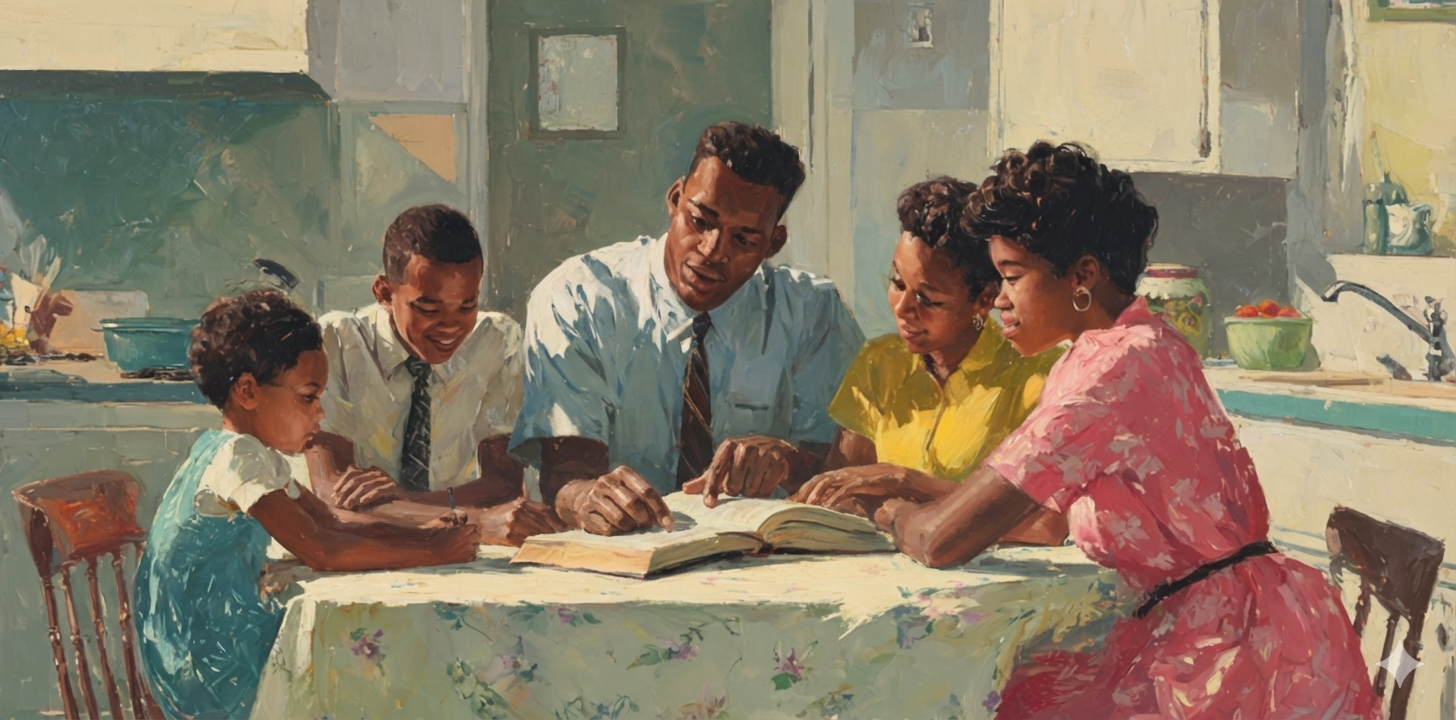
Leaning on the Lord: Lessons from Exemplary Black Families on Faithfully Coping with Racism
This article is part of a four‑part series that draws from insights in our forthcoming book, Exemplary, Strong Black Marriages & Families (Routledge, in press). Research on family stress indicates that many African American families face racism and systemic stressors. These families susceptible to the cumulative burdens of stress spillover—defined as profound stress in one area of life “spilling over” and leading to poor outcomes in other domains. In this article, we take an in-depth look at 46 strong, exemplary religious African American families to determine what actions and attitudes helped these families be optimistic about life and cope with racism and other hardships. These married couples and families were referred by their respective clergy as among the strongest and most faithful families in their congregations. This approach is consistent with “exemplar research,” where researchers study participants who embody the characteristic under study in an exceptional manner. It has taken our American Families of Faith research team more than two decades of dedicated interviewing, transcribing, and coding to gather the strong choir of 97 rich voices behind this study of Black families. Our efforts have taken us to living rooms from Wisconsin to Louisiana, from California to Delaware, and from Oregon to Georgia. We have written elsewhere regarding the exemplary Black families of faith that we have interviewed: For these families, the United States is not a “post-race” nation. Poverty, often deep poverty, as well as unemployment, inadequate educational opportunities, discrimination, incarceration, and many other social ills are far too familiar to them and their loved ones. Further, these marriage-based families are often the first to receive “knocks of need”—requests for money, help, and even temporary housing—from the less fortunate who surround them. Their lived religion is not a sanitized, upper middle-class spirituality, it is a desperate, deep, and pleading faith of survival that—even [in 2026]—still contains echoes of the mournful notes of the shame of American slavery. Theirs is not merely a faith that enriches or adds meaning to life. Their faith is often life itself. While few can claim to envy the plight of one of the most discriminated groups in U.S. history, we do envy the profound depth of their living faith in a God that reportedly hears and sustains them through profound challenges—challenges that … are ever present for most of these families. These exemplary Black families have taught us much. For the balance of this article, we will share their voices and their words regarding their central sources of strength in dealing with life’s challenges, including their experiences with racism and discrimination. Gwen, a Baptist wife, said: [Racism is] just one of those things where, yes, you will encounter it, and I know I will until Jesus comes and gets me out of here. But until then, it’s like, I have to realize that they’re the ones with the problem. I can’t become bitter about it or anything because God is not going to put up with that. … So, I have to just rest in the Lord on that one. … It’s tough, it hurts, but… I know it’s gonna hurt more for them than for me [at judgment day]. Many participants exemplified resilience in their responses to racism. Joelle, a Baptist wife, explained: [I experience racism] every day, pretty much. … I used to be a manager at a [J.C. Penney]. They had a big controversy going, so they called for the manager and [when] I got there the white people were so mad. They didn’t know what to do. ’Cause here was [a] Black woman [who] is going to make a final decision. … To me, it’s not personal, it’s their ignorance. I have never doubted who I am or how important I am and how much I deserve to be on this earth. … So, to me, I’m perfected in Him because [God] thought of my color. … He [chose] it. Orlando, a nondenominational Christian husband, said: Being a Black man, I can always recognize racism in full panoramic view. … If I were to allow the world to tell me how I was supposed to act, then I would have came home [and] I would have kicked the dog, I would have argued with my wife, I would have pulled out my belt, and I would have came home and beat my kids, and I’d have hit holes in the wall—but I wasn’t going to let society dictate how I was going to respond to situations. Because … society tries to write a script … [about what] certain racist behavior is supposed to trigger. And that’s where I hold on to God—because I know God gives me peace. And through God’s peace and through God’s love, I am able to just pray for that person who tries to make me unhappy, because they’re more unhappy than I am … if they feel they need to mistreat me to make themselves feel good. … [I am] trying to tell my children, ‘People are going to put things in your way. It’s not what they do to you, it’s how you respond to it.’ So, I try to set the example—not to respond to it [and not to get] to where I feel like I’m powerless. … No. You can’t go there. I can’t go there. Dean, a Catholic husband, spoke of empowering the next generation. A central part of his message to combat racism was to focus on self-worth. He said: All the kids I come across, I be talking to them: ‘Don’t you ever take no back seat to nobody. God created one yellow flower better than the red one? [No!]. He created them all equal. … Try to have some vision in yourself.’ … I can say that I encounter [racism] daily in some form or some fashion. [It] has to do with arrogance: somebody thinks they are one up on somebody, [but] they really aren’t up on nobody. … It doesn’t affect us negatively ’cause … when you understand who you are inside spiritually, then no