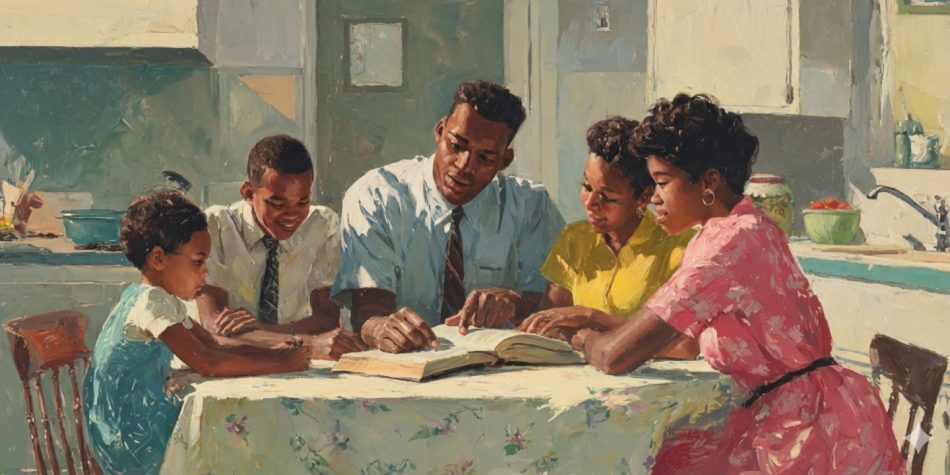
A young Black family gathers around the kitchen table studying from the scriptures, showing how families cope with racism through faith.

Leaning on the Lord: Lessons from Exemplary Black Families on Faithfully Coping with Racism

Experiencing social stressors can test marriages and families. What sources of strength guide Black families in coping with racism without bitterness?

Download Print-Friendly Version

This article is part of a four‑part series that draws from insights in our forthcoming book, Exemplary, Strong Black Marriages & Families (Routledge, in press).

Research on family stress indicates that many African American families face racism and systemic stressors. These families susceptible to the cumulative burdens of stress spillover—defined as profound stress in one area of life “spilling over” and leading to poor outcomes in other domains.

In this article, we take an in-depth look at 46 strong, exemplary religious African American families to determine what actions and attitudes helped these families be optimistic about life and cope with racism and other hardships. These married couples and families were referred by their respective clergy as among the strongest and most faithful families in their congregations. This approach is consistent with “exemplar research,” where researchers study participants who embody the characteristic under study in an exceptional manner.

It has taken our American Families of Faith research team more than two decades of dedicated interviewing, transcribing, and coding to gather the strong choir of 97 rich voices behind this study of Black families. Our efforts have taken us to living rooms from Wisconsin to Louisiana, from California to Delaware, and from Oregon to Georgia. We have written elsewhere regarding the exemplary Black families of faith that we have interviewed:

For these families, the United States is not a “post-race” nation. Poverty, often deep poverty, as well as unemployment, inadequate educational opportunities, discrimination, incarceration, and many other social ills are far too familiar to them and their loved ones. Further, these marriage-based families are often the first to receive “knocks of need”—requests for money, help, and even temporary housing—from the less fortunate who surround them. Their lived religion is not a sanitized, upper middle-class spirituality, it is a desperate, deep, and pleading faith of survival that—even [in 2026]—still contains echoes of the mournful notes of the shame of American slavery. Theirs is not merely a faith that enriches or adds meaning to life. Their faith is often life itself. While few can claim to envy the plight of one of the most discriminated groups in U.S. history, we do envy the profound depth of their living faith in a God that reportedly hears and sustains them through profound challenges—challenges that … are ever present for most of these families.

These exemplary Black families have taught us much. For the balance of this article, we will share their voices and their words regarding their central sources of strength in dealing with life’s challenges, including their experiences with racism and discrimination. Gwen, a Baptist wife, said:

[Racism is] just one of those things where, yes, you will encounter it, and I know I will until Jesus comes and gets me out of here. But until then, it’s like, I have to realize that they’re the ones with the problem. I can’t become bitter about it or anything because God is not going to put up with that. … So, I have to just rest in the Lord on that one. … It’s tough, it hurts, but… I know it’s gonna hurt more for them than for me [at judgment day]. 

Many participants exemplified resilience in their responses to racism. Joelle, a Baptist wife, explained:

[I experience racism] every day, pretty much. … I used to be a manager at a [J.C. Penney]. They had a big controversy going, so they called for the manager and [when] I got there the white people were so mad. They didn’t know what to do. ’Cause here was [a] Black woman [who] is going to make a final decision. … To me, it’s not personal, it’s their ignorance. I have never doubted who I am or how important I am and how much I deserve to be on this earth. … So, to me, I’m perfected in Him because [God] thought of my color. … He [chose] it.

Orlando, a nondenominational Christian husband, said: 

Being a Black man, I can always recognize racism in full panoramic view. … If I were to allow the world to tell me how I was supposed to act, then I would have came home [and] I would have kicked the dog, I would have argued with my wife, I would have pulled out my belt, and I would have came home and beat my kids, and I’d have hit holes in the wall—but I wasn’t going to let society dictate how I was going to respond to situations. Because … society tries to write a script … [about what] certain racist behavior is supposed to trigger. And that’s where I hold on to God—because I know God gives me peace. And through God’s peace and through God’s love, I am able to just pray for that person who tries to make me unhappy, because they’re more unhappy than I am … if they feel they need to mistreat me to make themselves feel good. … [I am] trying to tell my children, ‘People are going to put things in your way. It’s not what they do to you, it’s how you respond to it.’ So, I try to set the example—not to respond to it [and not to get] to where I feel like I’m powerless. … No. You can’t go there. I can’t go there. 

Dean, a Catholic husband, spoke of empowering the next generation. A central part of his message to combat racism was to focus on self-worth. He said:

All the kids I come across, I be talking to them: ‘Don’t you ever take no back seat to nobody. God created one yellow flower better than the red one? [No!]. He created them all equal. … Try to have some vision in yourself.’ … I can say that I encounter [racism] daily in some form or some fashion. [It] has to do with arrogance: somebody thinks they are one up on somebody, [but] they really aren’t up on nobody. … It doesn’t affect us negatively ’cause … when you understand who you are inside spiritually, then no external forces, no crap, is going to make you all the sudden [be] disenfranchised emotionally. So, in that way, [God] gives strength. 

As mentioned by Orlando, Dean, and others, a strong sense or “vision” of belonging to God was a partial buffer against racism. Similarly, feelings of belonging to one’s family were frequently mentioned by participants.

Catrina, a wife and dental assistant, said that after daily experiences with racism for her, her husband, and their children, they would unite and rally together

So, coming home, … we just come and talk about what may have happened, then realize that it is not our problem—it’s theirs—and [we’re] just gonna have to give it up and praise God anyway. And [we] just pray about it and encourage each other to do our best and … take those things to the Lord. 

Chris, a Baptist husband from Louisiana, referenced his Black heritage as a source of strength to him and his family. Significantly, even when he was speaking about ancestors long past, he often used the pronouns “we” and “us.” Chris said:

I think it’s more of a historical thing for us. Back in slavery when we were just against all odds, out there in the fields … being tortured, and we sang hymns. You heard the stories about how they overcame all the prejudice. … One thing that was always constant was their belief system, and I … I always fall back on that. … I think that sometimes, a lot of the young people today don’t really understand the struggle that some of our foreparents went through, [but I do] I think [about] that history of just dealing with all the, the prejudices … we’ve just endured. And through it all, we still seem to maintain. That’s the one thing we have that’s always been a strength for us.

Derek, a Baptist husband from North Carolina, wanted to impart a similar message to Black youth. He emphasized individuality and intentionality in the context of a strong heritage: 

To young Black couples, the young kids now, I would say go back and … look at your history. And see what the Black family was. And then turn around. Because you ain’t what somebody [else says] you are. You can be whatever you wanna be. And history plays a part of it. You pick out the good and throw away the bad. And don’t forget where you come from. Don’t forget who you are. 

Brianna and Ted, a Christian couple from Louisiana, described how they buoyed each other up by reaffirming their belonging with each other and with God. Ted said:

As I tell [my wife] all the time, ‘You know who you are, and that’s what you have to stand on. Know who you are in God and don’t worry about what nobody else says.’ And a lot of times with me, she’ll tell [me], ‘I don’t worry about people. I know who I am in Christ, and that’s what most matters to me.’ I know who I am.

Gary, a Methodist husband from Massachusetts, talked about how feeling accepted by God influenced him positively when he felt keenly aware of his weaknesses. Gary said: 

God puts up with me, and I’m a big pain in the butt. I’m imperfect and all other things, and so it really helps me. … It’s His open acceptance of me, the good, the bad, the ugly, everything that I’ve done [that blesses me]. He knows and He still loves me? W[e] are all sinners [but still] Christ died for us. … That [has] a direct influence [on me]. 

What We Learn About Coping with Racism

Collectively, the voices of these families reveal that racism is not an abstract construct or imaginary fixation; it is an experience that—sometimes daily—places undue stress and strain on Black families navigating a society that often sees color over character. However, these families also note that stress spillover from racism can be met and responded to with a divine sense of self-worth, deep self-respect, support of family, and profound faith in a God who knows and helps.

For these exemplary Black families, their reliance on a loving Creator is not simply embedded in hope for the afterlife, but rather in a resilience that helps them to interpret hardship, regulate difficult emotions, and to continually choose love over hatred. These families embody the wisdom captured by the late Annie Mae Denton who grew up in Jim Crow-era Mississippi but served as a vibrant model of loving all around her—in spite of the racism she faced throughout her life. Her creed? “Never let someone else’s bad moment get between you and the Lord.” 

About the authors

Antonius Skipper

Dr. Antonius Skipper, dubbed the “strong Black marriages guy,” is an Assistant Professor at Georgia State University. He is a collaborator on the American Families of Faith Project, where his research broadly examines faith within exemplary Black marriages and families.

Loren Marks

Loren D. Marks, Ph.D. is professor of Family Life at BYU, co-director of the American Families of Faith project, and co-author of Psychology of Religion and Families. He is a Fellow at the Wheatley Institute.

Justin Hendricks

Justin J. Hendricks, M.S., is a PhD student in sociology and demography at Pennsylvania State University.
On Key

You Might Also Like

The Ordinary Saint’s Guide to Under the Banner of Heaven: Episode 4, “Church and State”

Summary — The episode begins with the detectives checking in on Bishop Low’s home, which they find ransacked and deserted. Pyre finds a letter written by Ron’s wife to the Prophet expressing concern about her husband’s refusal to pay taxes. The detective contacts the Church about the letter and is told the letter was handed down to one of the bishop’s counselors, LeConte Bascom, who works at the bank. Brother Bascom says he had to turn Ron down for a loan because his brother’s refusal to pay taxes made him a liability, though it’s heavily implied that the real reason is that his wife’s letter was seen as an embarrassment to the Church. In flashbacks, we see Dan marching in a Pioneer Day parade, shouting about the government’s illegal taxes, as well as smoking and kissing a woman who isn’t his wife. Dan’s father says he’s ashamed of his immoral behavior and anti-tax nonsense and advises him to study the scriptures to set himself back on the right path. This unfortunately drives Dan into researching more obscure history of the Church, including information on polygamy.  He makes a business trip down to Colorado City to visit the breakaway polygamist sect there and manages to get the name of a pro-polygamy pamphlet called “The Peace Maker.” He reads this pamphlet and brings up the idea to his wife Matilda, telling her she’s limiting his spiritual power if she doesn’t let him marry a second wife.  During this conversation, Dan is pulled over for speeding and refuses to cooperate with the officer, leading them on a police chase that ends with his arrest. At the jail, Dan’s brothers try to convince him to stop his resistance to the government. Ron feels it’s his responsibility to show Dan the error of his ways, but instead, Dan runs circles around him, leaving him speechless and admitting that he’s going to lose his business and home. Dan somehow turns this fact into evidence that his views are correct and ends up winning over Ron to his side. In the present, Detective Pyre is being leaned on by the Laffertys’ stake president to release them into his custody but refuses. The detectives have identified the car the killers were probably using and plan to hold a press conference to ask for tips when the police chief returns from vacation and demands that all mentions of fundamentalism Mormonism be scrubbed from the press briefing. (It’s implied he’s being leaned on by the Church.) Pyre tries to toe the line at the conference but eventually caves to a persistent reporter and admits that he thinks that the murders may have something to do with fundamentalist beliefs. The next day at church, the ward is shunning the Pyres, and a specific couple is assigned to keep an eye on their faith. Meanwhile, a police officer has located Bishop Low fly fishing in the mountains and safe. Church History — During Dan’s explanation of polygamy, we get flashbacks to the infamous scene where Emma finds out about the doctrine of polygamy for the first time and throws the revelation in the fire. Though church members will be familiar with this story, the tone is portrayed very differently than we are used to. Emma is shown as being absolutely skeptical of Joseph’s translation of the Book of Mormon and other prophetic acts, even though she firmly testified of the truth of these things even after her break with the Church after Joseph was murdered. Joseph is portrayed as proclaiming the doctrine of polygamy only for his own physical gratification, which is a common anti-Mormon trope with little evidence behind it. While it is true that one of Joseph’s wives was only 14, the facts behind the situation are more complex than portrayed in the show. The pamphlet “The Peace Maker” is portrayed by Dan Lafferty as an “essential LDS tract” written by Joseph Smith, and no one in the show ever corrects this perception. In fact, the tract was not written by Joseph Smith, and he repudiated it during his lifetime. This episode presents a slanted view of church history, giving only one side of the conversation and showing the modern church as trying to hush it up rather than having its own interpretation of events. Shibboleths — Pyre claims that writing a letter to the prophet is like writing to “Heavenly Father himself,” which is absolutely wrong. While members of the Church do revere the prophet and listen to his teachings, he is not God, and this equivalency is not one Saints would make (though outsiders think we do). The idea that doing business with fundamentalists is like “doing business with the mafia” is totally alien to me. They are regarded as somewhat of an oddity in Utah, but not dangerous like organized crime. One unusual phrase occurs when the stake president claims that the Laffertys need to be released into his custody for “healing prayer.” I honestly have no idea what this phrase refers to and have never heard it in an LDS context. And the formal type of shunning portrayed happening to the Pyres is not something we do. Though obviously, wards vary in their culture, there is no formal instruction not to talk to those who have questions. Rather, we are encouraged to keep being friends with those who are struggling with faith and support them however we can. Changing History — It is interesting to note that in the actual chain of events, it was Sister Low, not Bishop Low, who was on the Lafferty hit list. Sister Low was a Relief Society President who supported Dan’s wife as she sought a divorce. Why does the show change this? Perhaps the idea that the Church has female leaders doesn’t fit well with the show’s depiction of the oppression of women in the LDS church. Brenda Lafferty’s sister has also expressed her disappointment with the way the show is misconstruing her sister’s murder in pursuit of an

A reflection on violence in film

Gladiator II is a serviceable historical epic. If you loved Gladiator, you’ll like Gladiator II. Gladiator II opens as Rome is about to siege the “last free city in Africa.” Our nameless hero loses valiantly with his wife dying in the battle, and he is brought to be a slave in Rome. But if our hero can perform well enough as a gladiator, he can buy his own freedom. And with that, we’re off. The beats of this film will be familiar, with a massive twist only halfway through that changes the stakes for everyone. Our hero is really the son of our hero from the last movie! Which means he has a legitimate claim to the throne of Rome. The movie tries to follow three different stories. Our hero (Paul Mescal) is trying to win his freedom and avenge his wife’s death. Acacius (Pedro Pascal), the general of the armies, wants respite and time with his wife; he also wants to lead a coup against the emperors. Macrinus (Denzel Washington) wants to work his way up in Roman power through political scheming. And then on top of all of that, we are told that our hero must deal with his father’s legacy and discover who he truly is.  It’s a lot, even for an epic, and the screenplay is not nearly tight enough to keep all the storylines coherent and moving. We are led to believe that Macrinus is successful in maneuvering to the top of Roman society because of his exceptional political skill, and Denzel Washington’s delicious performance makes that believable, but all we actually see him do is win a bet and carry out an assassination. Pedro Pascal’s excellent work as the weary general does some of the work in helping reconcile the contradictions in his character, but a look on his face here or there has to carry a lot that a simple conversation could have fleshed out.  Perhaps the reason the script doesn’t have time to breathe is also its biggest contradiction. There is something grotesque about watching audiences cheer on the brutal violence taking place in the film. And yet, the entire film is centered on having us, the audience, watch one set piece of over-the-top violence after another. We don’t get to see Macrinus manipulate the Roman senate because, instead, we need to see our hero fighting with CGI rhinos or CGI sharks. There is a place for violence in a moral movie. It can be helpful to attune our senses to recoil from violence or recognize the rare places it is justified. But the violence on display in Gladiator II is so relentless and gratuitous that it dulls the senses instead.  This is not to diminish the craftsmanship that has been used to bring this world and its many battle scenes to light. Rome feels broad and alive in true epic fashion, and it’s easy to get swept away into its world—with the exception of a few uncharacteristic pieces of clunky CGI work. The opening battle sequence is perhaps the best ever put to screen.  The best part of Gladiator II was its opening. A 1950s style opening credits are shown over a lavish dreamy animated retelling of the first film. Everything about it screams that something epic is about to be shown. But throughout the movie I stayed fixated on what it could have been. What if it had been more focused on the characters I cared about? What if it didn’t try to connect so much plot to the previous film and let this story stand on its own merits? What if they had expanded it to a TV miniseries so that its many plot points had space to breathe? In the end, despite some good acting and a beautiful setting, the movie just left so much to be wanted.  Gladiator II is R-rated. It is not appropriate for children or, in my estimation, most adults. At its core, this film has a moral message: life is hard, but it’s worth fighting for. But the way it’s presented on screen does more to drag down the spirit than to lift it up. Two and a half out of five stars. Gladiator II opens nationwide November 22, 2024.

Subscribe To Our Weekly Newsletter

Stay up to date on the intersection of faith in the public square.

You have Successfully Subscribed!