Ward and stake choirs do far more than make music; they help shape a healthy Latter‑day Saint culture.
Of course, when it comes to choir, we immediately think of the tremendous impact of The Tabernacle Choir at Temple Square. But members of The Church of Jesus Christ of Latter-day Saints have also created the powerhouse 5,000-strong Millennial Choirs and Orchestras across the Western U.S., and there are regional choirs in places like the Washington, D.C. Temple Visitors’ Center. However, at the level of local wards (congregations) and stakes (local congregation groups), choirs serve unique functions that go beyond the public performance of music. They contribute to an ideal church culture by building unity and social capital, modeling male-female harmony, opening opportunities for outreach, and teaching skills of belonging.
How Choirs Help Build Culture
In every Latter-day Saint congregation, culture is a two-part challenge. The first part tends to get the most focus with the question: “How do we distinguish between the gospel and church culture?” The concern is that some members may get caught up in cultural expectations—such as the style of our church activities, dress standards, and more—to a degree that those expectations are seen to have the same authority and seriousness as divine commandments.
With the other challenge, we ask a different question: “How can we create a healthy ward culture?” In a healthy ward culture, church members feel loved and valued. They feel unity even amid their diverse life experiences. They feel supported in difficult situations. All of that is made possible as, together, they feel connected to God.
Unity & Social Capital. The ideal ward culture does not just happen on its own, however. It takes members who are willing to get out of their comfort zones and do difficult things. It requires patience and a willingness to let things go, as we experience interpersonal “fenderbenders” in our callings and activities. It requires constant attention to what is most important in our church experience, and constant discipline in managing lesser priorities. In wards that feel “ideal,” we typically find some number of devout, converted members who are relentless about teaching and modeling a healthy church culture. In moments when we glimpse that ideal, it really is a glimpse of heaven on earth. In a healthy ward culture, church members feel loved, valued and unified even amid diversity.
Within the context of church, our activities—and especially our service—lead us to develop social capital, a shared sense that we contribute to each other’s well-being. Service projects are notably effective for developing unity and social capital, and this is also true of choir activities. Choirs are contexts for personal development, joy, fun, and transcendence.
Male-Female Harmony. Choirs also serve another important purpose. Throughout history, one of the most persistent sources of frustration has been the ongoing tension between men and women. In recent decades, the feminist movement has been met with the emergence of the “manosphere,” a collection of online spaces and content creators that claim to promote and defend male perspectives. Together, these two movements often diminish and denigrate one another. The conflict between these ideological online extremes is often presented as the only possible reality for men and women.
Choirs present a different and more hopeful view of reality, where male and female exist in harmony and produce a combination of beauty, strength, and transcendence. In the work of The Tabernacle Choir at Temple Square, the world sees hundreds of men and women joining together in an ideal ordering and blending of male and female strengths. My personal favorite of their performances is of Carl Nygard’s piece, “God So Loved the World,” based on John chapter 3:16-17. In the chorus, the women’s voices soar in a way that men’s voices cannot, creating the sense of astonishment that should be our response to the power of that passage of scripture.
Likewise, in The Tabernacle Choir’s arrangement of “Come, Thou Fount of Every Blessing,” The men’s voices begin the second verse a cappella, highlighting the unique character of the male voice to convey the poetry of commitment and devotion. Whenever I sing in church in a men’s ensemble, we hear expressions of gratitude from women in the ward. I suspect this gratitude reflects the experience of seeing male energy channeled into something good and noble, in contrast with so much of the negative male behavior we often witness in the world. Choirs allow for clear public demonstrations of Christlike manhood.
The Tabernacle Choir is one of the world’s greatest models of how feminine and masculine gifts and voices work together to produce experiences where the harmonious sum is far greater than the individual parts. The musical value of the choir is extraordinary, but there is also profound symbolic value in what the choir does, modeling for the world the power of complementarity. The Tabernacle Choir is uniquely great, but there are also smaller, more local examples of what is possible to experience.
Outreach & Community Bridges. When I was called as a ward choir director earlier this year, the outreach potential immediately came to mind. In my calling, I hope to see struggling youth and other ward members find strength and renewal in choir. I hope to see all Latter-day Saints participate in choir. I would love to see members of our community, people not of our faith, sing with our ward choir. I would love for our community to feel comfortable asking our ward or stake choirs to serve by joining in community events or funerals, beyond the doors of our church buildings. Many people who participate in high school and college choirs leave their choir experiences behind as they move through life, and, similar to how Latter-day Saints are viewed with family history, I would love for members of our community with past experiences in choirs to see Latter-day Saint buildings as centers of excellence offering opportunities to once again experience the joy of singing in a choir.
Belonging and Connection. Former Surgeon General Vivek Murthy wrote a book called Together, where he explained that a lack of human connection has become in our time a pervasive public health crisis. With technology allowing us to narrow our interpersonal interactions to people who are just like us, many of us are missing out on the benefits of regular interaction with people who experience the world differently than we do. This can happen even among people sitting together in church meetings. To a great extent, connection and belonging require skills that can be taught and practiced. Participation in a choir is an ideal context for the development of those skills.
Much recent research suggests that participation in community choirs uniquely accelerates social bonding and reduces loneliness.
A Case Study
In my stake in Virginia, we do a community Christmas choir event every year that brings together our stake choir with members of our community for a beautiful experience of worship. In 2025, we decided to do a similar kind of program for Easter, and a member of our stake offered for the event an original a capella choir composition called “Intercessor,” based on the text of Isaiah 53.
I immediately jumped at the opportunity to participate, as Isaiah 53 is my favorite chapter in all of scripture. The composer, Savannah Turk, assembled sixteen people to learn and perform the piece, and it was the hardest vocal part I have ever learned. The piece includes a number of dissonant chords, which can be difficult for most amateur choirs, but because Isaiah 53 is written with the intent to convey painful irony in the suffering of the innocent Messiah, I could see how dissonance is a good approach for expressing that irony in music. All of the effort was worth it, as “Intercessor” provided a transcendent musical experience that became central to our Easter event. “Intercessor” was so spiritually rich for those of us who participated that I helped to create a separate recording of our amateur choir performing it, in the hopes that other choirs will become familiar with its powerfully unique approach.
When it comes to sacred music, we are spoiled with an abundance of music for Christmas, and much less for Easter. I hope to see Latter-day Saint composers rise to the challenge like Savannah Turk did with “Intercessor,” and create new compositions that can become sacred Easter standards like “This is the Christ” and our more recent “Gethsemane.” The musical value of the choir is extraordinary, there is also profound symbolic value in … modeling … the power of complementarity.
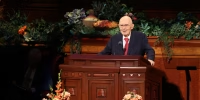
In closing, I recall Elder Jeffrey R. Holland, the president of the Church’s second presiding body, speaking in April 2017 General Conference talk “Songs Sung and Unsung.” There, to teach foundational principles of diversity and belonging in the Church, Elder Holland used the metaphor of a choir:
… remember it is by divine design that not all the voices in God’s choir are the same. It takes variety—sopranos and altos, baritones and basses—to make rich music. To borrow a line quoted in the cheery correspondence of two remarkable Latter-day Saint women, “All God’s critters got a place in the choir.” When we disparage our uniqueness … we lose the richness of tone and timbre that God intended when He created a world of diversity.
Now, this is not to say that everyone in this divine chorus can simply start shouting his or her own personal oratorio! Diversity is not cacophony, and choirs do require discipline … but once we have accepted divinely revealed lyrics and harmonious orchestration composed before the world was, then our Heavenly Father delights to have us sing in our own voice, not someone else’s …
Don’t demean your worth or denigrate your contribution. Above all, don’t abandon your role in the chorus. Why? Because you are unique; you are irreplaceable. The loss of even one voice diminishes every other singer in this great mortal choir of ours, including the loss of those who feel they are on the margins of society or the margins of the Church.
While Elder Holland was using choir as a metaphor, he was also teaching some valuable principles that go beyond metaphor into our experience of the Church. In that spirit, I invite ward and stake choir leaders to raise our sights. Choir is not about doing something musically dazzling, or reliving the glory days of our musical-performer past. In choir, we have the opportunity to do things that are much more significant—to teach gospel doctrines, develop interpersonal skills, cultivate unity amid diversity, build bridges, and heal cynicism in the hearts of our choir members and our congregations. In allowing others to participate in the leadership of our choirs—even in the selection and conducting of music—we help to infuse their experience of the gospel with growth and joy. We teach them that they are empowered to elevate their church experience.
Finally, if you are a member of the Church and can participate in a choir, hopefully, this essay has opened your mind to the benefits of doing so. From my personal experience, I wholeheartedly invite you to make that commitment.