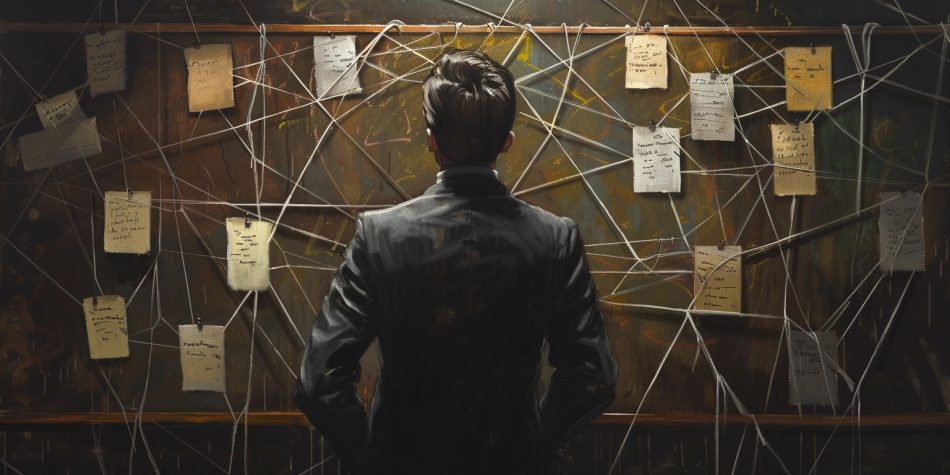
Man Looking at Paper & Yarn Linked on Chalkboard | Numerology or Nonsense? | Public Square Magazine | Jewish Mysticism & Numerology | Why Numerology is Nonsense

Numerology or Nonsense?

Is numerology reliable? Despite intriguing patterns, it often leads to confusion and misinterpretation.

We lived in Israel for 8 years, and our kids attended Israeli schools for part of that time. One adjustment we had to make was trying to understand numbers written with letters. When our son was in 11th grade, his class was called “yud-aleph” because the Hebrew letter yud has a numerical value of 10, and the letter aleph has a numerical value of 1. Today’s date (5/21/24) on the Hebrew calendar is the 13th of the Jewish month of Iyar, in the Jewish year 5784. In Hebrew letters, it’s written like this: י״ג בְּאִיָיר תשפ״ד (to see a chart of Hebrew letters with their numerical values, go here.)

Since numbers are written with letters, that means every name and every word has a numerical value. Many of these numerical words have become memes in Jewish (and Israeli) life. The word חַיִים means life and has a value of 18. Thus, the number 18 is used casually in conversation. It might be your fortieth birthday, but everyone will tell you that you look 18. 

One name with numerical value captures the attention of modern readers of the Bible and the Book of Revelation 13:18, trying to understand end-time prophecies. The number is 666 and is supposed to be the value of the name of the anti-Christ. It shows up first in the Old Testament and is the number of talents of gold that King Solomon received in a year (1 Kings 10:14). That’s probably an exaggeration, but it equals more than 600 million dollars. Solomon’s increasing greed enabled his worldliness to overcome the wisdom given to him by God. He enslaved his own people in order to increase the value of his holdings and the grandeur of his kingdom. Those slaves were marked, sometimes on their foreheads or hands.

Jewish mystics sought spiritual meaning in the numerical value of words and phrases.

For many ancient Christians, the anti-Christ had to be Nero, Emperor of Rome. The numerical value of his name (Neron Caesar) in both Hebrew and Greek is 666. (For older scriptural records that use the number 616, dropping the final ‘n’ in ‘Neron’ takes care of the discrepancy.) Since he martyred Christians for fun, he was the perfect anti-Christ. Yet, modern Christians are still looking for this prophesied figure to arrive on the scene. Meanwhile, they see “666” in barcodes and the w’s in the World Wide Web (in Hebrew, ווו), but 666 is not a row of three sixes, but six hundred, sixty-six, or נרון קסר in Hebrew letters.

Gematria, Numerology, and Apophenia

Jewish mystics sought spiritual meaning in the numerical value of words and phrases in the practice of Gematria. They used Gematria to examine mystical texts and the Torah. The scriptures were written in Hebrew at first, but when over a million Jews had settled in Alexandria, Egypt, scriptures were written in Greek, a language that also used letters for numbers. At least they had two solid starting points: 1) they were working with a language that actually used letters for numbers and had done so from ancient times, and 2) they were looking at scripture, which could be assumed to hold hidden spiritual knowledge from God to man. Jewish mysticism, Kabbalah, which flourished during the Middle Ages and which was hidden from the uninitiated, includes Gematria.

The Bible Code (or Torah Code) is a purported set of encoded words within a Hebrew text of the Torah that, according to proponents, has predicted significant historical events. Looking for a coded message in scripture became widely popular with everyday people in the late 1990s with the publication of Michael Drosnin‘s book The Bible Code (1997) and the release of the movie The Omega Code (1999). Drosnin published a second book, “The Bible Code II,” on December 2, 2002, with several predictions that have already proved false. Drosnin suggests that “the code was written by extraterrestrial life (which he claims also brought the DNA of the human genetic code to Earth).” 

“Numerology (known before the 20th century as arithmancy) is the belief in an occult, divine, or mystical relationship between a number and one or more coinciding events. It is also the study of the numerical value, via an alphanumeric system, of the letters in words and names.” As you might surmise from Michael Drosnin’s philosophies, assigning numerical values to words and looking for secret messages is a fraught endeavor and can lead you in some very strange directions.

In fact, this situation has a name. It’s called “apophenia”—seeing meaningful connections or patterns between unrelated things. Conspiracy theorists are among those who engage in apophenia: “The president drank four cokes on camera on 9/11, and there were four planes used in the attack! Therefore, the president is implicated.” The truth is that the human mind can perceive “truth” in nearly everything, and the pull of finding secret knowledge that exalts the ego is strong.

Woman Examines Bible with Magnifying Glass | Numerology or Nonsense? | Public Square Magazine | Beliefs About Jewish Mysticism and Numerology | Jewish Numerology
We can find a connection in anything if we look hard enough.

Some examples of apophenia are the 23 Enigma and the Law of Fives. “The lesson that the Law of Fives, the 23 enigma, etc. teaches is that ‘What the thinking mind thinks, the proving mind proves’ (to quote Robert Anton Wilson). When you start looking for the number 5 in everything because you think it has some connection or mystical significance, then, with a bit of creativity, you can find “proof” of this connection everywhere. This is not necessarily because there is any actual significance, but because the human brain is built for finding patterns in coincidences, for finding order in chaos.” (Robert Anton Wilson was a Discordian philosopher whose goal was “to try to get people into a state of generalized agnosticism, not agnosticism about God alone but agnosticism about everything.”)

Other systems of numerology include the Mandaean number alphasyllabary, the Abjad numerals in Arabic, the Pythagorean method, the Agrippan method, and even life path numbers currently used in horoscopes that begin with your birthday. A system of numerology has even sprung up from the remarkably creative The Hitchhiker’s Guide to the Galaxy, Douglas Adams’ 1979 sci-fi novel. “Toward the end of the book, the supercomputer Deep Thought reveals that the answer to the ‘Great Question’ of ‘Life, the Universe and Everything’ is ‘forty-two.’”

Deep Thought takes 7.5 million years to calculate the answer to the ultimate question. The characters tasked with getting that answer are disappointed because it is not very useful. Yet, as the computer points out, the question itself was vaguely formulated. To find the correct statement of the query whose answer is 42, the computer will have to build a new version of itself. That, too, will take time. The new version of the computer is Earth.

Thus, Adams supplies us with a joke as the answer for every question, as in the computer world, “42” means anything you want it to mean. In Geek Culture, 42 has become an anchor for memes and humor. Ask any search engine what is the answer to everything. Adams says he chose the number completely at random and that it held no meaning for him. Yet, “in ancient Egyptian mythology, during the judgment of souls, the dead had to declare before 42 judges that they had not committed any of 42 sins.” The anti-Christ will control the world for 42 months, and Armageddon will last 42 months. Yes, 42 is divisible by 7, the holiest number, but in these two instances, 7 is a multiple of 6, the evil number that can never reach heaven. You see a fake holiness in the number 42. That said, there were 42 generations from Abraham to Jesus.

Can We Prove God’s Truth Using Numerology?

The above discussion demonstrates that our “playing” with numerology to find meaning is fraught with so many variables that finding any sort of truth is like trying to catch water in a sieve. 

You would think that God may have different levels of approval for the various Christian churches in the world. Since there are about 45,000 unique Christian denominations, they can’t all be true. Would it be possible to cancel out the least true by using numerology? If so, how would you do it? The wisest choice, it seems, would be to start with a language of which God approves and even relies upon Himself. The Adamic language would be the obvious first choice since it was given to Adam by God and was perfect and undefiled. In Genesis 11:1 it says that the earth spoke all one language. Were that true today, the choice would be a given, but today, according to the Ethnologue Guide, there are 7,139 officially known languages in the world.

Finding any sort of truth is like trying to catch water in a sieve.

We no longer have the Adamic language, but we do have Hebrew and Greek, the languages of scripture. Hebrew and Greek would be a good choice because God spoke to ancient prophets, and they wrote truth in these languages. They also used letters for numbers, which could be of paramount importance. Egyptian might be nice, especially because the Egyptians were technologically advanced, had a pictorial way of writing, and obviously understood spiritual secrets we are still trying to understand. Choosing English could be silly because no reliable numerology for English exists, English does not use letters for numbers, and it’s a chaotic language that breaks rules in its grammatical structure. It’s also very recent and influenced by other languages with no religious connection.

We could quickly sink into the realm of apophenia, fishing for coincidental connections in events, names, and numbers. Since our choice of religion, our pattern of worshipping Christ, can have eternal consequences, would numerology (especially based on an alphabet of our own choosing) be the best vehicle for finding or disqualifying truth? I think not. God has given us the way: asking Him directly with a willingness to change our lives according to the answer we receive. He has also provided a holy testator to the truth who speaks every language perfectly—the Holy Ghost.

About the author

Gale Boyd

Gale Boyd has been a teacher, poet, author, and editor and is currently the copy editor for Public Square Magazine. Born in D.C. and raised in L.A., she joined the Church at age 16, converting from Science, which was the religion in her home. She discovered her true heritage a few years later and began her deep dive into Judaism at that point. Fifteen years into her temple marriage, her then family of seven began their 14-year adventure in international living by moving to Israel, where they lived for 8 years, adding one more child and changing the trajectory of eight lives.
On Key

You Might Also Like

Mother Figurine Holding a Baby | Public Square Magazine | Meaning of the Lyrics Peace on Earth, Goodwill to Men

Now is the Time for Peace on Earth, Goodwill to Men

You’ve heard it before: “Peace on earth, goodwill to men.” Whether viewed as prophecy for a hopeful future, as rebuke to a fallen world, or as the deep aspiration of many human hearts, these words invoke wonder still today, especially at a time like 2020. I believe these words point towards legitimate reasons for great hope in humanity’s future, even in the midst of our current distress. A closer look at their meaning provides a glimpse into bright possibilities. The modern-day enshrinement of these words was penned by the hand of Henry Wadsworth Longfellow during a time of deep personal sadness and grief in his 1863 poem “Christmas Bells.” Subsequently, these words have been sung by millions as the hymn “I Heard The Bells On Christmas Day.” Sadly, few choirs will sing this popular carol during the Christmas season this year as many of our most cherished traditions are disrupted by the continuing, unprecedented epidemic.  Notwithstanding the familiarity of these words in the modern context, their first recorded rendering came anciently in a most unusual setting. It was one of the few instances in all of secular or religious writings where an entire host of heavenly beings—angels—came to deliver a message to a few lucky ones on earth. Their entire message as recorded in Luke 2:14 of the New Testament was “Glory to God in the highest, and on earth peace, good will toward men.” If there was more to the message or not, we don’t know. But this was the message that was recorded and handed down over thousands of years since that momentous event.  It was this short heavenly song of praise that Longfellow was referring to when he lamented that “hate is strong and mocks the song of peace on earth goodwill to men.” Then as now, we join Longfellow in observing a world stricken with contention, tragic death, and human suffering with no clear end in sight. As a bold counterpoint, however, his poem and the hymn conclude with a resounding proclamation of hope that indeed there will be yet “peace on earth and goodwill to men.” Is it possible to find for ourselves this same hope of which Longfellow wrote so long ago?    Some might assume that the author had somehow arrived at more pleasant circumstances and material conditions. Yet in describing his world that Christmas morning in 1863, Longfellow was feeling the weight of personal tragedy in the death of his wife and the strife of a hot civil war spreading devastating carnage across the land. In such a heavy time, he couldn’t help but underscore how much the surrounding hate he saw in the world seemed to mock the idea of peace and goodwill – a word that suggests to “tease or laugh at in a scornful or contemptuous manner.” The hate he was referring to, and which has the power to infect us in our own day, was between groups of people and between individuals who looked at each other with scorn and contempt. In an environment that fosters hate, any suggestion that feelings of scorn and contempt might be replaced with feelings of peace and goodwill can seem to be almost laughable (another reason it’s powerful to have a heavenly host delivering this message to the world).   We sometimes think of peace and goodwill as synonyms. They are not. In fact, they represent very different human conditions – either one by itself being incomplete. But together they weave a social fabric of heavenly dimensions. There are many examples of one without the other, but relatively few of both existing and being sustained for any great length of time.  In its simplest form, peace could be defined as the absence of conflict. When this kind of peace is voluntary, due to an underlying feeling of goodwill toward all, it is a wonderfully satisfying human condition.  However, a “peaceful” absence of conflict can also be achieved through coercion, even in the notable absence of goodwill. In that case, it comes at the obvious, and dear price of freedom and liberty and represents a most cruel form of the human condition. Coerced peace is usually a political construct as it requires overwhelming use of force to constrain human behaviors. There have been modern examples of peace without goodwill in the recent past. One can reflect on Yugoslavia, Libya, Iraq, and other nations. For example, Yugoslavia was created after World War II as a federation of six different ethnic regions. A strong central governing party ensured that conflicts were resolved emphatically and quickly. There was “peace,” but without the underlying goodwill among the different ethnic groups. Under Josip Broz Tito the country experienced an extended period of prosperity characterized by enforced peaceful interaction among the various ethnic groups. In many ways, it was considered a model of economic success.  But after Tito died in 1980, the ability to continue the peaceful climate through coercive means declined, and the unresolved conflicts among the different ethnic groups emerged with frightening consequences in human suffering for the whole country and region. In a relatively few years, the region completely lost both its peace and prosperity.  Similar events have unfolded in other countries where peace was enforced despite the absence of “goodwill toward men.” As the power to enforce coercive peace diminishes, people are subsequently often subjected to tragic suffering that can take decades and even generations to overcome to a point of regaining a semblance of stability. In short, peace without goodwill has a terrible historical record for producing great human suffering in the end.  Unlike “peaceful” conflict suppression, goodwill to men cannot be coerced. It is almost by definition an innate feeling of each individual human heart. It can be contagious, and it often seems to be either in large supply or in short supply in a particular family, community, or nation. It would seem that goodwill to other human beings is something that would be a universal good. However, once again we find that

The Audacity of Temples

Can temples justify their costs? What if those who built temples knew something that outside observers didn’t?

Celebrating Black Pioneers, Then and Now

A conversation with Mauli Bonner, who with Tamu Smith, were the trailblazing force in establishing new monuments to Black pioneers arriving in Utah in 1847 – and whose work also points towards a vibrant path of racial healing in America today.