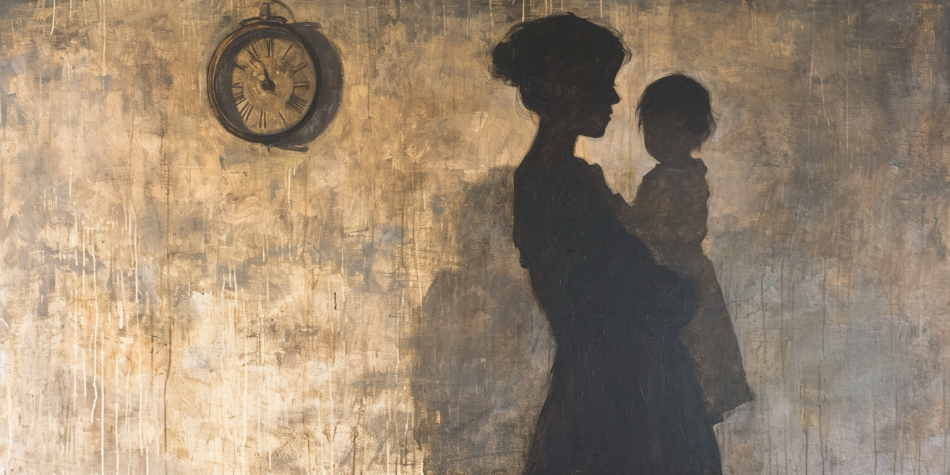
A serene mother with her child, overshadowed by time, representing a mother's near-death experience.

Motherhood, Mortality, and the Myth of Control

A near-death experience at 39 leads a mother to challenge her perceptions of entitlement, faith, and mortality.

Sorry to be dramatic, but a few weeks ago, I had a heart attack.

Yes, seriously. I never dreamed middle-aged moms’ coronary arteries suddenly shredding themselves was a thing, but apparently, it’s a thing. One moment, I was brushing my hair; the next moment, I collapsed, I couldn’t breathe or see, and my right arm went totally limp. My four little children were still in their beds, waiting for Mommy to come get them up. The fear they would find me dead is the most terrible thing I’ve ever felt.

Technology, wealth, and peace have insulated me from the tragedy that has been perfectly ordinary throughout human history. I felt like I owned my life as long as I did a pretty good job with it; I raise my kids pretty good, I live the gospel pretty good, and I don’t get in knife fights or hang glide or do drugs.

But now, my illusion of entitlement is shattered. I’ve no right to be here. I’m not entitled to be alive. I own nothing because the ancient wisdom was always true: The Lord gives, and the Lord takes away (but didn’t go through with it this time). Blessed be the name of the Lord.

I’m besotted with gratitude that He let me stay. There’s nothing like a brush with death to make you count your blessings. But I’m also reeling with dismay that it happened (and that it has an uncomfortably high chance of an encore). I guess I’m grieving my old illusion.

I’m not entitled to be alive.

If I had died that morning, I imagine I would have arrived in the spirit world absolutely spitting fire. Struck down at age 39, with no warning, leaving four little children motherless before my baby even reached his first birthday? I had been a bit impatient with my daughter at bedtime the night before—that was to be her last memory of me? My husband, who was out of town, wouldn’t even get a chance to say goodbye? I was killed by a freak of biology that Jesus could have healed without even blinking? How could a loving God possibly allow this?

Maybe I’m the only one impertinent enough to imagine “How dare you, Sir” -ing the Almighty, but plenty of others have as good and better reasons to beat down the door at the heavenly Complaints Department. The longer I experience life as a mother, the more I can’t help crying when I read about mothers losing babies and babies losing mothers. I don’t dare read many headlines out of Israel, Yemen, or Sudan. I used to love visiting historic sites, but Alice Frary’s gravesite on Antelope Island wrecked me last summer. A friend my age who was born in a developing country told me both her and her brother’s names mean “good health.” Did it ever occur to you to name your children “good health” as a prayer they’d survive to adulthood?

We think we’re normal and boring. But a peaceful, prosperous life with my loving husband and children, growing old in good health, as a member of latter-day covenant Israel, is such an absurdly lucky stroke when considered in historical context that I might as well be a Powerball winner. There’s an entire Millennium coming just to give everyone else the chance to have the life I’m already living.

I’m grieving my old, uncomplicated outlook where I took for granted a seamless transition from a happy life to a happy eternity. Untimely death and tragic separation from my little kids, who need me so much, is too terrible to contemplate, but I have to. I thought I trusted the Lord, but I don’t really, not with them.

So I’m alive and grateful but suffering ongoing symptoms, a bit paranoid about a recurrence, and wrestling with a feeling of vexation with God (and sheepishness for being vexed with God). Happiness is not very high on my current list of feelings. It will be again, but it’s not right now.

Sorry to be dramatic, but a few weeks ago, I had a heart attack. Yes, seriously. I never dreamed middle-aged moms’ coronary arteries suddenly shredding themselves was a thing, but apparently, it’s a thing. One moment, I was brushing my hair; the next moment, I collapsed, I couldn’t breathe or see, and my right arm went totally limp. My four little children were still in their beds, waiting for Mommy to come get them up. The fear they would find me dead is the most terrible thing I’ve ever felt. Technology, wealth, and peace have insulated me from the tragedy that has been perfectly ordinary throughout human history. I felt like I owned my life as long as I did a pretty good job with it; I raise my kids pretty good, I live the gospel pretty good, and I don’t get in knife fights or hang glide or do drugs. But now, my illusion of entitlement is shattered. I’ve no right to be here. I’m not entitled to be alive. I own nothing because the ancient wisdom was always true: The Lord gives, and the Lord takes away (but didn’t go through with it this time). Blessed be the name of the Lord. I’m besotted with gratitude that He let me stay. There’s nothing like a brush with death to make you count your blessings. But I’m also reeling with dismay that it happened (and that it has an uncomfortably high chance of an encore). I guess I’m grieving my old illusion. If I had died that morning, I imagine I would have arrived in the spirit world absolutely spitting fire. Struck down at age 39, with no warning, leaving four little children motherless before my baby even reached his first birthday? I had been a bit impatient with my daughter at bedtime the night before—that was to be her last memory of me? My husband, who was out of town, wouldn’t even get a chance to say goodbye? I was killed by a freak of biology that Jesus could have healed without even blinking? How could a loving God possibly allow this? Maybe I’m the only one impertinent enough to imagine “How dare you, Sir” -ing the Almighty, but plenty of others have as good and better reasons to beat down the door at the heavenly Complaints Department. The longer I experience life as a mother, the more I can’t help crying when I read about mothers losing babies and babies losing mothers. I don’t dare read many headlines out of Israel, Yemen, or Sudan. I used to love visiting historic sites, but Alice Frary’s gravesite on Antelope Island wrecked me last summer. A friend my age who was born in a developing country told me both her and her brother’s names mean “good health.” Did it ever occur to you to name your children “good health” as a prayer they’d survive to adulthood? We think we’re normal and boring. But a peaceful, prosperous life with my loving husband and children, growing old in good health, as a member of latter-day covenant Israel, is such an absurdly lucky stroke when considered in historical context that I might as well be a Powerball winner. There’s an entire Millennium coming just to give everyone else the chance to have the life I’m already living. I’m grieving my old, uncomplicated outlook where I took for granted a seamless transition from a happy life to a happy eternity. Untimely death and tragic separation from my little kids, who need me so much, is too terrible to contemplate, but I have to. I thought I trusted the Lord, but I don’t really, not with them. So I’m alive and grateful but suffering ongoing symptoms, a bit paranoid about a recurrence, and wrestling with a feeling of vexation with God (and sheepishness for being vexed with God). Happiness is not very high on my current list of feelings. It will be again, but it’s not right now.

What does God want?

Our society doesn’t care much about what God wants except to self-servingly proclaim God wants us to be happy.

God isn’t going to rewrite His commandments to ease modern woes.

Which is true but too vague and misleading to be useful. Does God care about my happiness more than someone like me who was born a hundred years ago? She got stillbirths and deadly hemorrhage, where I got Rhogam and urgent surgery. What about the 500,000 children who die from malaria each year and their parents? What about my own children, left in grief if I had died?

It’s tempting to answer a different, much easier question—of course, God loves everyone just as much as everyone else, the unfortunate perhaps even more than the fortunate. But the actual question—how does God prioritize our happiness?—is difficult. The answer is that He does care, surely, but not necessarily in the way we’d ignorantly prefer. He weeps for us but seems more moved by our self-inflicted spiritual suffering than our hardships in life. There are plenty of miracles, but far more often, He allows events to take their course. The Savior came to earth to be one of us in order to suffer with us and succor us, not to bippidi-boppedi-boo our troubles away.

C.S. Lewis called it: “I’m not sure God wants us to be happy. I think he wants us to love and be loved. But we are like children, thinking our toys will make us happy and the whole world is our nursery. Something must drive us out of that nursery and into the lives of others, and that something is suffering.” Pain is instrumental, necessary. Hope in the Millennium and eventually the Celestial Kingdom is our comfort, not deliverance from difficulties now. God really will reunite families, give parents the chance to raise their children, allow those who didn’t have the chance in life to finally marry and have children, and wipe all tears from our eyes. But we have to wait for it.

Where wealth and technology make life Instagrammable and seemingly risk-free, we’re lulled by the flippant God wants us to be happy, or its dark corollary, any suffering proves there is no God because if there were a God He’d want us to be happy. The path from the first to the second, from flippant faith to angry atheism, is not long when pain interrupts an assumption of entitlement.

Instagram theologians, including many Christians who ought to know better, pile on even more flippant assertions: God wouldn’t want and God would never.

God wouldn’t want me to be alone.
God would never expect me to live inauthentically.
God wouldn’t want me to deny myself love.
God would never inspire His prophet to endorse a vaccine I oppose.

This is obvious nonsense to anyone who takes the scriptures seriously. We strive to follow a Savior who told us to take up our own crosses, to cut off our own hands, to observe our covenants by every sacrifice which the Lord shall command. The God who dragged our ancestors across a continent on foot and allowed horrific infant and maternal mortality rates isn’t going to re-write His commandments to ease modern woes.

We’re here to be proven, much more than to be happy.

In my current mordant, post-heart attack mood, “God would never” provokes me to mutter back, “He jolly well might.” God let my family stand on the brink of tragedy, nearly blighting my children’s lives with agony. Other families, millions of them, have plunged over the brink, still trusting in Him. “God would never” is an infantilizing theology designed to keep us in the spiritual nursery. It sets us up to abandon faith completely when things get real.

In October, President Nelson urged us to “think Celestial.”

“When someone dies prematurely, think celestial …

“Consider the Lord’s response to Joseph Smith when he pleaded for relief in Liberty Jail. The Lord taught the Prophet that his inhumane treatment would give him experience and be for his good. “If thou endure it well,” the Lord promised, “God shall exalt thee on high.” The Lord was teaching Joseph to think celestial and to envision an eternal reward rather than focus on the excruciating difficulties of the day.”

If we don’t try to see from God’s eternal perspective, the sorrows meant to purify us will instead only fester. We’re here to be proven, much more than to be happy. We’re here to learn happiness on God’s terms, not ours.

What does God want? For us to act justly and to love mercy and to walk humbly with Him. To be grateful for succor in times of hardship. To enjoy our blessings without feeling entitled to them. To choose difficult obedience over unscriptural platitudes about happiness that will inevitably turn to ashes.

To trust Him, though He slay us.

About the author

Cassandra Hedelius

Cassandra Hedelius has a law degree from the University of Colorado. She is board chairman of FAIR (Faithful Answers, Informed Response), homeschools her four children, and writes at cassandrahedelius.substack.com.
On Key

You Might Also Like

“Deep” Norwegian Film About Nothing in the End

How does a community and the families within it respond to a nearly unspeakable accusation? How do you treat everyone with dignity? How do you suss out the truth? Do you need to? “Armand,” the Norwegian submission for The Academy Award’s best international feature film, sets out as though it is interested in answering those questions. The film opens with a young teacher, a principal, and a school staff member wondering what they are going to do. Armand has done something again. The parents are called in. The film’s premise is that Armand was accused of hitting Jon in the bathroom when Jon said he didn’t want to play with Armand. There are many additional revelations about the context, the relationship between Armand and Jon’s families, and the history of Armand’s family. There are accusations upon accusations that both indict and exonerate the boys and the adults around them. But these revelations eke out. It feels like filling up a mug from a leak in the sink. “If you want us to know what’s happening, just tell us,” I felt like shouting at the screen more than once. The film’s first act works well. The cinematography is ragged, framing its subjects well but always just off from what we’d expect. Too close, or the light is just wrong. It felt like how I imagine it would feel to have my child accused of something horrific.  And when the parents first start talking the tension is terrific. Those first few drops of exposition in the mug were thrilling. Oh there’s something happening here; it’s complicated and interesting.  Thea Lambrechts Vaulen, plays Sunna, a young teacher in over her head trying to manage the meeting between Armand’s mother, Elisabeth, played by Renate Reinsve, and Jon’s parents Sarah and Anders played by Ellen Dorrit Petersen and Endre Hellestveit.  Vaulen is particularly effective. She has been sent on a mission by her principal, Jarle, to make sure the whole thing blows over. Watching her struggle to navigate this while the parents are processing what’s been said is captivating. But it just keeps going.  The film’s entire second act consists of learning the basic facts of what has happened and the context around it. This is a complicated situation, and as a viewer I’m interested to see how the compelling characters navigate that situation. But the screenplay seems mostly interested in telling you the information. As though learning that Armand “plays doctor” at school is enough to compel me to the film’s ending. But once the audience finally understands the situation, the third act begins and flies wildly off the handle into surrealism, including two interpretive dance numbers, three over-the-top metaphors, and five straight minutes of Anders’ mother laughing.  The movie feels so desperate to be deep that it forgets to be about anything. It’s the first film of director Halfdan Ullmann Tøndel, so perhaps the bold ideas and beautiful cinematography will be wielded for a more worthwhile story next time. The film is entirely in Norwegian. And its English subtitles include a fair amount of profanity, though not an overwhelming amount. And the accusations that fly include suicide, alcoholism, and sexual assault. So these are adult themes. The film is R-rated, but not an egregious one, it pretty well all takes place in a parent-teacher conference.  I can’t imagine ever showing this to my kids. The themes are hard ones, and the film has nothing worthwhile to say about them. Two out of five stars. Armand releases in US theaters on February 14, 2025.

Tales of the Texas Blackout

Messages of light emerging from darkness are so common as to be almost cliché. Until you experience it yourself. Like I did in an unusually cold, isolated Texas in February.

Formula Shortage Hits White House + Today’s Digest

Our daily rundown of the articles from around the web that we feel our readers would enjoy and appreciate. We hope to highlight the best of what’s around. Public Square Bulletin recommends: Under Pressure to Act White House Says It Will Address Formula Shortage Annie Karnie—New York Times Last week I highlighted a distressing news story about a baby formula shortage. The Biden administration has recently spoken about the issue and has promised to find ways to address the concern. Factsheet: Overview of Refugees Fleeing Religious Persecution Globally United States Commission on International Religious Freedom USCIRF has released a report on what it calls an “unprecedented” global refugee crisis. Latter-day Saints who have been asked to help support in this area can benefit from the report’s bird-eye view of the situation. ‘If someone asked you why the priesthood restoration was so significant, what would you say?’ Joseph Smith Papers historian answers Morgan Jones—LDS Living Spencer McBride, historian for the Church focusing on Joseph Smith, sits down with Morgan Jones to discuss the restoration. His insights help put us in the mind of Joseph Smith and better understand his life and ministry. Deconstructing? There’s a coach for that. Ericka Andersen—Religion News Services A trend to keep an eye on, Religion News Services reports on an increasingly likely decision of believers to not merely leave their faith but to use the help of life coaches to try and deconstruct their beliefs so they can find a way to still identify with their faith tradition while rejecting its beliefs.