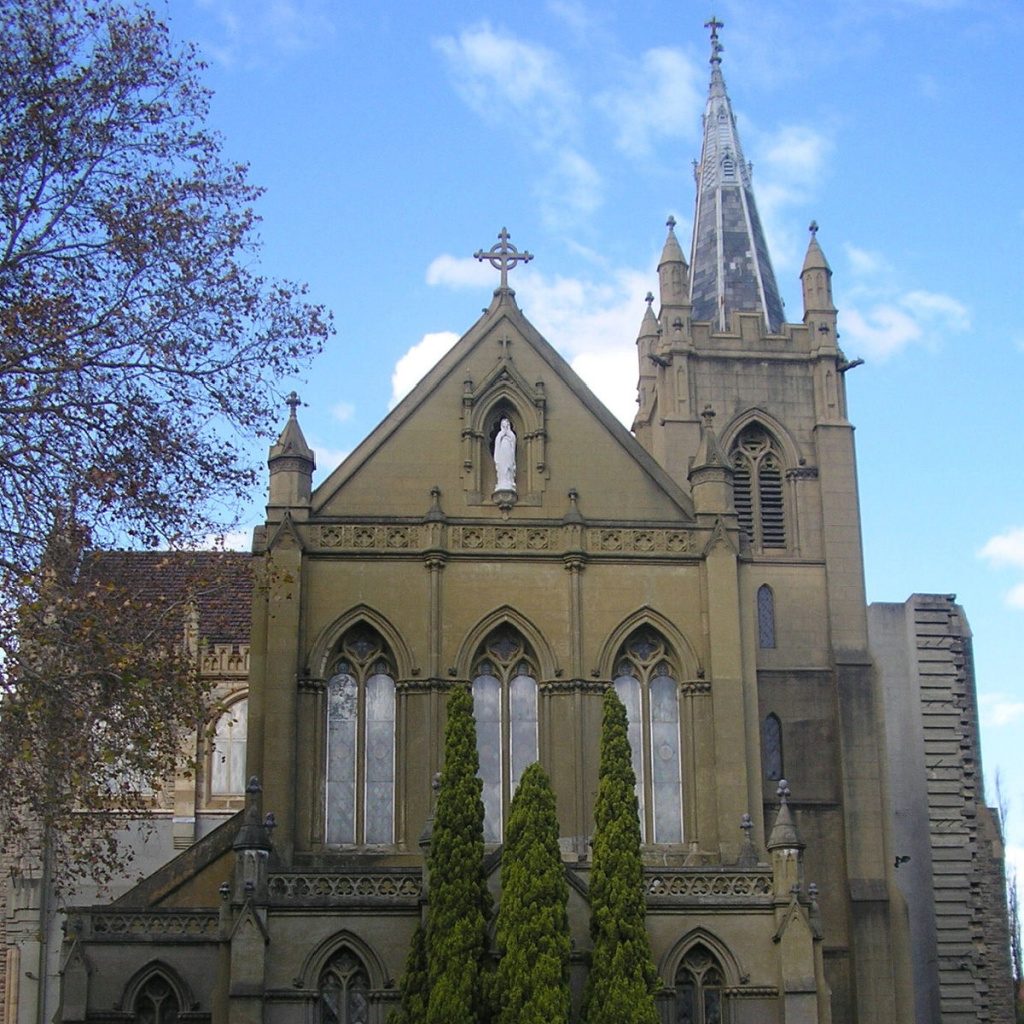
Summary – The episode opens with Detective Pyre leading a group of officers up the mountain to rescue Taba, who is completely fine and sitting on the ground outside one of the cabins. (The episode doesn’t explain how he got there after having a gun pointed at his face at the end of episode 2.) Pyre calls for more backup and finds a little girl wandering in the woods, lost and scared. The officers apprehend her and she tells Pyre about how things function up at the “fort” and about “Uncle Allen and Auntie Brenda” when her mother Sara arrives. Pyre questions Sara about Brenda’s experiences in the temple. The episode then depicts the beginning of an endowment session in a pretty good imitation of the garden room in the Salt Lake Temple. Brenda shares with her sisters-in-law her worries about making a covenant to “surrender” to her husband. One of the signs is shown as well as the penalty motion. Sara claims the end of the world is nigh, that her husband Sam’s job is to separate the wheat from the tares, and that Brenda was subject to the doctrine of blood atonement. A large squadron of police officers prepares to storm the Lafferty “fort,” when Pyre realizes that the situation resembles the Haun’s Mill Massacre and decides to instead approach unarmed. A wild-looking Sam and his family are taken into custody while one man escapes into the woods. Meanwhile, Pyre’s mother with dementia is recovered after she wandered out during the twin’s birthday party. We see a flashback to Father Lafferty confronting Dan about refusing to pay taxes and beating him with his belt. The next day, Dan receives a “revelation” that he is the rightful leader of the family. In the present, Pyre and his wife take the girls to their baptismal interview with their bishop, and Pyre stays behind to discuss his mother’s health with the bishop. He also brings up how his current case ties into difficult church history topics, which the bishop encourages him to “put on a shelf.” At home later, Pyre and his wife fight about whether to postpone the girls’ baptism until after the case is closed. At the police station, Sam Lafferty is ranting and raving. Pyre corners Allen about his criminal record due to unpaid parking tickets. He shares how his brothers pressured him into it, and as a result, he was arrested and missed Brenda’s graduation from BYU. Brenda’s anger about this led her to confront Dan about his beliefs (which involve a lot of strange reasoning about the constitution and separation of powers), and during the confrontation, Dan reveals his plan to run for sheriff and eventually pull down most government institutions from the inside. Allen ties this story to Brigham Young encouraging Joseph Smith to fight persecution, but Allen says he made a deal with Brenda that he would leave their influence if she gave up her career to start a family. Pyre and Tab interrogate Sam Lafferty, who claims to be the Lord’s destroying angel, murdering those who are on his “holy list.” Robin Lafferty, still in custody, overhears Sam’s rants and demands to know if Brenda and her daughter are okay. Pyre shows him pictures of their deaths and Robin breaks, revealing that the Lafferty’s are likely also planning an attack on their bishop and stake president, who tried to stop their apostasy. Flashback to Brenda finding out she is pregnant and deciding to try to help the Lafferty family back onto the path of the mainstream church. Church History – This episode has a violent depiction of the Haun’s Mill Massacre, which most members will readily recognize. Less well known is the obscure early church concept of blood atonement, which the Lafferty’s appear to believe is still in force and to be enacted by them. Allen also pins violence in the early church on Brigham Young’s influence on Joseph Smith, with Emma Smith being against it. This neatly parallels the Lafferty situation, but it’s a significant simplification of the complex web of influences and responses to constant violence against the early Saints. We also get a mention of Joseph Smith running for president, which from my understanding he mostly did to draw attention to the plight of the church rather than expecting to win and reform the government. The show also alludes to the alleged assassination attempt on Governor Boggs by Porter Rockwell. Shibboleths – Sara Lafferty asks Pyre if he “follows his covenants.” This phrasing is off: LDS members would say “keep your covenants” or “honor your covenants.” (A search for the phrase “follow the covenants” on the church website yields only one result.) In the temple, Robin’s wife remarks on the importance of “keeping our agency strong,” another formulation that makes no sense. To Latter-day Saints, agency means the God-given ability to choose. This isn’t something we can strengthen, but an inherent condition of mortality. During their fight, Sister Pyre worries that delaying the baptism will shame her in front of their “congregation.” Members would never use this word, especially in private. We exclusively refer to our congregation as a “ward.” Her concern about people wondering if her daughters “failed” their interview seems off as well. Finally, let’s talk about LDS family size. Several times in this episode we get references to “at least 10” or “dozens” of kids as though this is the typical size of an LDS family. But in actuality, in 1980, only 12% of Utahns had a family of 6 people or more, and only a fraction of that 12% would have 10+ children. The wards I have lived in have maybe one family that has more than 5 kids. It’s just not that typical. I Don’t Love to See the Temple – Alright, here we are at the biggest controversy of the series: the decision to portray sacred temple ordinances. The temple scene takes place from timestamp 14:00 to 17:00. Only three minutes long, yet