The January 6th Committee Hearings have brought up many memories and raised even more questions. I was there that day. And the event being portrayed was very different than the one I attended.
The year 2020 critically altered my awareness of the world around me. For much of my adult life, I preferred to avoid the news; I experienced it as all bad, disturbing, and disruptive to my belief in the goodness of humanity.
However, the events of 2020 up to and including the presidential election demanded my attention and shook me. Like other citizens, I tried to find non-partisan news in the destructively divisive climate, and consumed media from a wide variety of sources. I was proud when I purchased my ticket to be in Washington, D.C. on January 6th, for what was represented to me as a patriotic rally. I felt drawn to attend, engaged, responsible, and concerned for our country.
From the moment I landed, I met many others who expressed similar sentiments. Picture the crowd with me: dressed in casual everyday clothing, Gen-Y mingling with Boomers. Everyone I spoke with was energetic, God-fearing, and patriotic, with many races and cultures present. Being in this crowd felt like attending a hometown parade, where everyone is polite, lets you cut through to the front of the group, helps people up on shoulders and walls to see better, holds your place in line, and offers to take pictures for you—and sometimes with you. As I moved with the crowd down the streets and onto the trains, it was common to hear DC locals thank us for being there. One of them pulled her car over and stopped us at a crosswalk—expressing thanks to us for showing up. A woman on the train told us she worked for the current administration, and as grateful as she was, she was open about her disappointment that the presence of so many would not make a difference.
Speaking for myself, everyone I met was the kind of person who makes eye contact, shakes your hand, and makes an art of casual, friendly conversation. However, I did see people that didn’t look or feel that way. These individuals moved differently, they walked with purpose and focus—like when you have instructions to get somewhere quickly. They wore backpacks, boots, and masks. They stomped through the friendly crowds, never making eye contact or stopping to talk with anyone. At one point, we were walking along the street and witnessed two young 20-something-year-old men dressed in all black, coordinated backpacks and other gear that seemed out of place and tactical. They were pulling things from their backpacks and changing clothes topped off with red MAGA baseball caps. Although I didn’t witness any wrongdoing by them, they didn’t fit in with the bulk of others at the rally. Never once did I hear talk of rebellion. I didn’t see guns. I didn’t hear anger. I didn’t hear hate.
When we visited the BLM Boulevard our first night there, we witnessed a number of angry, anti-Trump protestors. Though unafraid to be with people who thought differently from me, it seemed wise to not overly engage. Although we were near the White House, we witnessed a police-escort emptying out two white, unmarked school-type buses filled with a crowd of the boot-wearing, tactical-looking men we had seen earlier. At this point, we didn’t understand why there’d be a need for this.
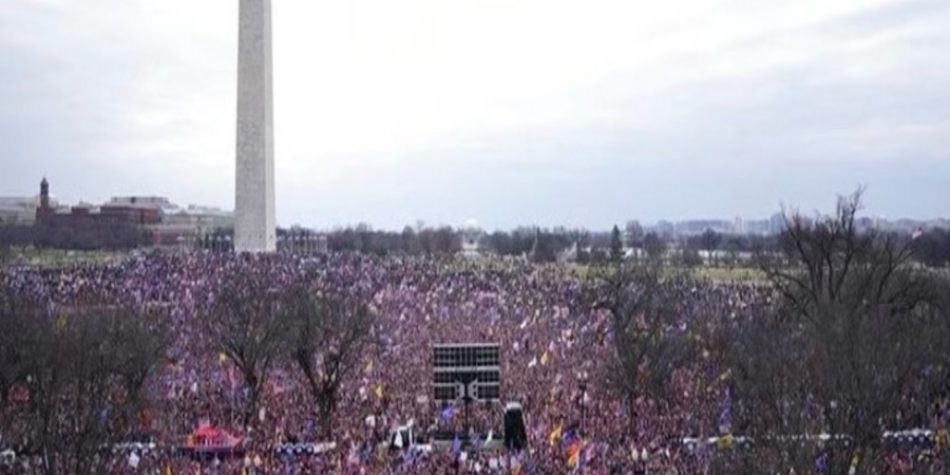
On the day of the rally, we arrived early, probably 4:30 a.m. Even as we arrived, in those early morning hours, there was a crowd like I have never seen at any concert or sporting event! The description of a “sea of people” doesn’t come close—the vastness was more like an ocean! Once we were inside the gates of the event, we found ourselves about 15 rows back from the stage and felt lucky to have landed seats right behind the reserved, seated “special guest” section. When it became light enough to really see the crowd behind us it blew my mind! The crowd was at least as wide as the block and went back well past the Washington Monument that was across the lawn and street from the rally. People were shoulder to shoulder the entire way back. This crowd had gathered out of a collective love for our nation and our freedoms. My eyes will never unsee it! My heart will never unfeel it! Since then, I have heard reports about the crowd being closer to 10,000-20,000. Yet we witnessed hundreds of thousands.
It was cold and we spent most of the day standing, walking, meeting, and talking to others. As we did, it was common to hear of struggles with phones—batteries draining, no signals to send photos or videos, and only occasionally getting a text or call coming through. Because of that people were being especially helpful to one another, the old-fashioned way before we all had phones, sharing information and updates. Because we were all still taking photos and videos (just couldn’t share them), many exchanged phone numbers so that later we could be in touch. Those many millions of friendly and celebratory photos and videos of the day’s happenings are certainly not what we see represented in media representations of January 6, even though in my experience, this kind of interaction was the majority of what took place.
Another common topic of discussion was how many were not necessarily there “for Trump.” Clearly, many were. But many others we talked to were there for reasons like ours; we felt concerned about the integrity of the election, had a desire to be part of something important, and were showing up to show we cared about our country. Never once did I hear talk of rebellion. I didn’t see guns. I didn’t hear anger. I didn’t hear hate. I saw people sitting on walls, swinging their feet, and singing patriotic and gospel songs.
I listened to many speeches that day from politicians and Trump’s family. Their words were truly inspiring, showing respect for the core principles of our great nation. They shared their desire to help America be its best. President Trump spoke for over an hour. Not once did I feel like he was encouraging any kind of misconduct. In fact, I remember him reminding us that if we were going to the Capitol, to do it “peacefully.” The speeches we heard from the rally stage are recorded and can be viewed by anyone seeking to know what was said in its entirety. It’s all there to appreciate in its full context rather than edited “sound bites;” and what I’m suggesting is the full picture tells a different story.
When the speeches were done, we started to make our way back to our hotel. We were anxious to warm up, rest, charge our phones and get some decent cell reception. As we began to hear more rumors of updates, we were all the more anxious to get back to the hotel at that point so we could hear the news updates for ourselves. We watched in horror as other photos and videos exploded across our screens.
We felt an urgency to go to the capital area and see for ourselves how things had changed so much. Worried calls and messages from family back home were confusing. We didn’t feel scared or in danger. Nobody was running in the opposite direction telling us to get to safety. Nothing and no one gave us any impression that we should clear out or not be there. To the contrary—the crowd was still singing.
It’s true that as I eventually left the Capitol, I heard loud bangs, looked back, and saw puffs of clouds near where I had just been standing. We later learned it was tear gas set off by Capitol police to clear people away. It was nearly 5 pm and the Washington, D.C. mayor had ordered a 6:00 curfew. The crowd then quickly thinned out and dispersed.
Even at the airport, as we were leaving, townspeople who attended the rally seemed to find each other. We would gather in a circle and share the things we had experienced. We shared stories and headed home. Not once did I feel like he was encouraging any kind of misconduct. In fact, I remember him reminding us that if we were going to the Capitol, to do it “peacefully.”
It’s true I’m among those with questions about the integrity of an election process that experienced consequential changes against the backdrop of a global pandemic. I’m also concerned (like so many) with a growing amount of chaos in our institutions. But the last thing I would want is to participate in something that threatens American democracy. That’s not why I was there. And it’s not why the people I spoke to were there.
We were standing with other Americans proud to be patriots. Like so many things, the “Save America” rally was multi-faceted and complicated. And there’s a good chance, you’re not hearing the story of how it looked to most of us who were there.