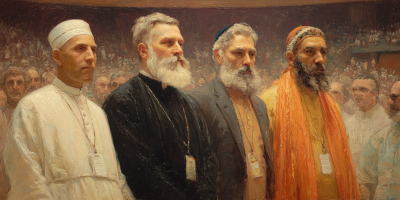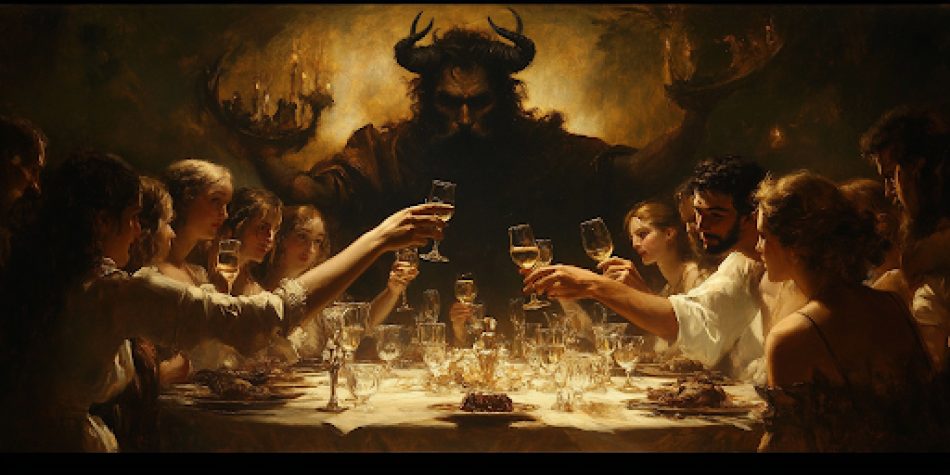
In a world marred with conflict, division, and war, can the ancient Greek god Dionysus help us find peace? Apparently, the organizers of the Opening Ceremonies of the 2024 Olympic Games thought so. Though most of the controversy surrounding the Opening Ceremonies has focused on whether the tableau of Dionysus and drag performers was a parody of Davinci’s The Last Supper, it’s worth pausing for a moment to engage the overt message that organizers were trying to share. Dionysus, god of wine and revelry, is presented as a symbol of community, tolerance, and non-violence. But this sanitized picture conveniently omits the darker elements of Dionysus, a jealous deity whose followers literally tear apart people who do not honor the god. Though it is tempting to think that we can party and deconstruct our way to social harmony, the Greeks knew that Dionysus’s unity came at a cost. As Nietzsche writes, Dionysus’s festive madness can lead to merriment or cruelty.
To be clear, there is no reason to believe that the organizers of this display “believe” in Dionysus as an actual deity with power. Rather, Dionysus is an archetype for festivals, revelry, and intoxication. Understood as an archetype, the myth of Dionysus can provide insights into important impulses or tendencies in human life. It can also help us see the truth more clearly. This sanitized picture conveniently omits the darker elements.
Community, tolerance, non-violence: to put it mildly, this is an idiosyncratic reading of Dionysus. To the organizers’ credit, it must be acknowledged that Dionysus offers a version of community. In a festival atmosphere, where music and alcohol lower inhibitions, there is a kind of blurring of boundaries and a jovial spirit that lubricates social connection. There can be no hierarchy—no social classes—at the Dionysian festival. As the wine flows freely and the drums beat ever louder, all the petty divisions that separate human beings fade away into insignificance. The contemporary fashion of wanting to “dismantle” or “deconstruct” social norms is right at home with the Dionysian spirit.
But there is a crucial difference between the Dionysus of the Olympics and the Dionysus of the Greeks. The Olympic version is advanced as a benign character—a silly blue man singing about how we should all go naked all of the time, not a threat to anyone or anything. It is a vision of comic transgressivity, harmless extravagance, and festive naughtiness that no one has any reason to fear or criticize. Indeed, an AP report of the opening ceremonies led with this line, written as a compliment: “Paris: the Olympic gold medalist of naughtiness.”
But the Greeks were not nearly so naïve about the character of Dionysus. They recognized that when social conventions are dismantled, there are vicious as well as merry impulses waiting to be let loose. Nietzsche notes that Dionysian festivals included an “extravagant lack of sexual discipline” and not just the fun kind of sex: “The most savage beasts of nature were unleashed . . . [including a] repellant nature of lust and cruelty.” Without common restraints on behavior, humans might imagine themselves to be gods, but they can also devolve into beasts.
It gets worse. What of those people who are unwilling to join the frenzied retinue of Dionysus? In Greek myths, they do not fare well. Euripides’ The Bacchae tells the story of King Pentheus of Thebes, who was not honoring Dionysus. By the end of the story, the followers of Dionysus (including Pentheus’ own mother, Agave) literally tear him to pieces while in a state of Dionysian frenzy. The same thing happened to the musician Orpheus—he did not honor Dionysus, and the female followers of Dionysus tore him apart when he would not have sex with them (this might go without saying, but Dionysus doesn’t seem to be too concerned with consent). This tearing apart of humans or animals is such an important theme in Dionysian myths that it has its own name: sparagmos. Humans might imagine themselves to be gods, but they can also devolve into beasts.
So when the official Olympics X account states that “Dionysus makes us aware of the absurdity of violence between human beings,” the statement can only come across as ironic. Dionysus is no pacifist, and his followers are not harmless. Further, like all gods, Dionysus is a jealous god. He demands recognition and honor, and those who will not give him his due face his wrath. The idea that Dionysus’s party is a harmless display of community, tolerance, and non-violence is not even a myth—it is a fairytale.