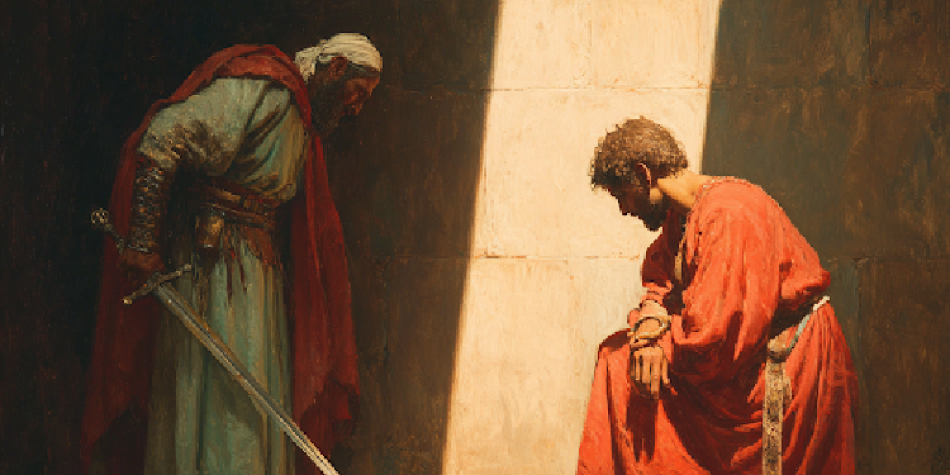

The policy paradox can be summarized this way: what is right for the one may not be right for the many, and what is right for the many often is not right for the one. Parents face it at the dinner table, leaders face it in government and the Church, and we all face it when our personal convictions seem to clash with collective expectations.
Human nature compels us to force a resolution of paradox with human hands (Daniel 2:45), but this often leads to misdirected frustration. However, with a new perspective we can receive a ‘greater portion of the word,’ as Alma taught, coming to ‘know the mysteries of God’ more fully (Alma 12:9–11). We will gain spiritual contentment and peace, despite worldly dissonance trying to force resolution masked as justice.
Let’s explore why the one-many tension persists, how to approach it through a faithful perspective, analyze a specific case study, and conclude with practices for peacemakers.
Why the One-Many Tension Persists
Some tend to favor what is right for the one, while others have a natural preference to prioritize what is right for the many. This tension will continue to persist amid our surrounding global and personal challenges. The following illustration shows this tug and pull with a question mark in the middle. Tension will continue to persist amid our surrounding global and personal challenges.

Understanding why this tension persists helps us see that it is not a problem to solve, but a condition to understand. The next step, then, is to explore how faith helps us hold that tension without losing peace.
A Faithful Way to Hold Policy Tension
The policy paradox can be understood through intellectual, emotional, and experiential approaches. We use both mind and heart to seek knowledge, righteous judgment, and wisdom. In the visual below, notice how our individual approach to understanding develops into a more experiential level when we are surrounded by family and a covenant community.
Experiential understanding helps open our minds to behold the face of God and connect with our sisters and brothers who were “prepared to come forth in the due time of the Lord to labor in his vineyard” (D&C 67:10; 138:56). Through meekness and peace, we resist the impulse to resolve tension without an eternal perspective.
As we enter the presence of the Savior, full of charity, we recognize how it is possible for the “many and the one” to receive light and patience. Which lens or lenses of knowledge do we bring to the policy-making table as we analyze decisions from Church leaders, past, present, and future (John 7:24)? How can an individual with unique needs and desires that seem to conflict with the needs and desires of the broader community gain peace as the controversy within the paradox seems never to end? As we enter the presence of the Savior, full of charity, we recognize how it is possible for the “many and the one” to receive light and patience.

As we truly behold the Savior and His trust in us, we can navigate global variables with a refined calibration of perspective through the still small voice of the Holy Ghost. The policy paradox through calibration of justice and mercy has been beautifully described by BYU law professor Shima Baughman. Shima gives examples of sentencing from criminal court judges who change their approach when considering individual cases compared to judges who approach sentencing through the lens of viewing the masses. When I listened to her powerful witness, her words brought to my mind Ammon’s approach to Lamoni’s father, imbued with charity and eternal perspective, seeking to individually calibrate justice and mercy for the “one”, while simultaneously considering the needs of the “many” (Alma 20). Shima clearly describes a vision of justice and mercy that is virtuous, praiseworthy, and of good report.
Further, we could debate the motives of Alma the Elder and Mosiah in their inspired non-linear “policy” journey in seeking to establish eternal principles of justice and mercy in Mosiah 26. Alma was troubled and went to Mosiah to apply the policy, but Mosiah “said unto Alma: Behold, I judge them not; therefore I deliver them into your hands to be judged.” Alma again had to go back to pouring out his whole soul to God to understand what was right for the one and what was right for the many, putting Alma in an “impossible” situation. And yet, with God, all things are possible (Matthew 19:26).
This soul-driven reality is the essence of the policy paradox folks often can not see until they personally experience and willingly participate and refract light, patience, and capital “T”ruth through a crystal prism of pure intelligence, a piercing angle of humility. Humility brings peace, which is a vital prevention as we sometimes calibrate the definition of law, doctrine, policy, or principle incorrectly, and at times continue to be distracted from a higher and holier understanding. For example, in Alma 1, notice how the term “law” is defined. It seems to be understood differently at different times according to the “many,” established laws acknowledged by the people, as well as the “one,” where Gideon had to deal with Nehor’s false interpretation of the policy paradox.
Oftentimes, the many can overwhelm the needs of the “one,” and sometimes the needs of the one can misdirect the needs of the “many,” thus the paradox of policy. Parents try to respect a child’s needs while balancing the needs of the entire family. The burden of leadership is on the parent (Numbers 11:17; Isaiah 48:17; Abraham 1:18). I believe being a parent is an experiential education in the policy paradox, where children may be too easily distracted from principles as they narrowly focus on the “policy” decisions through an incessant lens of assumed unfairness from a parent. This aligns with Elder Kim B. Clark’s teachings on the purpose of deep learning: to experience joy, and, I would add, gratitude by faith. The longer I am a parent, the more I gain a deeper intellectual, emotional, and experiential understanding, peace, and gratitude, ameliorating past perceived unfairness from my parents when I was a young adolescent.
The Case Study 2015-2019 and the D.E.E.P. Path
As an example, let’s analyze the policy from November 2015 specific to baptism for children of same-sex couples. What was right for the many? What was right for the one? Later, in April 2019, how did the policy change—and what remained the same? This leads us to recognize the journey of what I call D.E.E.P. learning within the policy paradox for individuals, one by one.
D–Discouragement (disorientation, depression, doubt, despair)
E–Engagement (wrestling, acting, pondering, proving)
E–Enablement (hope, faith)
P–Power (joy, gratitude by faith and by experience)
When the policy was announced and broadly disseminated in 2015, my circle of loved ones struggled deeply. I felt their pain. Although I couldn’t fully understand everything they were experiencing, I felt peace that the Savior knew and understood the timing and the D.E.E.P. learning journey of each person from each orbit, one by one, directly or indirectly affected by the policy. Humility brings peace, which is a vital prevention as we sometimes calibrate the definition of law, doctrine, policy, or principle incorrectly.
Obviously, President Nelson had taught about becoming peacemakers for several decades before this message. Time is only measured unto man (Alma 40:8). For me, it was a quiet reminder that the Lord guides His Church through His servants and each of His children—line upon line, precept upon precept, perspective upon perspective.
For some, this “fresh view” of eternal principles (what stays the same), policies (dynamic), practices (endless refractions of interpretations), and paradox may be seen as giving an excuse. Yet, as I’ve tried to listen to all sides of “middle of the road” to extreme perspectives towards the “reversal” of this policy, I keep feeling peace, light, and even greater charity towards those who drafted, reviewed, and wrote the policy originally, those who performed the research to understand patterns of exceptions by the First Presidency between 2015 and 2019, those who drafted, reviewed, and wrote the updated policy, and those who felt their hearts break during 2015 and 2019 with a “fresh sting,” mixed with love for their brothers and sisters directly affected by the policy.
This has been a D.E.E.P. learning experience for me that has carried me into intellectual, emotional, and experiential highs and lows. I felt the sting of discouragement and disorientation in 2015. Like in the movie Inside Out, where joy and sadness coexist, I engaged and wrestled with the policy, prayed and pondered deeply over several years, trying to keep an open heart to those hurting and the constant companionship of the Spirit of the Lord. I felt enabled by the Lord to rise to higher mountains of perspective that I couldn’t have received without His power and peace.
The original bright-line rules offered clarity, but all rules are inherently both overinclusive and underinclusive. The Savior, as Lawgiver, gives grace and power within and between the continuum of over- and under-inclusiveness.
In each policy decision, we are offered refractions of perspectives that can keep us humble and “equal evidence” for and against our preferred policy approaches, while we are “perched precariously between sets of demands held in dynamic tension.” Humility and meekness toward the paradox of policy provides a “ridiculously inefficient” approach to divinity, but it is nonetheless effective and imbued with eternal strength.
This case study shows how policies can be both inspired and imperfect, painful and refining. So how do we, as disciples, live within such paradoxes day to day?
Practices for Peacemakers
Where will you go next? For your personal intellectual, emotional, spiritual, and experiential education, you can start by analyzing the journals of those who went before us, both our ancestors and those from ancient scripture. The policy paradox influences us to seek those transformed perspectives, to see how something that feels wrong for the individual might serve the larger community, or how something that blesses the community might need adjustment for the one. Thank heavens the paradox is not resolved by human hands and human minds, for it would frustrate our learning journey to become more like our Heavenly Parents. In my personal orbit, I have learned an effective way to learn the policy paradox experientially is by becoming a parent, to gain a fresh view of how our Heavenly Parents navigate this tension with each of us. Although I couldn’t fully understand everything they were experiencing, I felt peace that the Savior knew and understood.
The paradox is not an obstacle to faith—it’s a training ground for intellectual, emotional, spiritual, and experiential discipleship. When we accept and learn from tension, we begin to see the Lord’s hand not just in the outcome of policies but also in the process of wrestling over them.
And so my invitation is simple: be humble. List the ancient, modern, and personal policies that shape your life. Then, prayerfully, apply the paradox lens. Seek to understand your neighbor and your neighborhood and how the Lord continues to guide both. The process will not always be quick. But if you walk it with the Savior, the past, present, and future will become one in peace (John 14:27). The paradox will move from an idea in your mind to a truth in your soul. And in that transformation, you will see not only the one and the many, you will see Him.