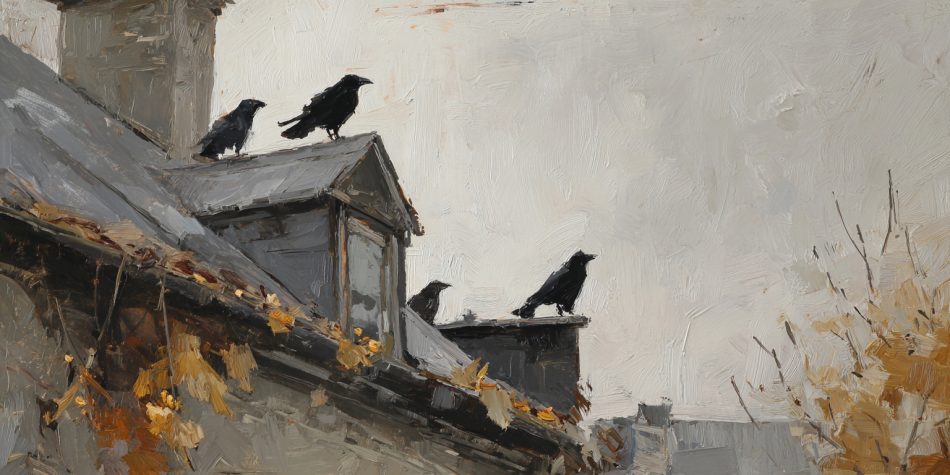
A roofline under gray skies with several crows perched along the ridge, one crow pecking near a skylight, a gutter visibly clogged with wet leaves and peanut shells, early morning light. Peacemaking grows harder when daily irritations pile up like debris.

The Continuous, Habitual Struggle for Peace

How can conflict be redeemed? The answer is slow, practiced love that resists pride and chooses reconciliation.

Download Print-Friendly Version

“Change does not roll in on the wheels of inevitability, but comes through continuous struggle.” —Martin Luther King Jr.

Sometimes the week’s sermons foreshadow a struggle that will soon knock at your door.

My wife, Missy, and I learned this recently in a peacemaking crisis with a neighbor, which came less than 24 hours after we heard two sermons on peacemaking. I’ll call our neighbor Alice (not her real name). She’s a short, stocky, 50-something woman who walks with a waddle. She loves animals. Between November and March, Alice feeds the crows pounds of peanuts. The result is a noisy murder of birds and a roof and yard (ours) littered with shells that clog our gutters.

This was quickly turning into a Shakespearean tragedy.

This past spring, as Missy cleaned leaves and peanut shells from our curb, she encountered Alice. It was a beautiful sunny day after another grueling winter. At one point, the conversation turned to what Missy was doing. My wife kindly and calmly asked Alice if she would consider feeding the crows something else because of the mess from the peanut shells. No promise was made, and life went on.

Then, about six months later, on the Monday morning before Thanksgiving, Alice knocked on our door as we were busy preparing to leave for the airport.

“Did you put this on my door?” she asked. 

She showed us a piece of light blue paper with these words: “PLEASE STOP FEEDING PEANUTS TO THE CROWS!!!!!”

“No,” I responded.

“Did someone else in your house put it out? I know you don’t like the peanuts,” Alice said, her face and voice making clear she was not convinced by my denial.

“No, we didn’t put that sign out,” Missy said.

“Are you lying to me?” Alice asked.

“No,” I said.

I was terse because there was no time to talk. Like those birds, we had to catch a flight.

And with that, Alice shrugged her shoulders in frustration, turned around, and stomped down our steps. In her mind, we were guilty.

The next Monday morning, we were back home. A crow was on our skylight, pecking away at something. I worried the bird might chip the window. As I often do, I opened our front door to raise my hands and shew away the murder congregating on the street.

Alice saw this through her window and was steamed. She stormed over, knocked on the door, and asked to speak with me.

“I was on the phone with my daughter just a minute ago when I saw you open your door and wave the crows away,” Alice said, her voice on edge and full of spite. “I know it was you who put the sign on my door. You are sign people. You have a no soliciting sign and that other one asking people to not leave dog poop on their lawn. Why can’t we just talk about this and not behave like we’re in middle school? What is your problem with the crows?”

This was quickly turning into a Shakespearean tragedy, with Alice misinterpreting our every word and move.

I explained calmly that the crows’ pecking wakes us up and clogs our gutters. I could have added that their repeated noises bothers one of our daughters, who has sensory issues. And there’s also the potential for their pecking to ruin our roof.

The peacemaking process can be chaotic.

Alice then accused Missy of yelling at her last spring when she asked her to consider feeding the crows something else. This is where things went off the rails. Missy never yells at anything. The accusation blindsided both of us. From there, voices grew louder, Missy was in tears, and a primal instinct drove me to tell Alice she needed to leave. I grabbed her by the arm and led her out the door. I pushed her past the threshold because she would not go willingly.

As I closed the door, she lobbed one last verbal grenade.

“The crows are the nicest neighbors I have,” Alice said. “You are so mean!”

I immediately wondered—was I too forceful, too rash? The exchange rocked us and turned the day to ash.

The next afternoon, we composed a note of apology for misunderstanding her and regret for the scene that marred our Monday. Missy left it on Alice’s porch with a loaf of pumpkin chocolate chip bread.

Alice responded a week later with a brief note, sent via snail mail. She thanked us for the bread but did not apologize. Her words felt like a backhanded way of saying we are to blame.

With the wound still fresh and our minds in disbelief at her callousness, we tossed her note in our recycle bin. We wanted to be right. We wanted her to see the logic of our clogged gutters and our daughter’s sensory needs. But the ensuing silence was heavy. The poison of strife was setting in, that physical tightening of the chest that happens when a neighbor becomes an adversary.

It was here that the sermons from that Sunday began to sink in. The peacemaking process can be chaotic and confusing. As the Rev. Dr. Martin Luther King famously noted, “Change does not roll in on the wheels of inevitability, but comes through continuous struggle.”

Love and forgiveness are the only way forward. Thus our quick offering of peace. This Dr. King also knew. “Darkness cannot drive out darkness: only light can do that,” he said. “Hate cannot drive out hate: only love can do that.”

Alas, progress toward peace feels less like a victory march and more like the slow process of clearing a blocked gutter—one handful of debris at a time. But we will try. And we will keep trying.

We want to be peacemakers. But peacemaking is a long dance, a communal project that must be engaged in by both sides. Whether it is building muscle, better habits, stronger relationships, or a neighborhood and society where we simply respect and love each other, nothing comes to pass without Dr. King’s idea of “continuous struggle.”

We are commanded to love her.

Moses knew this. The Hebrew prophet had a classic mountaintop experience where God spoke to him from a high place and showed him a vision of all of this world and its inhabitants. Then God’s presence withdrew and Moses was “left unto himself” and he fell to the earth, learning a lesson he’d never forget about his own limited abilities and God’s infinite powers.

In Moses’ reflection of the wonder of his theophany, we find a powerful phrase: “I beheld [God’s] face.”

Though this painful experience with Alice remains unresolved, it was an opportunity to behold her face up close—not merely as the “crow lady” or a source of drama, but as someone created in the image of God. We are commanded to love her who, at the moment, feels like an enemy. As the musical Les Miserables concludes, “To love another person is to see the face of God.”

The continuous struggle to find that divine face in the neighbor is the path toward the light of God. It is not paved with grand gestures or born of sudden, mountain top epiphanies, but is carved out of daily rhythms of relation where we smile at others, say hello, step into shared spaces, and listen. The struggle isn’t heroic—it’s habitual.


 

About the author

Samuel B. Hislop

Samuel B. Hislop is a writer in Utah.
On Key

You Might Also Like

A Day to Remember

“Never was so much owed by so many to so few.” That sentiment by Winston Churchill has been deeply felt by many over the years. Do we feel it anymore today?

Episode 7, “Blood Atonement”

Summary – Pyre joins Taba in talking with Prophet Onias about how Ron’s belief that he is the “One Mighty and Strong” tempted him into immoral behavior. In a flashback, Ron interrogates Matilda about the warning she gave Brenda and gets information about who helped Diana disappear. He comes up with the removal revelation, which Onias immediately rejects, but Dan pushes back, saying his doubts are just what an unbeliever would say. Ron brings out a blade he’s “consecrated” for the purpose. In the present, Pyre finds out that Ron has Diana’s address in Florida because their son sent a letter with a return address. Pyre struggles in his office to write out a testimony, presumably to give in church to fulfill his wife’s requirement or he quips to Taba he’ll “be single by fall.” Pyre is talking to Allen again when an unidentified church leader is brought in by Taba (I’m still not sure if it’s the stake president or a seventy). The church leader again pressures Pyre to wrap the case up, saying the church doesn’t need more bad press after the 1978 revelation and the “communists at the NAACP.” He then regales with Taba about how his “Lamanite” ancestors helped the Saints in the Mountain Meadows Massacre. Allen and Taba both dispute this interpretation, and the church leader leaves after brushing the dust off of his shoes against them. The detectives call the Florida police to do a welfare check on Brenda. They break into her home and find no one there, but security footage from a local store shows Diana and her kids at the grocery store four days ago. She looks behind her and is frightened by something, causing her to leave the groceries on the counter and quickly exit the store with her family.  At the police station, Jacob Lafferty, the mentally handicapped brother, wanders in and briefly causes a tense situation before turning over Dan’s journal to the police. Turns out he was the one who bolted from the cabin in episode 3. He was under orders to protect “God’s word” but heard the press conference and wants to help solve Brenda’s murder because he had a crush on her.  Pyre reads the journal, which reads like scripture, and finds out that Dan and Ron were holed up in Las Vegas earning money by gambling when they received the “revelation” that it was time to start the killing. Somehow (it’s not clear how) he knows that at that point Diana called Brenda to warn her and also called the prophet, which Pyre calls “bold as it gets for a woman.” He wants to fly out to Florida immediately to look for Diana. While he’s packing for the trip, Becca Pyre walks in. She’s disappointed he’ll be skipping out on Sunday’s testimony meeting. We find out that she’s the one who called the church leader on him. Pyre again orders her not to interfere with his investigation, pulling rank as the priesthood holder again. He claims that early church leaders saw “little girls and women as eternal servants” and that he’s afraid of what will happen to his daughters in the church. Ron’s car is located in Cheyenne and so the detectives are rerouted to there to investigate. They find the two strangers, Ricky and Chip, identified by Ma Lafferty in a previous episode. Ricky and Chip claim Dan and Ron are in Reno trying to make more money so they can finish their list, and that they stole the car to get away because they were disturbed by the murders. In flashback, we see Ron and Dan preparing for the murders at the Lafferty house, leaving Sam and Jacob behind. They stop by Robin’s home to ask for his rifle but he doesn’t have it. Ron leans in and kisses Robin on the mouth and then leaves. Now we come to the actual murder. Ron knocks on Brenda’s door, but no one answers, so they drive away. Brenda comes in from the backyard, calls Allen worried that there’s someone at the door, but no one is there. She goes out to check the mail and finds a letter from Diana which she writes a reply to. Back in the car, Dan stops in the middle of an intersection and attempts to wrest religious control back from Ron, saying that this was just a test of their faith and they should go back and try again. This time, Dan knocks on the door. Brenda answers and immediately tries to shut the door. She is overpowered by Dan who knocks her to the ground. She tries to convince Ron that this isn’t who he is and quotes scripture to them about being cast to outer darkness and testifies that she knows God will make her whole again. Ron cuts the cord from the vacuum cleaner that will be used to strangle Brenda before the camera cuts away to Dan and Ron leaving the house covered in blood. They drive to the Lows, find them not home, and miss the turn to the stake president’s home. Dan interprets this as a sign that they should stop killing and regroup, focusing on Diana so that he can keep Ron involved. Pyre and Taba are searching on the side of the highway where Ricky and Chip have told them the Laffertys discarded the weapon. Pyre worries that the men lied because they are atheists, but Taba asserts that it’s Mormons who have an allergy to facts. He shares the version of the Mountain Meadows Massacre that he was taught as a child, and eventually they find the murder weapon on the side of the road. The detectives return to Reno to search for the brothers, with Pyre trying to get details without a warrant by reminding the casino owner that “if there’s one thing our people have in common, it’s that we hate the feds crawling around our home.” They hear back from the Florida agents who

Strengths In Diverse American Families of Faith

Introducing and launching a new series of articles based on the American Families of Faith project involving scholars at BYU and beyond. The project aims to deepen understanding of diverse religious families across the United States.

Subscribe To Our Weekly Newsletter

Stay up to date on the intersection of faith in the public square.

You have Successfully Subscribed!