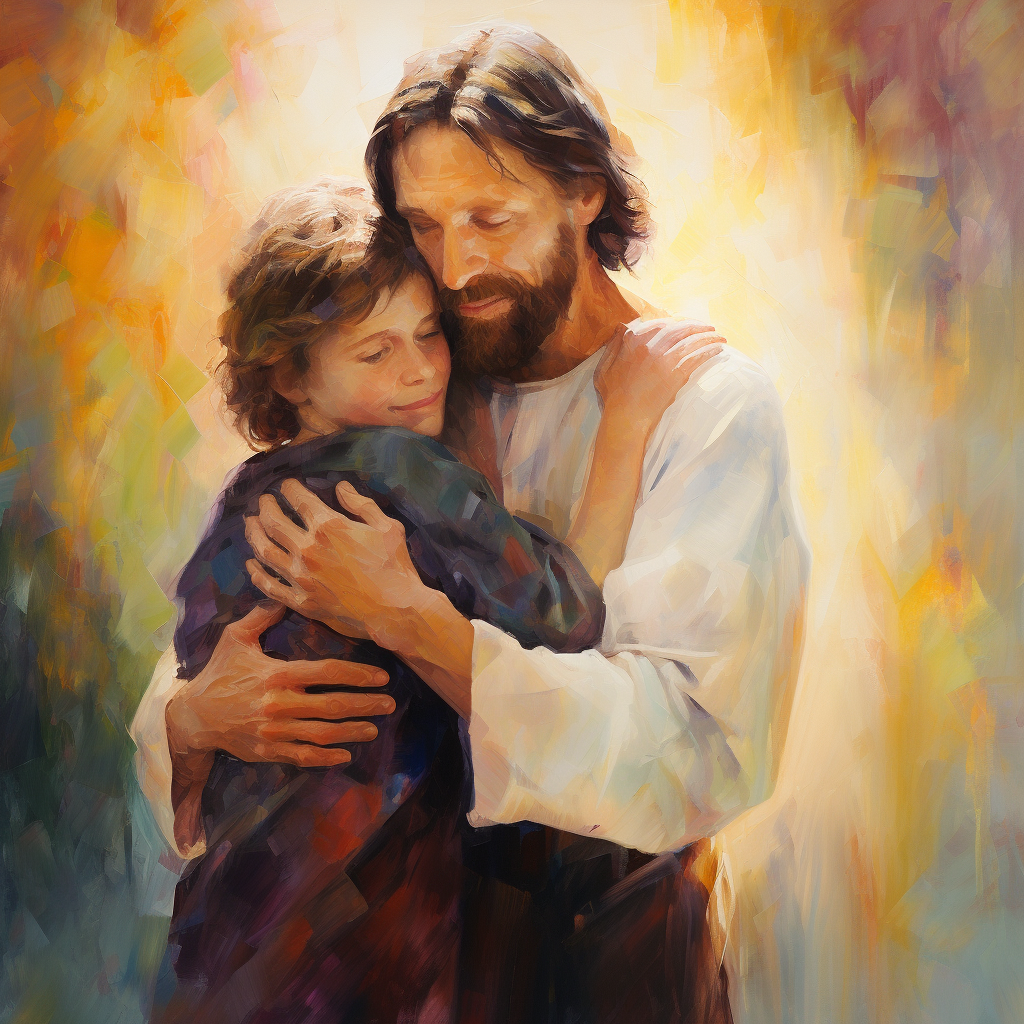
A self-care scene showing a figure weighed down by overthinking with subtle, swirling details.

Faith and the Overburdened Self: The Paradox of Self-Care

Does reliance on self-help deepen guilt? Findings reveal that faith redirects trust from the self to the Divine.

Download Print-Friendly Version

As a psychologist and psychotherapist who specializes in the relationship between psychology and faith, I regularly work with religious people who struggle with feelings of unworthiness and guilt. Some of them have developed symptoms of OCD/Scrupulosity because their thoughts and feelings convince them––despite what Christ taught––that they are not forgiven for their sins even when they have repented. Sometimes, they find themselves compelled to call their priesthood leader every morning to confess all their sins, just as they did the day before, to calm their mind and get a brief respite from debilitating obsessive thoughts and feelings of guilt.

With ancient religious roots, self-compassion has become too secularized and psychologized.

Obsessive thoughts and feelings of unworthiness reflect complex psycho-spiritual dynamics needing culturally sensitive and competent treatment. Unfortunately, few psychotherapists have received education or training for treating clients’ spiritual and religious issues (Vieten et al., 2016). I have dedicated my 30-year career to rectifying this concern by publishing research for professional and lay audiences, teaching and training students in the relationship of psychology and faith, and personally practicing an approach to psychology and psychotherapy that appreciates and effectively treats the unique challenges people face at the intersection of psychology and theistic faith.

Because I uniquely position myself to help people of faith with psycho-spiritual issues, church leaders regularly ask me to speak to their members about related topics. Recently, I have been asked to speak more often about self-compassion. Like other concepts with ancient religious roots, this topic has become too secularized and psychologized of late. Compassion  has been mostly or altogether separated from its original purpose and meaning—‘to suffer with another.’  Now ironically made into a property of the self, each of us needs to develop and practice self-compassion in order to be healthy and well.

Too Much Self!

This shift from the religious and the relational to the secular and the individual is commonplace in psychology. It is not an exaggeration to say psychology has a fixation on locating properties and qualities within the self and then placing responsibility for the care of those properties onto the self. Here are just a few examples:

  • Be more self-reliant and strive to become increasingly self-sufficient, recognizing each person is ultimately responsible for themself.
  • In pursuit of self-mastery practice self-control over thoughts, self-regulation over feelings, and self-discipline over actions.
  • Develop a strong and positive self-concept and high self-esteem. Minimize negative self-talk and maximize positive self-affirmations.
  • Be true to yourself, live in a manner that is self-authentic and self-congruent, and beware of becoming the social self––which is the self others want you to be.
  • Above all else, love yourself, which entails things like forgiving yourself and practicing self-compassion and self-care.

Why does psychology demand so much of the self both professionally and in its wildly popular “self-help” arm?

Why the Self?

Almost 400 years ago, a French soldier, mathematician, scientist, and philosopher by the name of Rene Descartes endeavored to find certainty––which had long been the holy grail of philosophical inquiry. His 1637 publication Discourse on Method describes his application of a systematic form of skepticism through which he doubted everything possible. Descartes doubted the existence of God, the physical world, the existence of other people, and even our own bodies until he arrived at that which could not be doubted: doubt itself. To doubt is to engage in doubting. So, doubting anything––including doubt––requires doubt and the doubter. Doubting, he concluded, is a form of thinking done by a thinker. So, the thinking self is the one thing that cannot be doubted and, therefore, must be certain. This is the origin of perhaps the most influential philosophical assertion of the Western world, “I think, therefore I am,” or “When I am thinking, then I exist.”

Rene Descartes

The Burden of the Thinking Self

This makes the often frustrating “chatter” in our heads (Kross, 2021) necessary to the survival and maintenance of the self. But survival requires more than continuous thought, it requires correct thinking. Wrong thinking may not threaten being, but it wobbles the certainty of its foundation. One could live getting things wrong, but not securely or safely. So, we think very hard to get things right. From a Cartesian worldview, thinking has to be constant and correct.

The burden of self-contained thinking leaves little bandwidth available for caring about other things, including other people.

The self also has to rely on its own thinking, not the thinking of others, because the thinking self is its only sure foundation. Because of this, the consequences of the effort and energy required for thought are simply massive. In his sculpture titled The Weight of Thought, Thomas Leroy artistically captures this giant cognitive load causing people’s heads to become so disproportionately massive relative to their bodies that they literally tip over!

The Weight of Thought by Thomas Leroy

The burden of self-contained thinking leaves little bandwidth available for caring about other things, including other people. Research bears this out, showing our thoughts, conversations, and posts are self-centered most of the time (Ward, 2013). Social isolation and loneliness have become a significant public health epidemic in many countries (Surkalim and others, 2022). Psychology and psychotherapy contribute to this problem when only offering people self-solutions, which leave the self increasingly isolated (Cushman, 1990). But when the thinking self alone is the trusted source of certainty, what else can be done? 

Faith in Self or Faith in Christ?

For Christians, the philosophy of being doesn’t begin or end with Descartes and his doubt. Sixteen hundred years earlier, Jesus Christ told his followers to trust in Him––not in themselves––saying, “If any man will come after me, let him deny himself” (Matthew 16:24). His words echo the proverb “Trust in the Lord with all thine heart; and lean not unto thine own understanding” (Proverbs 3:5). Nephi––whose thoughts condemned him as a “wretched man” (2 Nephi 4:17)––would not put his trust in his thoughts and feelings, instead crying out, “O Lord, I have trusted in thee, and I will trust in thee forever. I will not put my trust in the arm of the flesh” (v. 34).

Trusting in Christ over personal thoughts and feelings … requires faith …  no matter what one thinks and feels about themself.

Nephi exemplified a faithful disciple in his answer to the question facing all followers of Jesus: In whom do we place our trust, in the thinking self or in the Lord? Any self-proclaimed Christian wants to answer ‘the Lord,’ but in truth, this is not always the case. Sometimes, by prioritizing our own thoughts and feelings, we put our trust in “the arm of the flesh.”

Faith over Feelings

Consider again the psycho-spiritual issue of feeling guilty and unworthy. When breaking a commandment or neglecting the things one should do, a feeling of guilt is common. If the guilt works in a manner consistent with God’s will, then it will lead to repentance and the forgiveness God promises. The guilt should then end, having served its purpose. But often, for many people––and not just those with OCD and Scrupulosity––the guilt remains, and the forgiveness is questioned. Was the repentance sincere and sufficient? Was the sin really forsaken? Were full reparations made? Shouldn’t I feel better? Why do I still feel bad? Maybe I don’t deserve forgiveness. Maybe I can’t be worthy again. Into our heads we go.

Trusting in Christ over personal thoughts and feelings … requires faith …  no matter what one thinks and feels about themself.

People racked by thoughts and feelings of guilt after repenting trust more in their self-contained thoughts than the Savior. He has stated He will forgive sinners readily every time they repent (Mosiah 26:30), that He will remember their sins no more (Hebrews 8:12)––something only God can do, and that even if their sins are as scarlet, with repentance, they will be white as snow (Isaiah 1:18). Trusting in Christ over personal thoughts and feelings means to accept his forgiveness even when one doesn’t feel forgiven. It requires faith to trust in Him, His words, and His atonement, no matter what one thinks and feels about oneself. Nephi did that, as did Paul (Romans 12:3), a lowly prostitute (Luke 7: 36-50), and a woman caught in adultery (John 8: 3-11).

Choose His Thoughts Over Your Thoughts

This is not easy. It is actually scary. It is hard to give up something that feels familiar and essential to existence for something promised by someone other than the self, even God. It requires the leap of faith captured so beautifully by Minnie Haskins (1908):

And I said to the man who stood at the gate of the year,

“Give me a light that I may tread safely into the unknown.”

And he replied:

“Go out into the darkness and put your hand into the hand of God. 

That shall be to you better than light and safer than a known way.”

Putting faith in Christ over ever-present thoughts and feelings is a very real and conscious choice that has to be made and remade on a regular basis. Thankfully, we have access to His thoughts––which are not our thoughts––as scripture stated by Him directly or revealed through His prophets. He has spoken to those who wrestle with their own thinking and feelings, with anxieties and fears, people who are “careful and troubled about many things” (Luke 10:41). He shows that we can be careful and troubled and still trust in His words. To accept His forgiveness, peace, and comfort, we can’t make our thoughts and feelings the arbiter of our status with the Lord, and we cannot employ self-compassion. Instead, we must yield to His compassion and what He has said over and over again that 

“My sheep hear my voice, and I know them, and they follow me: And I give unto them eternal life; and they shall never perish; neither shall any man [not even oneself] pluck them out of my hand” (John 10:27-29).

References:

Cushman P. (1990). Why the self is empty. Toward a historically situated psychology. American Psychologist, 45, 599-611. doi: 10.1037//0003-066x.45.5.599. PMID: 2190505.

Haskins, M. L. (1908). God knows. In https://www.stgeorges-windsor.org/the-gate-of-the-year/

Kross, E. (2021). Chatter: The voice in our head, why it matters, and how to harness it. Crown: New York.

Surkalim, D. L., Luo, M., Eres, R., Gebel, K., van Buskirk, J., Bauman, A., & Ding, D. (2022). The prevalence of loneliness across 113 countries: systematic review and meta-analysis. BMJ (Clinical research ed.), 376, e067068. https://doi.org/10.1136/bmj-2021-067068

Vieten, C., Scammell, S., Pierce, A., Pilato, R., Ammondson, I., Pargament, K. I., & Lukoff, D. (2016). Competencies for psychologists in the domains of religion and spirituality. Spirituality in Clinical Practice, 3(2), 92–114.

Ward, A. F. (July 16, 2013). The Neuroscience of everybody’s favorite topic: Why do people spend so much time talking about themselves? Scientific American.


About the author

Jeffrey Reber

Jeffrey S. Reber, Ph.D., LPC, is a professor of psychology at the University of West Georgia, a fellow of the American Psychological Association, a licensed professional counselor, and the founder of Relational Counseling and Consulting Services. He is a leader in the fields of relational psychology and theistic psychology, which treats our relationship with God as fundamental to our being, our relationships with others, and our morality. Dr. Reber is the author of Are We Special? The Truth and the Lie about God’s Chosen People (Deseret Book) and The Paradox of Perfection: How Embracing our Imperfection Perfects Us (Crosslink), as well as more than 40 articles and book chapters that are informed by his uniquely theistic relational perspective.
On Key

You Might Also Like

“Deep” Norwegian Film About Nothing in the End

How does a community and the families within it respond to a nearly unspeakable accusation? How do you treat everyone with dignity? How do you suss out the truth? Do you need to? “Armand,” the Norwegian submission for The Academy Award’s best international feature film, sets out as though it is interested in answering those questions. The film opens with a young teacher, a principal, and a school staff member wondering what they are going to do. Armand has done something again. The parents are called in. The film’s premise is that Armand was accused of hitting Jon in the bathroom when Jon said he didn’t want to play with Armand. There are many additional revelations about the context, the relationship between Armand and Jon’s families, and the history of Armand’s family. There are accusations upon accusations that both indict and exonerate the boys and the adults around them. But these revelations eke out. It feels like filling up a mug from a leak in the sink. “If you want us to know what’s happening, just tell us,” I felt like shouting at the screen more than once. The film’s first act works well. The cinematography is ragged, framing its subjects well but always just off from what we’d expect. Too close, or the light is just wrong. It felt like how I imagine it would feel to have my child accused of something horrific.  And when the parents first start talking the tension is terrific. Those first few drops of exposition in the mug were thrilling. Oh there’s something happening here; it’s complicated and interesting.  Thea Lambrechts Vaulen, plays Sunna, a young teacher in over her head trying to manage the meeting between Armand’s mother, Elisabeth, played by Renate Reinsve, and Jon’s parents Sarah and Anders played by Ellen Dorrit Petersen and Endre Hellestveit.  Vaulen is particularly effective. She has been sent on a mission by her principal, Jarle, to make sure the whole thing blows over. Watching her struggle to navigate this while the parents are processing what’s been said is captivating. But it just keeps going.  The film’s entire second act consists of learning the basic facts of what has happened and the context around it. This is a complicated situation, and as a viewer I’m interested to see how the compelling characters navigate that situation. But the screenplay seems mostly interested in telling you the information. As though learning that Armand “plays doctor” at school is enough to compel me to the film’s ending. But once the audience finally understands the situation, the third act begins and flies wildly off the handle into surrealism, including two interpretive dance numbers, three over-the-top metaphors, and five straight minutes of Anders’ mother laughing.  The movie feels so desperate to be deep that it forgets to be about anything. It’s the first film of director Halfdan Ullmann Tøndel, so perhaps the bold ideas and beautiful cinematography will be wielded for a more worthwhile story next time. The film is entirely in Norwegian. And its English subtitles include a fair amount of profanity, though not an overwhelming amount. And the accusations that fly include suicide, alcoholism, and sexual assault. So these are adult themes. The film is R-rated, but not an egregious one, it pretty well all takes place in a parent-teacher conference.  I can’t imagine ever showing this to my kids. The themes are hard ones, and the film has nothing worthwhile to say about them. Two out of five stars. Armand releases in US theaters on February 14, 2025.

The Ordinary Saint’s Guide to Under the Banner of Heaven: Episode 4, “Church and State”

Summary — The episode begins with the detectives checking in on Bishop Low’s home, which they find ransacked and deserted. Pyre finds a letter written by Ron’s wife to the Prophet expressing concern about her husband’s refusal to pay taxes. The detective contacts the Church about the letter and is told the letter was handed down to one of the bishop’s counselors, LeConte Bascom, who works at the bank. Brother Bascom says he had to turn Ron down for a loan because his brother’s refusal to pay taxes made him a liability, though it’s heavily implied that the real reason is that his wife’s letter was seen as an embarrassment to the Church. In flashbacks, we see Dan marching in a Pioneer Day parade, shouting about the government’s illegal taxes, as well as smoking and kissing a woman who isn’t his wife. Dan’s father says he’s ashamed of his immoral behavior and anti-tax nonsense and advises him to study the scriptures to set himself back on the right path. This unfortunately drives Dan into researching more obscure history of the Church, including information on polygamy.  He makes a business trip down to Colorado City to visit the breakaway polygamist sect there and manages to get the name of a pro-polygamy pamphlet called “The Peace Maker.” He reads this pamphlet and brings up the idea to his wife Matilda, telling her she’s limiting his spiritual power if she doesn’t let him marry a second wife.  During this conversation, Dan is pulled over for speeding and refuses to cooperate with the officer, leading them on a police chase that ends with his arrest. At the jail, Dan’s brothers try to convince him to stop his resistance to the government. Ron feels it’s his responsibility to show Dan the error of his ways, but instead, Dan runs circles around him, leaving him speechless and admitting that he’s going to lose his business and home. Dan somehow turns this fact into evidence that his views are correct and ends up winning over Ron to his side. In the present, Detective Pyre is being leaned on by the Laffertys’ stake president to release them into his custody but refuses. The detectives have identified the car the killers were probably using and plan to hold a press conference to ask for tips when the police chief returns from vacation and demands that all mentions of fundamentalism Mormonism be scrubbed from the press briefing. (It’s implied he’s being leaned on by the Church.) Pyre tries to toe the line at the conference but eventually caves to a persistent reporter and admits that he thinks that the murders may have something to do with fundamentalist beliefs. The next day at church, the ward is shunning the Pyres, and a specific couple is assigned to keep an eye on their faith. Meanwhile, a police officer has located Bishop Low fly fishing in the mountains and safe. Church History — During Dan’s explanation of polygamy, we get flashbacks to the infamous scene where Emma finds out about the doctrine of polygamy for the first time and throws the revelation in the fire. Though church members will be familiar with this story, the tone is portrayed very differently than we are used to. Emma is shown as being absolutely skeptical of Joseph’s translation of the Book of Mormon and other prophetic acts, even though she firmly testified of the truth of these things even after her break with the Church after Joseph was murdered. Joseph is portrayed as proclaiming the doctrine of polygamy only for his own physical gratification, which is a common anti-Mormon trope with little evidence behind it. While it is true that one of Joseph’s wives was only 14, the facts behind the situation are more complex than portrayed in the show. The pamphlet “The Peace Maker” is portrayed by Dan Lafferty as an “essential LDS tract” written by Joseph Smith, and no one in the show ever corrects this perception. In fact, the tract was not written by Joseph Smith, and he repudiated it during his lifetime. This episode presents a slanted view of church history, giving only one side of the conversation and showing the modern church as trying to hush it up rather than having its own interpretation of events. Shibboleths — Pyre claims that writing a letter to the prophet is like writing to “Heavenly Father himself,” which is absolutely wrong. While members of the Church do revere the prophet and listen to his teachings, he is not God, and this equivalency is not one Saints would make (though outsiders think we do). The idea that doing business with fundamentalists is like “doing business with the mafia” is totally alien to me. They are regarded as somewhat of an oddity in Utah, but not dangerous like organized crime. One unusual phrase occurs when the stake president claims that the Laffertys need to be released into his custody for “healing prayer.” I honestly have no idea what this phrase refers to and have never heard it in an LDS context. And the formal type of shunning portrayed happening to the Pyres is not something we do. Though obviously, wards vary in their culture, there is no formal instruction not to talk to those who have questions. Rather, we are encouraged to keep being friends with those who are struggling with faith and support them however we can. Changing History — It is interesting to note that in the actual chain of events, it was Sister Low, not Bishop Low, who was on the Lafferty hit list. Sister Low was a Relief Society President who supported Dan’s wife as she sought a divorce. Why does the show change this? Perhaps the idea that the Church has female leaders doesn’t fit well with the show’s depiction of the oppression of women in the LDS church. Brenda Lafferty’s sister has also expressed her disappointment with the way the show is misconstruing her sister’s murder in pursuit of an

Subscribe To Our Weekly Newsletter

Stay up to date on the intersection of faith in the public square.

You have Successfully Subscribed!

Pin It on Pinterest

Share This