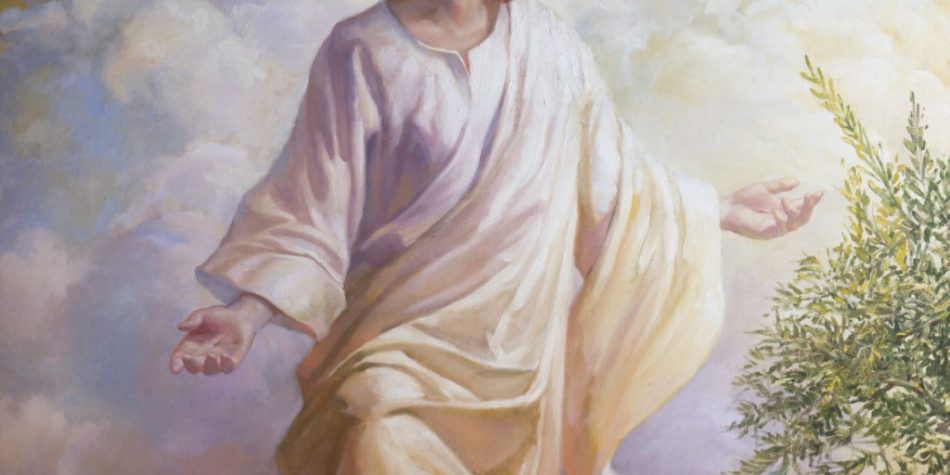
resurrected_christ_wilson_ong

The Hope Resurrection Provides Here and Now

Talk of resurrection usually hearkens to a day far off into the future when all will be made right—with little reference to the fears and despairs crowding us right now.

As Christians around the world prepare to celebrate Easter, there are stark reminders all around us that many people in the world today need hope. Although we live in an era of unparalleled abundance, material prosperity alone cannot cure many of the ailments that afflict people in modern society. So, what if anything can?

19th-century Christian writer Simon Greenleaf once suggested that if Jesus Christ really did rise from the dead, it changes everything. It’s worth asking ourselves this week: What hope can the Resurrection of Jesus Christ provide for those who lack hope today? 

When I have thought about the resurrection in the past, I have most often focused on what is going to happen in the future without giving too much thought about what might happen today. For example, I love quoting the prophet Amulek’s vivid description of our future resurrection (“both limb and joint shall be restored to its proper frame … and even there shall not so much as a hair of their heads be lost”). This is one of my favorite scriptures, and it brings tremendous comfort in relation to all the unfairness and disadvantages that this life can bring. But it is definitely focused on something that will happen in the future. What about the here and now?  

In thinking about this question, I believe that Latter-day Saints can learn a great deal from New Testament scholar N. T. Wright. Wright has shared countless insights about the resurrection over the years, including how the resurrection offers hope for the present world.

The Resurrection of Jesus Christ is the greatest evidence we have that what is impossible in human terms is possible to God.

In his book, Surprised by Hope, Wright contrasts Christianity’s view of the future of the world with two other perspectives one might have in our modern era. Wright calls the first perspective “evolutionary optimism,” “materialistic optimism,” or the “myth of progress.” This is basically the idea that history is advancing toward a wonderful goal: that humanity will “continue to grow and develop, producing unlimited human improvement and marching toward a utopia.”

This bears some semblance to the Christian view. The problem, however, is that this perspective is typically expressed without any reference to God. And in a purely secular context, there are plenty of reasons to be skeptical that humanity will be able to reach utopia by means of our own efforts alone. Among other things, the many horrors of the twentieth century serve as sobering reminders of our proclivities toward sin and evil. Moreover, as Wright correctly notes, “even if ‘progress’ brought us to utopia after all, that wouldn’t address the moral problem of all the evil that’s happened to date in the world.” Nor would it address the problem of death — both on an individual basis and as a collective human family. Without God, we are left with the harsh reality that (as Bertrand Russell puts it) “all the labours of the ages, all the devotion, all the inspiration, all the noonday brightness of human genius, are destined to extinction in the vast death of the solar system, and … the whole temple of Man’s achievement must inevitably be buried beneath the débris of a universe in ruins.” So much for the myth of progress.

The second perspective that Wright discusses is essentially Gnosticism (or at least something quite close to it), namely the idea that “we are made for something quite different, a world not made of space, time, and matter, a world of pure spiritual existence where we shall happily have got rid of the shackles of mortality.” I can’t help but hear echoes of Gnosticism in the modern view of the self. I agree with Wright that “if you move away from materialistic optimism but without embracing Judaism or Christianity, you are quite likely to end up with some kind of Gnosticism.”

This perspective, however, offers no hope for this world—it is, rather, an escape from this world.

Wright goes on to argue that Christianity’s view of the future of the world “combines the strengths and eliminates the weaknesses” of both the secular belief in progress without God and the quasi-religious tendency toward some type of Gnostic spirituality. Above all, the focus within Christianity is on redemption, and the Resurrection of Jesus Christ teaches us about what that means:

Redemption is not simply making creation a bit better, as the optimistic evolutionist would try to suggest. Nor is it rescuing spirits and souls from an evil material world, as the Gnostic would want to say. It is the remaking of creation, having dealt with the evil that is defacing and distorting it. … What God did for Jesus at Easter He will do not only for all those who are “in Christ” but also for the entire cosmos. It will be an act of new creation, parallel to and derived from the act of new creation when God raised Jesus from the dead.

In other words, Wright is saying that the ultimate redemption of the world—the ultimate Christian hope—is in some important ways analogous to the Resurrection of Jesus Christ. This has profound implications for our world today. For one thing, it means that the redemption of the world as a whole is actually possible. While such redemption may seem impossible right now, given all that is happening around us, so does raising someone from the dead. The Resurrection of Jesus Christ is the greatest evidence we have that what is impossible in human terms is possible to God. 

Of course, we cannot transform the world all by ourselves, just like we cannot raise anyone from the dead by ourselves. So perhaps our grand ambitions for social, political, and cultural revolution should be tempered by a bit of humility.

On the other hand, this does not mean that we are off the hook with respect to improving the present world. True Christianity is not an attempt to escape from the present world. As Wright says (emphasis in original): “Precisely because the resurrection has happened as an event within our own world, its implications and effects are to be felt within our own world, here and now.” Just as Jesus prayed and worked for God’s kingdom to come “in earth as it is in heaven,” disciples of Christ strive to bring God’s kingdom to this very pain-filled world in which we live:

The message of Easter is that God’s new world has been unveiled in Jesus Christ and that you’re now invited to belong to it. And precisely because the resurrection was and is bodily, albeit with a transformed body, the power of Easter to transform and heal the present world must be put into effect both at the macro level, in applying the gospel to the major problems of the world … and to the intimate details of our daily lives.

Latter-day Saint author Adam Miller has written along similar lines. In his book, An Early Resurrection, Miller says that “starting a new life in Christ can be described as an early resurrection and … this kind of early resurrection is intended to save both my future and my present.” This is counterintuitive in some respects, but Miller explains it clearly and beautifully:

In Christ, the way I live—my manner of living—is changed from the inside out. Like being in love, living in Christ changes what it means to be alive. Living in Christ, I carry myself differently. I desire differently. I love differently. I greet pain and loss differently. I fail differently. I succeed differently. I part with the past differently. I respond to the present differently. I look to the future differently.

It is my faith that those differences will manifest themselves in a multitude of ways that can and will bring about healing and hope to the present world. Those who truly “live in Christ” will treat family members with greater kindness and sensitivity. They will work to help and support their local communities. They will diligently seek to obey the Lord’s admonition to “succor the weak, lift up the hands which hang down, and strengthen the feeble knees.” They will be more attentive to prophetic counsel about the social ills of our day, whether in relation to ending poverty or racial strife or conflicts of any kind. As a result, families will be strengthened, schools will be improved, civic engagement will be increased, and new job opportunities will be created. As the influence of those who live in Christ continues to expand outward, hope will be fostered at every level of society—including hope about the macro-level problems that seem so intractable right now. While much of this hope is clearly still directed at future events, at least some of it can be directed at what is possible today.

“The message of Easter is that God’s new world has been unveiled in Jesus Christ and that you’re now invited to belong to it.”

This should not be confused with the “evolutionary optimism” that was described above. Our efforts to live in Christ will not always achieve the results that we desire—the effects of sin and death are very real, and we can’t heal the world all by ourselves. An “early” resurrection is not a substitute for the actual, physical resurrection that will one day take place. But that doesn’t mean that our efforts here and now are futile. As Wright says:

Every act of love, gratitude, and kindness; every work of art or music inspired by the love of God and delight in the beauty of his creation; every minute spent teaching a severely handicapped child to read or to walk; every act of care and nurture, of comfort and support, for one’s fellow human beings and for that matter one’s fellow nonhuman creatures; and of course every prayer, all Spirit-led teaching, every deed that spreads the gospel, builds up the church, embraces and embodies holiness rather than corruption, and makes the name of Jesus honored in the world—all of this will find its way, through the resurrecting power of God, into the new creation that God will one day make.

This is a glorious, hope-filled perspective—indeed, it is the only perspective I can conceive of that offers any real hope for the present world. And it is exactly what the world needs right now.


About the author

Tom Hardman

Tom Hardman is a husband, a father of four daughters, an intellectual property attorney, and an occasional blogger residing in Draper, Utah.
On Key

You Might Also Like

Under the Banner of Heaven Episode 6, “Revelation”

Summary – The detectives show up at the Lafferty home to interrogate Ma Lafferty about the whereabouts of Ron and Dan. She claims they are not there. Pyre takes Brother Brady to the basement to interrogate him about the School of the Prophets meetings there. Brady claims that he experienced a “burning of the bosom” during those meetings and questions why Pyre is so sure those revelations weren’t true. In a flashback, Ron travels to Oregon in search of “true Mormonism” from a man named John Bryant. He discovers Bryant’s commune practicing a “free love” version of polygamy and drinking wine, claiming it’s natural and spiritual and that the Word of Wisdom is an outdated part of the temperance movement. During a communal bath, Bryant explains that he’s received a revelation that he is the One Mighty and Strong and asks to baptize Ron. After he does, Ron is overcome with love and kisses Bryant. Ron returns home to find the School of the Prophets working hard to print pamphlets of warning to the Church based on Prophet Onias’s revelations. They demand that polygamy and the priesthood ban for black members be restored. Onias tells Ron he believes that the six Lafferty brothers are chosen to help him in his work. He takes Ron up the mountain to his Dream Mine, where he believes a great treasure is buried under a capstone. Onias tells Ron that he believes Ron is the One Mighty and Strong and that Diana will come back to him when she sees how blessed he is in this work. Later in the episode, Ron writes a revelation to Diana and reads it to the School of the Prophets. They vote on its authenticity and approve it as true, declaring Ron as the one mighty and strong. Meanwhile, in the present, Taba finds a recently sawed-off shotgun and takes this as evidence that Ron and Dan are nearby. When the detectives confront Ma Lafferty, she calls Taba a dark-skinned Lamanite and claims that the only law she’s subject to is the law of God. When they press her, she blames everything on two men who were with her sons, Chip and Ricky, who had long hair and smelled like skunk. In flashback, Allen comes home to Brenda who is distressed about baby Erica’s fever, but Allen refuses to let her go to a doctor until he can figure out whether his brothers are right about not trusting modern medicine. They get into an argument during which he hits her. Brenda stands up and walks out. A little while later, Brenda’s sister comes to take her to the doctor while Brenda’s dad, Bishop Wright, stays with Allen and grills him about being too extreme in his religious beliefs. Meanwhile, Brenda tells her sister she wants to leave Allen because “this is how it started with Diana,” but her sister pressures her to stay or to let her bishop make the decision for her.  At the Pyre’s home, Pyre visits with Bishop Wright and Brenda as he tries to reassure them. The Wrights wonder if Pyre will be swayed by the “power” of the Lafferty name and question what he’ll do if the case causes trouble for people “above.” Pyre swears loyalty to Brenda alone and says that the Laffertys have no hold on him. Brenda’s sister gives Pyre a pile of her sister’s letters, hoping to piece together the events leading up to the murder. After the Wrights leave, Pyre gives his mother a bath. Grandma Pyre admits that she pinched Pyre’s wife and claims “the devil made me do it.” Pyre uses a “fake” priesthood blessing to calm her and get her to rinse her hair. In flashbacks, Diana and Brenda’s letter got her a meeting with a member of the Seventy. The men offer the solution that “true revelation causes an increase in love and appreciation for the brethren.” Allen brings up the Mountain Meadows Massacre as a counterargument, saying that Brigham Young commanded it and it couldn’t have been inspired. The seventies try to push the issue aside, but Allen accuses them of inconsistency and storms out. Brenda asks the seventies to approve a divorce, but instead, they give Brenda a blessing, calling her to bring the Laffertys back into the fold. Brenda takes up this cause very literally, buying forbidden store-bought goods for her sisters-in-law and sending missionaries to talk with them. As a result of this meddling, Matilda arrives on Brenda’s doorstep with a warning: “A wife who alienates her husband from her children risks her life.” Because of this threat, Bishop Low and his wife smuggle Diana and her children out of town, though Brenda insists on staying to carry out her calling. Pyre asks Allen about the likelihood that his brothers will leave Diana alone, but this conversation devolves into a discussion of Pyre’s faith crisis. Allen says he “tried to defeat the Church in my mind and see what was left.” He tells Pyre about a red book in his house that tells “a truer story of our people.” Pyre takes Allen’s book home and is reading it in the car and sobbing when his wife discovers him. He admits that he’s struggling, and she asks him to pray with her. He tries but he can’t. She tells him that she refuses to struggle through this with him and demands that he bear his testimony in church to strengthen their children’s faith.   Church History – Allen brings up the Mountain Meadows Massacre as the ultimate example of how revelation is inherently unsafe and unclear. He claims that Brigham Young ordered the massacre. The historical record about whether this is the case is complex, and beyond my scope of expertise. However, I do know that the Church was much more hesitant to comment about the massacre in the 80s, whereas now it has published an essay about the topic as well as supported the publication of a thorough book

Baseball Does Religious Freedom

Two stories out over the past several days seem deserving of attention. In one, Walmart settled a religious freedom complaint that seemed likely to end up before the Supreme Court. While in the other, the Major League Baseball team, the Tampa Bay Rays, had a temporary team uniform celebrating sexuality as an identity that several players had religious objections to wearing. The similarities between the two cases are clear. In both, employees sought religious accommodations at work. And in our opinion, these represent a positive step forward for religious freedom. The Walmart case is more complicated. One employee was offered an assistant manager position, but because he was a Seventh-day Adventist, he chose not to work from sundown Friday to sundown Saturday. This meant that Walmart would need to rearrange schedules by asking other managers to cover unpopular shifts, leave the store understaffed, or hire an additional manager. All of these potential accommodations would impose some cost on Walmart. The current law on this issue is that employers do not need to accommodate religious employees if there is more than a trivial cost attached. This is a much lower standard of accommodation than is required in other cases, and so some have suggested that the Supreme Court might intervene to make the standard for religious accommodations the same as other kinds of accommodations. While Walmart’s settling prevents that Supreme Court case, for now, it does suggest perhaps a changing tide that employers may be recognizing the prudence of a fairness for all approach. The Tampa Bay Rays situation is in much murkier legal waters. Private employers can compel speech in most cases, even if it’s not directly related to the job, but does asking for a specific religious exemption constitute more than a trivial cost? The Rays sidestepped this question entirely by putting their diversity policies where their mouth is. While some fans opposed anything other than total conformity from the players, the coach said that conversations in the clubhouse were what the Associated Press described as “constructive and emphasized the value of differing perspectives.” It is certainly always difficult to be part of the small group that opts out of the popular statement, but I think it is a sign of progress that in both the cases of Walmart (eventually through litigation) and the Rays, employers recognized the need to appreciate the religious diversity in their workplace.

Ketanji Brown Jackson on Religious Freedom

Any time someone is nominated to be a Supreme Court Justice, people of faith are intensely interested in how this person will understand and protect their free exercise of religion. And analyses of Ketanji Brown Jackson’s approach on this issue have begun to spring up. Andrea Picciotti-Bayer at the National Catholic Register concludes that on religious liberty issues Jackson’s “record is not encouraging.” But while Picciotti-Bayer asks several important questions about how Jackson will rule, ultimately she provides little reason for concern. On the other side, Michael Helfand at the Canopy Forum concludes, “Her engagement with questions of law and religion, for now, seem the kind of balls-and-strikes decisions you would expect from a federal judge.” He cites decisions from her in 2014 and 2017 in favor of religious freedom, and ultimately concludes that there is no reason that American Jews should be worried about her approach to religious freedom. Before her nomination, Tanner Bean looked at the religious freedom approaches of Biden’s short list including Jackson for us here at Public Square. For Jackson, Bean looked at the same cases Helfand does, but also looks extensively at her public comments during her last judicial confirmation, including that “religious freedom is a foundational tenet of our entire government.” Which suggests her statement in her confirmation hearings that freedom of religion is a “foundational constitutional right” may be more deeply felt than performative.

Subscribe To Our Weekly Newsletter

Stay up to date on the intersection of faith in the public square.

You have Successfully Subscribed!

Pin It on Pinterest

Share This