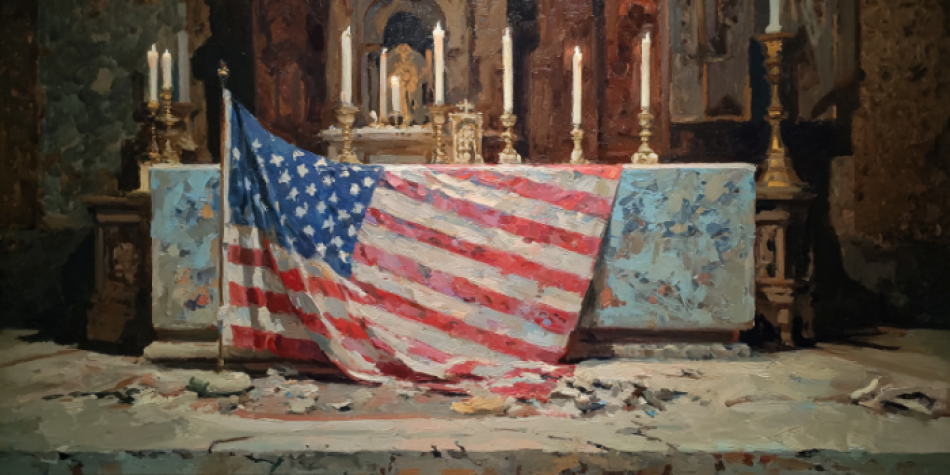
Christian nationalism is symbolized by the American flag replacing sacred symbols in a church, showing faith overtaken by politics.

Perspective: Religion Can Support the Constitution. A Religious ‘Takeover’ Does Not

Constitutional conflicts can arise when religious language and behavior take an aggressive and domineering posture toward government and society as a whole.

Download Print-Friendly Version

The idea that religion is essential to the American experiment in self-government has carried significant weight since the Founding era. For example, in his final address, George Washington declared that “religion and morality are indispensable supports” to the new country. Many others throughout American history have made similar arguments. I lead America’s Quilt of Faith, an organization committed to this idea in today’s modern and turbulent public square.

[These movements] are rooted in dominion theology and a vision … dominance over every sector of society.

But it is possible to take the idea too far. There are several large, mainstream, and influential religious movements afoot that have tacitly (and often explicitly) argued that Christians are mandated by God to rule over every domain of society: family, religion, education, media, arts and entertainment, business, and religion. Examples include the Seven Mountain Mandate, dominionism, Reformed “Reconstructionists,” “radical traditionalists,” and the New Apostolic Reformation.  Phrases such as “dominion through reformation,” “spiritual revolution,” “national exorcism,” and “radical reconstruction” have been used to describe the theological conception of Christian dominance.

While it is true that many religions and traditions draw upon forceful, even militant language to describe the spiritual quest to enact God’s will on the earth, these movements are different.

They are rooted in dominion theology and a vision of enacting Christian political and cultural dominance over every sector of society. Several are influential within conservative politics, and a majority of their proponents are also fervent supporters of the current president. The original articulator and foremost proponent of one of these movements is among the most influential MAGA Christian activists today.

This particular belief was central to the spiritual warfare theology and political propaganda that drove many Christians to participate in the January 6 insurrection. Some are part of a broader movement of the Christian right in the United States to more fully embrace (what they perceive as) the workings of the Holy Spirit, which has brought a more assertive, militaristic rhetoric and sensibility to the values and policy agenda of the old Christian right.

America’s Quilt of Faith celebrates the freedom that allows for all religious beliefs, including those described above. Yet we are concerned that these particular religious movements undermine American constitutional democracy.

The founders of the United States held that religion was essential because religions have a unique capacity to build virtue in citizens. We applaud all religions and beliefs in this indispensable work, which brings peace and stability to communities and the nation. However, we believe the founders of the United States of America did not intend for religion, let alone one sect or belief system, to “take over” any sector of society, most especially the government they had just created.

We believe the founders … did not intend for religion, …  to “take over” any sector of society …

For example, in August 1790, George Washington sent a letter to the Hebrew Congregation in Newport, Rhode Island, in response to their inquiry regarding how Jews would be treated in the new nation. The letter ends with, “May the Children of the Stock of Abraham, who dwell in this land, continue to merit and enjoy the good will of the other Inhabitants; while every one shall sit in safety under his own vine and fig tree, and there shall be none to make him afraid.”

It is true that many Christians believe Jesus will one day return and rule on earth during a time of worldwide peace. It’s hard to imagine even in this scenario that such a global reign would be enacted through aggression that somehow forces a belief in Him, and without an allowance of continued free expression and peaceful pluralism.

Latter-day Saints join many other believers in insisting on an unpressured conversion experience—respecting other faiths to walk their paths even as they seek to “build the Kingdom” by influencing and persuading through love and the Holy Ghost’s workings. As Princeton’s Robert P. George argues, “Any attempt by the state to coerce religious faith and practice, even true faith and practice, will at best be futile and would likely damage people’s authentic participation in the good of religion.” A true relationship with God “cannot, by its very nature, be established by coercion.”

A true relationship with God “cannot, by its very nature, be established by coercion.”

Attempting to “take over” or “control” any part of our free society, especially in the name of religion or a religious belief, risks limiting citizens’ moral agency and creating second-class citizens (or worse) of adherents of non-Christian faiths or Christians who do not subscribe to a militaristic, domineering form of Christianity. Most importantly, if religious believers were to “take over” the U.S. government—one of the seven societal sectors—the establishment clause of the First Amendment would be violated, and American constitutional government would suffer a fatal blow.

We urge all religious Americans who, as part of their faith, believe that God had some role in establishing the United States Constitution and see it still relevant today to be wary about supporting the aggressive goals and methods of these movements and instead participate in the public square in ways that support, protect, and defend the U.S. Constitutional order.


About the author

Chris Stevenson

Chris Stevenson is the President and Co-Founder of the National Museum of American Religion. He co-founded the Community Levee Association, which champions virtue to the American experiment. He wrote "Letters from an American Husband and Father."
On Key

You Might Also Like

We Need to Talk About Bruno + Today’s Digest

Our daily rundown of the articles from around the web that we feel our readers would enjoy and appreciate. We hope to highlight the best of what’s around. Public Square Bulletin recommends: How can Vladimir Putin be described as a defender of Christian values? Michael Cook – Mercator Net There is much Christian rhetoric that has come from the Kremlin regarding the war in Ukraine. And the religious elements of the conflict run deep. But some American commentators have started to frame Putin as an ideal Christian. Michael Cook argues that this goes much too far. Along the religion beat: Should ‘mainstream media’ pundits take sides on church disputes? Richard Ostling – Get Religion Richard Ostling responds to a recent article in Real Clear Religion that asks New York Times journalists David Brooks and Ross Douthat to stop writing op-eds on religious issues. Ostling believes there is already too little coverage of religion issues. The Power of Laughter Aleah Ingram – LDS Daily Tomorrow’s “Daily Dose” at LDS Daily appropriately looks at humor for April Fool’s day and looks at the gospel need for joy in our lives. Transitioning from Science to Philosophy Joachim Ostermann – Church Life Journal Biochemist turned Franciscan Friar, Joachim Ostermann, looks at his work in the sciences and examines the philosophical underpinnings that were all too often missing from his understanding. We Need to Talk About Bruno Ryan McDonald – The Gospel Coalition A look at one of the most popular films of the year and it’s gospel themes. McDonald sees in Bruno a type of Jesus Christ. His thoughts should add to the already deep themes of forgiveness and family present in the film.    

Subscribe To Our Weekly Newsletter

Stay up to date on the intersection of faith in the public square.

You have Successfully Subscribed!

Pin It on Pinterest

Share This