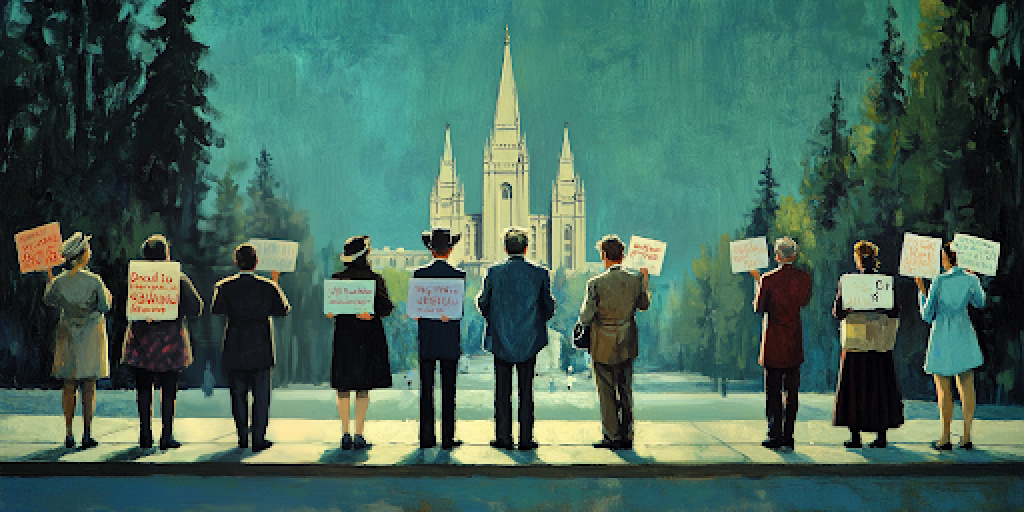

In recent years, it’s become increasingly common to hear Latter-day Saints acknowledge—sometimes with real sorrow—that family relationships are getting more complicated. My family, like many others, is fractured by a variety of pressures, some relational, some religious, some political. We frankly don’t talk much anymore. For all intents and purposes, we’ve scattered. And yet, through it all, I remain active in my faith, trying to live and teach the gospel while navigating family dynamics that are often more painful than edifying.
I know I’m not alone. Pew Research has noted the sharp rise in both political polarization and religious disaffiliation in American life over the past 20 years. According to 2023 data from PRRI, about 27 percent of Americans now claim no religious affiliation at all. Gallup reported in 2021 that church membership in the U.S. fell below 50 percent for the first time since they began tracking it. Among young adults, those numbers are even more stark. Add to that a steady climb in family estrangement, and it becomes clear that the pressures on faith-filled families are immense.
Of course, this isn’t just an external cultural problem. Within the Church, the old social glue that once held extended families together—mission service, marriage, and weekly sacrament meeting attendance—no longer binds with the same universality it once did. Gospel living has become, in some sense, more intentional and more home-centered and church-supported. Faithful Latter-day Saints today are often raising children, ministering, and serving in callings alongside people they love who no longer believe. Sometimes those people are in their own homes.
The old social glue that once held extended families together … no longer binds with the same universality it once did.
So, how can someone in a situation like mine live the gospel without retreating into either isolation or bitterness? How can we pursue a life of conviction that is still open-hearted and gracious in divided circumstances?
First, it helps to acknowledge the emotional toll that fractured families take. A great deal of writing about faith crises focuses on those who leave. But those who stay often feel displaced in a different way. Many live with grief, confusion, or quiet shame, unsure of what they did wrong. It is not uncommon to feel spiritually alone, even when active in the Church. For some, a kind of survivor’s guilt creeps in. For others, fear about saying the wrong thing leads to chronic anxiety. These are real struggles that deserve compassion and care.
Second, we need a framework for understanding these divisions—one that recognizes not only personal pain, but deeper moral and epistemological divergence. While some separations arise from trauma or offense, many reflect fundamentally different assumptions about truth, authority, and what it means to live a meaningful life. As the apostle Paul asked, “What fellowship hath righteousness with unrighteousness? and what communion hath light with darkness?” (2 Corinthians 6:14). Paul’s point is not to vilify ex-believers, but to emphasize that meaningful communion depends on shared foundations. Without them, even sincere efforts at connections can falter. Meaningful communion depends on shared foundations. Without them, even sincere efforts at connections can falter.
This divergence doesn’t remain abstract. It plays out in families, friendships, and communities. In our time, moral disagreement is often mistaken for personal rejection. Thus, when a believing parent expresses concern about a child’s choices, it is often interpreted not as loving guidance but as judgment or control. Likewise, when an ex-member critiques church teachings, faithful relatives may hear it as betrayal rather than sincere conviction. This cycle of hurt and misinterpretation creates a relational impasse.
Here, the principle of charity becomes essential—not the therapeutic empathy of modern discourse, but the scriptural virtue of love grounded in truth. Charity “rejoiceth not in iniquity, but rejoiceth in the truth” (1 Corinthians 13:6). It refuses to lie about what is right and wrong, but also refuses to give up on people. It allows us to keep our hearts open without compromising our convictions. In practice, this means listening without needing to agree, showing up without needing to fix, and loving without needing to control. It means resisting the urge to “win” conversations instead of making space for relationships to breathe. Latter-day Saint thinkers like Terryl Givens and Ralph Hancock offer helpful resources here. Givens describes faith as a chosen, relational trust rather than mere intellectual assent, and Hancock emphasizes the sacred role of moral authority in a fragmented age. Together, these perspectives help us understand not only why these divisions run so deep but also how we might navigate them with both clarity and compassion.
But knowing these things doesn’t automatically fix family estrangement. Faithfulness does not guarantee relational harmony. In fact, Christ Himself warned that loyalty to the kingdom might set “a man at variance against his father” and “the daughter against her mother” (Matthew 10:35). These words are difficult, but they remind us that division is sometimes the price of discipleship. The principle of charity becomes essential … the scriptural virtue of love grounded in truth.
The point is not to force unity where it cannot exist. Rather, it is to live with integrity, trusting that the Lord sees the efforts we make and honors the covenants we keep. The family is not only central to the Plan of Salvation—it is also the arena in which we often experience our greatest mortal trials. But these trials, painful as they are, can shape us into more faithful disciples.
If I could speak to a younger version of myself, or to anyone just beginning to navigate these kinds of family fractures, I would say this: it’s okay to feel disoriented. It’s okay to grieve. You’re not failing because your family doesn’t look like the ideal. You’re not weak for feeling torn between loyalty to your faith and love for those who no longer share it.
You may find yourself in situations where you don’t know what to say. A sibling makes a snide comment about the Church in a social media post. A parent quietly withdraws at the mere mention of the Church. A child rolls their eyes when you call for prayer. These moments sting — not just because of what’s said, but because of what’s lost: the ease, the shared language, and the sense of spiritual intimacy that once came so naturally.
Practicing compassionate orthodoxy in these moments doesn’t mean pretending those differences don’t matter. It means choosing to stay soft-hearted anyway. It might look like biting your tongue when you want to defend the Church, not out of fear, but out of love. It might mean sending a birthday text even when you haven’t spoken in months. It might mean praying for someone who thinks prayer is meaningless. It might mean setting a boundary, not to punish, but to protect your peace. These moments sting — not just because of what’s said, but because of what’s lost: the ease, the shared language, and the sense of spiritual intimacy that once came so naturally.
If you’re feeling overwhelmed, remember: you’re not alone. Many faithful Saints are walking this same road. And while the path may be narrow, it’s not empty. The Savior walks with you. He knows what it is to be misunderstood, to be rejected, and to love without being loved in return. And He will strengthen you to love as He loves—with truth, tenderness, and hope.
I’ve come to think of my own situation not as a personal failure, but as part of the cost of discipleship in a fractured world. I hope for healing, but I do not expect perfection. I pray for reunion, but I try not to demand it. Instead, I seek to live in a way that honors both truth and kinship, conviction and kindness. This is what I mean by compassionate orthodoxy—not a softening of doctrine, but a deepening of love rooted in fidelity to Christ.