I occasionally lecture in various venues around the country on the miracles and challenges peculiar to our singular civic order. On a few occasions, I have taught at locations made sacred by the great things that Americans have spoken or wrought. I often find that actually standing on some sacred spot of civic history permits truths to penetrate more deeply, greatness to stand forth more sharply, and the challenge of rising to Americanism at its best to distill upon heart and mind more clearly.
In sharp contrast, there is a dispiriting malaise that increasingly characterizes our lived experience of the state of our American Union. With many readers of Public Square Magazine, I find myself reflecting with increasing frequency of late on:
- The frightening unfreedom and the deepening division, mutual suspicion, and rancor in which we have become ensnared as a nation.
- And the flagging hope that God will yet work the miracle in our minds and hearts that he once wrought in the minds and hearts of our fathers (Note #1). That is, that he will prod us to discover, believe, espouse, and live the truths of the Declaration of Independence and, by so prodding, teach us to become Americans, unite us in self-government, and redeem the American Project.
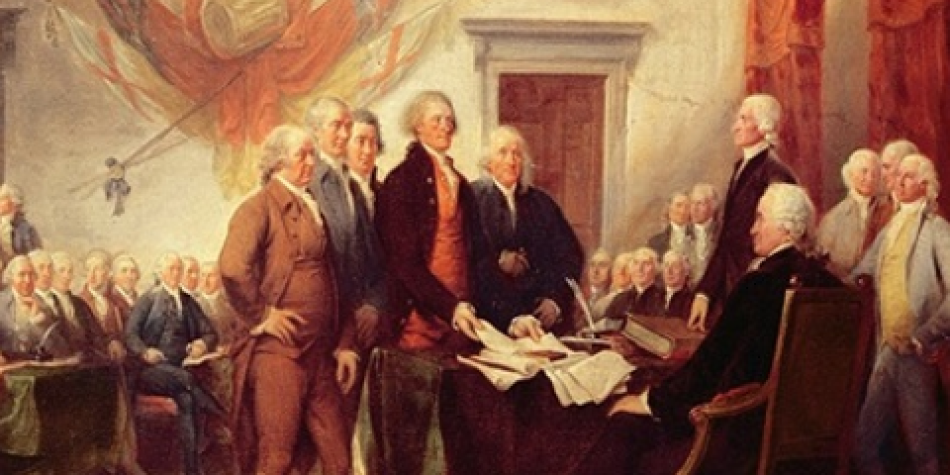
With mounting anxiety for our country, I’ve been reflecting more deeply in this vein this year than in any previous year. My own conviction is that all hope for renewal lies in “re-knowal”—in being led to consciously and deliberately re-embrace that syllogism of five self-evident Truths articulated in the second paragraph of the Declaration:
(1) “That all men are created equal”
(2) “That they are endowed by their Creator with certain unalienable Rights”
(3) “That among these are Life, Liberty and the pursuit of Happiness”
(4) “That to secure these rights, Governments are instituted among Men, deriving their just powers from the consent of the governed”
(5) “That whenever any Form of Government becomes destructive of these ends, it is the Right of the People to alter or to abolish it, and to institute new Government, laying its foundation on such principles and organizing its powers in such form, as to them shall seem most likely to effect their Safety and Happiness.”
It was only the discovery and belief of these truths, followed up by the humble faithful, and courageous espousal and living of them, that once transformed Englishmen into Americans, empowering them to bring forth the only truly free country of which secular history bears record. Nothing short of an analogous conversion can make Americans of us today or bring forth a purer and more permanent instantiation of that Blessed Free Country now slipping our grasp.
Some have questioned how distinctly, unreservedly, and unanimously our first American fathers really did once hold those saving civic truths. Others, not doubting the fathers’ clarity, sincerity, or unanimity, have asked: Were they wrong? Are those truths really true?
Thankfully, there are unambiguous answers to such questions. More importantly, the more thoroughly we explore both questions and answers, the more we will be brought to confront consciously and deliberately the question of our own, personal civic faith. Do we still hold these truths? And what might the practical consequences be of holding them to be true today?
In the howling tempest of our present civic discontent, as the cold civil war that embroils us becomes increasingly hot, George Mason’s admonishment to “frequent recurrence to fundamental principles” (Note #2) beams like a lighthouse in the dark. If we should so recur now, might we not find those truths of the Declaration as relevant today, even essential to the success of the American Project, as ever?
My own conviction is that the miraculous historic phenomenon of Americans and America was possible only to a nation of truth-tellers. With many of our greatest presidents, I believe in the intrinsic connection between individual and national probity, on the one hand, and liberty and self-government, on the other.
All of which begs the question today: Has a nation of truth-tellers become a nation of liars? If so, how has this come about, and what have been the consequences for the American Project?
All such questions deserve deep exploration and attention, but perhaps none more than the essential question of conciliation. Why, in the mutual estrangement that threatens a national divorce, should we still insist upon seeking together this mutual conciliation? What is the difference between conciliation and appeasement? For a nation so peculiarly conceived and dedicated as ours, can there be, ultimately, any other ground for genuine conciliation than those same five truths asserted in the Declaration?
I invite you, in the weeks and months ahead, to join me in reflecting more deeply on questions such as these—not as idle philosophical speculations, but as the locus of enduring solutions to what is most urgently confronting us as an American people. As we do so, may God shine some light on our examinations, and coax forth some wholesome fruit therefrom.
Notes:
1. I employ the term fathers in the special American sense so aptly described by Lincoln, in which he who understands, believes, and subscribes to those same truths becomes—by the same process of spiritual and civic rebirth, which had once transformed the fathers—blood of the blood, flesh of the flesh, of those first Americans. (See his speech at Chicago, IL, 10 JUL 1858, in reply to that of Judge Stephen A. Douglas of the previous day.)
2. George Mason, original draft (20 – 26 May 1776) of the Virginia Declaration of Rights, “That no free Government, or the Blessings of Liberty can be preserved to any People, but by a firm adherence to Justice, Moderation, Temperance, Frugality, and Virtue and by frequent Recurrence to fundamental Principles.”