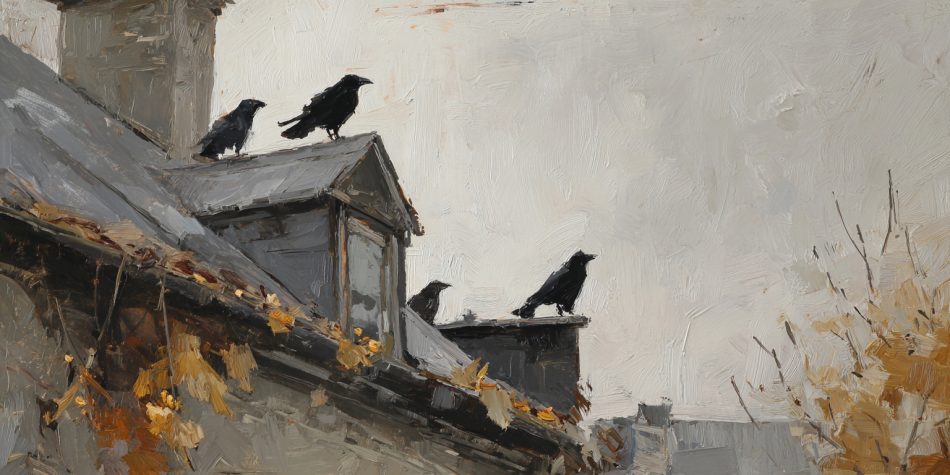
A roofline under gray skies with several crows perched along the ridge, one crow pecking near a skylight, a gutter visibly clogged with wet leaves and peanut shells, early morning light. Peacemaking grows harder when daily irritations pile up like debris.

The Continuous, Habitual Struggle for Peace

How can conflict be redeemed? The answer is slow, practiced love that resists pride and chooses reconciliation.

Download Print-Friendly Version

“Change does not roll in on the wheels of inevitability, but comes through continuous struggle.” —Martin Luther King Jr.

Sometimes the week’s sermons foreshadow a struggle that will soon knock at your door.

My wife, Missy, and I learned this recently in a peacemaking crisis with a neighbor, which came less than 24 hours after we heard two sermons on peacemaking. I’ll call our neighbor Alice (not her real name). She’s a short, stocky, 50-something woman who walks with a waddle. She loves animals. Between November and March, Alice feeds the crows pounds of peanuts. The result is a noisy murder of birds and a roof and yard (ours) littered with shells that clog our gutters.

This was quickly turning into a Shakespearean tragedy.

This past spring, as Missy cleaned leaves and peanut shells from our curb, she encountered Alice. It was a beautiful sunny day after another grueling winter. At one point, the conversation turned to what Missy was doing. My wife kindly and calmly asked Alice if she would consider feeding the crows something else because of the mess from the peanut shells. No promise was made, and life went on.

Then, about six months later, on the Monday morning before Thanksgiving, Alice knocked on our door as we were busy preparing to leave for the airport.

“Did you put this on my door?” she asked. 

She showed us a piece of light blue paper with these words: “PLEASE STOP FEEDING PEANUTS TO THE CROWS!!!!!”

“No,” I responded.

“Did someone else in your house put it out? I know you don’t like the peanuts,” Alice said, her face and voice making clear she was not convinced by my denial.

“No, we didn’t put that sign out,” Missy said.

“Are you lying to me?” Alice asked.

“No,” I said.

I was terse because there was no time to talk. Like those birds, we had to catch a flight.

And with that, Alice shrugged her shoulders in frustration, turned around, and stomped down our steps. In her mind, we were guilty.

The next Monday morning, we were back home. A crow was on our skylight, pecking away at something. I worried the bird might chip the window. As I often do, I opened our front door to raise my hands and shew away the murder congregating on the street.

Alice saw this through her window and was steamed. She stormed over, knocked on the door, and asked to speak with me.

“I was on the phone with my daughter just a minute ago when I saw you open your door and wave the crows away,” Alice said, her voice on edge and full of spite. “I know it was you who put the sign on my door. You are sign people. You have a no soliciting sign and that other one asking people to not leave dog poop on their lawn. Why can’t we just talk about this and not behave like we’re in middle school? What is your problem with the crows?”

This was quickly turning into a Shakespearean tragedy, with Alice misinterpreting our every word and move.

I explained calmly that the crows’ pecking wakes us up and clogs our gutters. I could have added that their repeated noises bothers one of our daughters, who has sensory issues. And there’s also the potential for their pecking to ruin our roof.

The peacemaking process can be chaotic.

Alice then accused Missy of yelling at her last spring when she asked her to consider feeding the crows something else. This is where things went off the rails. Missy never yells at anything. The accusation blindsided both of us. From there, voices grew louder, Missy was in tears, and a primal instinct drove me to tell Alice she needed to leave. I grabbed her by the arm and led her out the door. I pushed her past the threshold because she would not go willingly.

As I closed the door, she lobbed one last verbal grenade.

“The crows are the nicest neighbors I have,” Alice said. “You are so mean!”

I immediately wondered—was I too forceful, too rash? The exchange rocked us and turned the day to ash.

The next afternoon, we composed a note of apology for misunderstanding her and regret for the scene that marred our Monday. Missy left it on Alice’s porch with a loaf of pumpkin chocolate chip bread.

Alice responded a week later with a brief note, sent via snail mail. She thanked us for the bread but did not apologize. Her words felt like a backhanded way of saying we are to blame.

With the wound still fresh and our minds in disbelief at her callousness, we tossed her note in our recycle bin. We wanted to be right. We wanted her to see the logic of our clogged gutters and our daughter’s sensory needs. But the ensuing silence was heavy. The poison of strife was setting in, that physical tightening of the chest that happens when a neighbor becomes an adversary.

It was here that the sermons from that Sunday began to sink in. The peacemaking process can be chaotic and confusing. As the Rev. Dr. Martin Luther King famously noted, “Change does not roll in on the wheels of inevitability, but comes through continuous struggle.”

Love and forgiveness are the only way forward. Thus our quick offering of peace. This Dr. King also knew. “Darkness cannot drive out darkness: only light can do that,” he said. “Hate cannot drive out hate: only love can do that.”

Alas, progress toward peace feels less like a victory march and more like the slow process of clearing a blocked gutter—one handful of debris at a time. But we will try. And we will keep trying.

We want to be peacemakers. But peacemaking is a long dance, a communal project that must be engaged in by both sides. Whether it is building muscle, better habits, stronger relationships, or a neighborhood and society where we simply respect and love each other, nothing comes to pass without Dr. King’s idea of “continuous struggle.”

We are commanded to love her.

Moses knew this. The Hebrew prophet had a classic mountaintop experience where God spoke to him from a high place and showed him a vision of all of this world and its inhabitants. Then God’s presence withdrew and Moses was “left unto himself” and he fell to the earth, learning a lesson he’d never forget about his own limited abilities and God’s infinite powers.

In Moses’ reflection of the wonder of his theophany, we find a powerful phrase: “I beheld [God’s] face.”

Though this painful experience with Alice remains unresolved, it was an opportunity to behold her face up close—not merely as the “crow lady” or a source of drama, but as someone created in the image of God. We are commanded to love her who, at the moment, feels like an enemy. As the musical Les Miserables concludes, “To love another person is to see the face of God.”

The continuous struggle to find that divine face in the neighbor is the path toward the light of God. It is not paved with grand gestures or born of sudden, mountain top epiphanies, but is carved out of daily rhythms of relation where we smile at others, say hello, step into shared spaces, and listen. The struggle isn’t heroic—it’s habitual.


 

About the author

Samuel B. Hislop

Samuel B. Hislop is a writer in Utah.
On Key

You Might Also Like

Barry Keoghan shines in weak star vehicle

“Bring Them Down” is a careful small-town drama about Irish sheep farmers. The film stars Christopher Abbott as Michael after his acclaimed performance as the villain in “Poor Things,” and titular role in “Wolf Man.”  Barry Keoghan plays opposite as Jack, the son of neighboring farmers. Keoghan also made his mark in a Yorgos Lanthimos film, “Killing of a Sacred Deer.” He is as up-and-coming as an actor can be, set to star in the highly anticipated Beatles biopic.  The film is mostly a showpiece for the two talented leads to luxuriate in the acting moments that the revenge plot affords them. Abbott builds a character suspended in tension between his guilt over his mother’s passing, his deference to his strong-willed father, his honor, and his self-sufficiency. Keoghan has a slightly more complicated job, as he needs to find the motivation to start the feud inside a character that is juvenile and slight. As a showcase, the film is a success. Not many people will see it, but it will certainly help burnish the reputations of Abbot and Keoghan as formidable actors. And the plot is good enough to serve that purpose. Caroline, Michael’s ex-girlfriend, and Jack’s mother, has decided to leave Jack’s father because of their financial problem. A bridge is out, and Michael’s father is reluctant to let Jack’s family cross his property. So Jack hatches a plan to steal two prized rams from Michael’s family. When Jack’s dad catches him, he makes him kill the ram and get rid of it. The woman they sell it to offers them good money for sheep legs, offering what Jack sees as a solution to his family’s problems. But rather than tell the story in a forthright way, the edit tells the story twice, first from Michael’s point of view, and then from Jack’s. So during the first half of the film things move so fast and with so little context, you struggle to know what’s going on. Then when it restarts, the audience doesn’t know the device yet, and doesn’t figure it out for about twenty minutes when plot points begin to repeat themselves.  Once we figure it out, the idea isn’t terrible. When we were strictly in Michael’s perspective the feud seems meaningless and is cast in strictly moralistic terms. When we revisit it through Jack’s perspective, we can begin to appreciate the complicated factors that led to Jack’s decision.  But the edit doesn’t tell the story clearly enough. So the main emotion I felt while watching the film was confusion. I’m certain that the film would improve on a rewatch, but the ultimate story that a feud develops because Jack steals Michael’s sheep to keep his parents together doesn’t have enough heft to draw me back. It’s a pastoral film, and it does a good job of capturing the place. Colm Meaney, who plays Michael’s father, Ray, does a particularly notable job speaking Irish at length. First-time director Chris Andrews has some interesting ideas. He is clearly capable of letting talented actors do what they do best, a skill that will serve him well in his directing career. The film is also shot in a subdued way that highlights the natural light and natural beauty of the setting, but without ever drawing attention to itself.  The use of fire in the film’s back half is particularly notable.  “Bring Them Down” is R-rated for its violence and language. The domestic violence where Jack’s mother beats Jack’s father is particularly harrowing. But I found the film’s moral message to be largely in the right place. Jack’s theft leads to nothing but suffering. And revenge is shown as almost entirely futile. The film even offers a glimpse at honest redemption. Still, I wouldn’t watch this with my kids, at least until they were adults.  Two and a half out of five stars. “Bring Them Down” releases in theaters nationwide February 7, 2025.

The Grinch Who (Almost) Stole Thanksgiving

How to celebrate Thanksgiving this year is a challenging question for many American families. Whatever the details of the decision, let’s hold on to the transcendent spirit of the holiday.