
Man in Chains | Men, Pornography, and the Illusion of Control | Public Square Magazine | Men Pornography | Men and Porn | Emotion Porn | Intimacy Porn

Lost in a Sea of Pixels: Men, Pornography, and the Illusion of Control

Is pornography sabotaging men's emotional connections and ability to experience authentic intimacy? These emotional consequences are often overlooked in mainstream discussions.

Over three decades, the many presentations on sexism and racism in pornography that I gave changed as the pornography business and the culture changed. But one constant was a question that inevitably came up in the discussion period, always asked by a woman.

 Why do men like pornography so much?

 Based on years of scholarly research and public engagement, I believe the answer is simple: Pornography produces quick, reliable orgasms without the vulnerability that comes with intimacy. Men can experience sexual pleasure while staying in control. Or, more accurately, the appearance of control. More on that at the end.

Men, Pornography, and the Illusion of Control

Explicit Material Intensifies the Detachment

The feminist critique of pornography—the basis for my writing and speaking on the subject—focuses on the harm to women, psychological and physical, in the production of sexually explicit material; the sexist and racist images that dominate the pornography market; and the influence those images have on consumers’ sexual imaginations.

 In the time I’ve been studying the pornography industry, some things have changed. Most obvious is the technologies—from magazines and movies, the industry moved to home videos and the internet. Pornography became more accessible and affordable. Other trends are equally obvious: In those three decades, the women in pornography have been asked to perform increasingly more intense and dangerous sex acts; the cruel and degrading nature of the images has intensified; and more girls and women are using pornography, which once had been almost exclusively a male pursuit.

 One thing remains the same for the still mostly male consumers: Pornography appears to provide sexual pleasure without the risks that come with intimacy.

When we are sexual with another person, we open ourselves up to intense emotions that can’t be predicted or easily controlled. In a culture that trains us to stay in control, many men believe sexual intimacy is a potential threat to that sense of power. Pornography provides the illusion of a sexual experience without risk. But it comes with costs.

Behind women’s question about men’s love of pornography is often an experience of male partners who seem remote or disconnected in lovemaking. Sometimes that’s a problem independent of pornography, but men’s habitual use of sexually explicit material intensifies the detachment. I’ve talked to many women after these presentations, and that struggle with men who detach rather than engage emotionally during sex was a common theme. To make it more difficult, some of those habitual users also initiate sexual acts that female partners find uncomfortable or painful—the kind of “rough sex” that is standard fare in pornography.

 The feminist critique doesn’t rest on judgments about people’s sexual desire but on the negative consequences for the women used in producing pornography and used by men who consume pornography. The critique doesn’t pretend that the end of pornography would eliminate men’s sexual exploitation of women. But in a pornography-saturated culture, it would be folly to ignore the role of that particular media genre in our lives.

 The feminist critique focuses on the harm to women, which is appropriate for that movement. But the feminists I have worked with are also aware of the downside of pornography for men. That doesn’t mean that all heterosexual men have the same experience or that gay men’s experiences are exactly the same. But based on formal interviews and informal conversations with hundreds of men, I believe there is a pattern in men’s distress over pornography use.
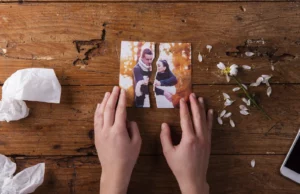
A broken family photo symbolizing broken family.
A broken family photo. Image via lds.org

Human Vulnerability 

Open up to the vulnerability, which is part of being human.

As much as men may try to live up to a masculine standard of toughness, we can’t hide from our emotions, at least not for very long. No matter how much we seek control, those emotions surface. I think much of the guilt and shame that many men report from using pornography is a result not of religiosity or prudishness but the recognition that using objectified female bodies for pleasure—the essence of pornography—is at odds with who we want to be. We want to be fully human, and pornography makes that difficult, and we know it.

 There’s a second trap in which many men get caught: their habitual use of pornography starts to control them. I’ve listened to many men talk about the pain of realizing how pornography has colonized their sexual imagination. Men have told me they can’t have sex with a partner without thinking of pornography. In extreme cases, men who use pornography compulsively experience erectile dysfunction with partners. But no matter how much they realize the downside, many men cannot stop masturbating to pornography. Whether or not pornography is officially classified as an addiction—and I think it should be—some men cannot get out of an addictive-like cycle.

 My only advice to such men is that if they try to cope with their distress alone, they will fail. The only way out of that cycle of arousal and regret is to give up the illusion of control. Therapy can help when counselors understand the destructive dynamics of pornography. Talking openly and honestly with other men is important. For me, the feminist critique of pornography and male dominance more generally was essential to seeing a different way of living. Opening up to a therapist, to other men, to feminists—all require that we open up to the vulnerability, which is part of being human.


Related Articles 

About the author

Robert Jensen

Robert Jensen is an emeritus professor in the School of Journalism and Media at the University of Texas at Austin and a founding board member of the Third Coast Activist Resource Center. He is co-author, with Wes Jackson, of An Inconvenient Apocalypse: Environmental Collapse, Climate Crisis, and the Fate of Humanity.
On Key

You Might Also Like

Being a Witness is Not Contention

When someone speaks openly against core doctrine in our faith community, concerns that arise in response are often portrayed as being “contentious,” in a way that silences those who object.

“Deep” Norwegian Film About Nothing in the End

How does a community and the families within it respond to a nearly unspeakable accusation? How do you treat everyone with dignity? How do you suss out the truth? Do you need to? “Armand,” the Norwegian submission for The Academy Award’s best international feature film, sets out as though it is interested in answering those questions. The film opens with a young teacher, a principal, and a school staff member wondering what they are going to do. Armand has done something again. The parents are called in. The film’s premise is that Armand was accused of hitting Jon in the bathroom when Jon said he didn’t want to play with Armand. There are many additional revelations about the context, the relationship between Armand and Jon’s families, and the history of Armand’s family. There are accusations upon accusations that both indict and exonerate the boys and the adults around them. But these revelations eke out. It feels like filling up a mug from a leak in the sink. “If you want us to know what’s happening, just tell us,” I felt like shouting at the screen more than once. The film’s first act works well. The cinematography is ragged, framing its subjects well but always just off from what we’d expect. Too close, or the light is just wrong. It felt like how I imagine it would feel to have my child accused of something horrific.  And when the parents first start talking the tension is terrific. Those first few drops of exposition in the mug were thrilling. Oh there’s something happening here; it’s complicated and interesting.  Thea Lambrechts Vaulen, plays Sunna, a young teacher in over her head trying to manage the meeting between Armand’s mother, Elisabeth, played by Renate Reinsve, and Jon’s parents Sarah and Anders played by Ellen Dorrit Petersen and Endre Hellestveit.  Vaulen is particularly effective. She has been sent on a mission by her principal, Jarle, to make sure the whole thing blows over. Watching her struggle to navigate this while the parents are processing what’s been said is captivating. But it just keeps going.  The film’s entire second act consists of learning the basic facts of what has happened and the context around it. This is a complicated situation, and as a viewer I’m interested to see how the compelling characters navigate that situation. But the screenplay seems mostly interested in telling you the information. As though learning that Armand “plays doctor” at school is enough to compel me to the film’s ending. But once the audience finally understands the situation, the third act begins and flies wildly off the handle into surrealism, including two interpretive dance numbers, three over-the-top metaphors, and five straight minutes of Anders’ mother laughing.  The movie feels so desperate to be deep that it forgets to be about anything. It’s the first film of director Halfdan Ullmann Tøndel, so perhaps the bold ideas and beautiful cinematography will be wielded for a more worthwhile story next time. The film is entirely in Norwegian. And its English subtitles include a fair amount of profanity, though not an overwhelming amount. And the accusations that fly include suicide, alcoholism, and sexual assault. So these are adult themes. The film is R-rated, but not an egregious one, it pretty well all takes place in a parent-teacher conference.  I can’t imagine ever showing this to my kids. The themes are hard ones, and the film has nothing worthwhile to say about them. Two out of five stars. Armand releases in US theaters on February 14, 2025.

Subscribe To Our Weekly Newsletter

Stay up to date on the intersection of faith in the public square.

You have Successfully Subscribed!