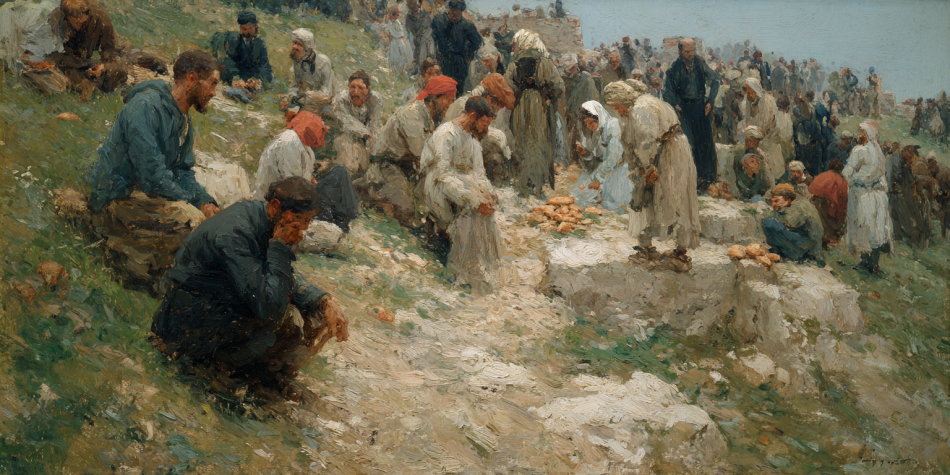

There are questions that create profound divisions among Christians. Some of these divisions become so deep that two Christians in the same congregation can be said to be living a completely different religion. For example, among Latter-day Saints, the question of whether or not to sustain the leadership of the church—and as President Henry B. Eyring taught, how strongly to define the word “sustain”—is one of those basic foundational questions that creates fundamentally different experiences of religion among people who sit in the same pews. And for the broader Christian world, one of the greatest divides is found in how believers respond to the gospel of John chapter 6. There, Christ provides a clear contrast between His mission and the world’s approaches to alleviating pain and poverty.
Christianity is experienced by believers internally, who then impact the world externally. The internal impacts of Christian faith are described in terms of repentance, inner rebirth, and transformation of our desires in the direction of goodness and holiness. With inner transformation, the Christian is then equipped to bless the external world with judgment, a scriptural concept that basically means to make the world right. Inner conversion leading to change in the world around us is the Christian order to follow for the transformation of society, and there are no shortcuts to the ideal society (“Zion”) that it produces. There are no shortcuts to the ideal society.
They go on to associate Jesus with Moses, under whose leadership the children of Israel were given a constant supply of manna in the wilderness: “Our fathers did eat manna in the desert; as it is written, He gave them bread from heaven to eat.” And there follows a demand: “Then said they unto him, Lord, evermore give us this bread.”
We read that the people saw Jesus as “the prophet who should come into the world” as a result of this similarity with Moses (v.14), and immediately they sought to “take Him by force, and make Him a king” (v.15). Jesus responded in ways that must have gone against the people’s mental conditioning: He refused to be a king, and He refused to perpetually feed them. With these choices, Jesus was only repeating His responses to the temptations in the wilderness, where Satan offered Him political power— “the kingdoms of the world”— and also recognition, “He shall give his angels charge concerning thee: and in their hands they shall bear thee up…”.
And as with the temptations in the wilderness, Jesus’ choices in John chapter 6 should give us pause. Every reader would benefit from pondering what we would do in Jesus’ situation. With the power to eliminate all hunger forever by distributing an endless supply of food, would we do it? Or would we see, as Jesus did, reasons to refrain from doing so? With the ability to eliminate oppression by becoming a politically all-powerful king or queen, would we do it? Or would we see, as Jesus did, reasons to refrain from doing so? These questions that arise in John 6 are at the heart of much of modern political conflict.
In the wonderful series “The Chosen,” this conflict has been represented in the story of Judas. Viewers are given a portrait of Judas as a man who is extremely earnest, who feels deeply the pain of the world and sees in Jesus the possibility of immediate resolution for all of that pain.
In this dramatization of Judas, the creators of The Chosen are tapping into a deep current in the psyche, the current of our expectations toward God. When we feel some sympathy toward Judas in The Chosen and we relate to his desire to see the world made right as quickly as possible, we can understand people’s expectations of God and how those shape so much of the world around us.
Consider the views of German academic Bruno Bauer, one of the formative influences on the mind of Karl Marx. Similar to The Chosen’s portrayal of Judas, Bauer said of Jesus,
On earth, [Jesus] would be a thousand times more necessary and useful to man than in heaven, if what we say about him in good Jewish fashion is true, that God will give him the kingdoms of the world and through him restore peace to the whole earth. What reasonable reason can Christians give as to why God did not keep his word to the Lord Jesus? Why did he take him to heaven if he is to be a Lord on earth and to judge the dead and the living in the way we imagine? Why must the devil, whom he is supposed to have overcome, still rule the whole world more than 1700 years after his overcoming and leave the conqueror behind? Why did he (the Lord Jesus) not take the kingdom immediately after his resurrection, as his Father had promised him? What was the reason that he had to ascend to heaven and in the meantime let everything on earth go topsy-turvy?
Marxism and its twin ideology of fascism on the right emerged in societies that knew the Bible. In biblical texts like the book of Isaiah, we read of an ideal future world free of the kinds of conflict and pain that we now experience:
The wolf also shall dwell with the lamb, and the leopard shall lie down with the kid; and the calf and the young lion and the fatling together; and a little child shall lead them.
And the cow and the bear shall feed; their young ones shall lie down together: and the lion shall eat straw like the ox.
And the sucking child shall play on the hole of the asp, and the weaned child shall put his hand on the cockatrice’s den.
They shall not hurt nor destroy in all my holy mountain: for the earth shall be full of the knowledge of the Lord, as the waters cover the sea.
Like The Chosen’s Judas, Bruno Bauer viewed Jesus as a failure: holding all the power to inaugurate this ideal world envisioned by Isaiah, Jesus frustratingly declined to do so. It is interesting to note that in his summer 1839 university studies at the Friedrich Wilhelm University in Berlin, Karl Marx took only one course, and it was a course on Isaiah taught by Bruno Bauer. With the power to eliminate all hunger forever by distributing an endless supply of food, would we do it? Or would we see, as Jesus did, reasons to refrain.
But are these horrors exclusive to the ideological left? Consider this statement:
If positive Christianity means love of one’s neighbour, i.e., the tending of the sick, the clothing of the poor, the feeding of the hungry, the giving of drink to those who are thirsty, then it is we who are the more positive Christians. For in these spheres the community of the people of _____ has accomplished a prodigious work …
Not knowing the source of the quote, we might assume it to come from a Marxist luminary like Antonio Gramsci, who famously said that “socialism is precisely the religion that must kill Christianity.” But in reality, if we fill in the blank in the above quote, it is referring to “the people of National Socialist Germany.” The speaker claiming that German national socialism was superior to commonly lived Christianity was, in fact, Adolf Hitler, speaking in February 1939.
In a recent discussion on the Doctrine and Governance program, we observed how at the extremes of left and right, people work toward delusional visions of an ideal world; on the left, there is the vision of a classless society articulated by Marx, and on the right, the current vision is Christian nationalism, which imagines a king-figure imposing Christian righteousness upon the nation. Both of these delusions emerge in the swamps of social theory that form as people reject the Christ of John chapter 6.
By stark contrast, consider a recent devotional address given by Sharon Eubank at BYU-Idaho. There she repeated and answered an “accusation-question” that is commonly aimed toward the church:
I am occasionally asked, “Why doesn’t the Church spend more money on humanitarian work? Why doesn’t it stop building expensive temples and focus its resources on relieving the poor?” This is a legitimate question for the Church of Jesus Christ. But is it money that solves society’s ills? The world has poured two trillion dollars into addressing chronic issues in Africa. Why isn’t the situation better? Because money isn’t really the issue. Lasting progress comes through trusted relationships, infrastructure, reducing corruption, and the ability of people to work together. Money doesn’t necessarily create those things. They must be developed alongside the resources, and frankly, it is much harder work.
I will never discount the one thing this Church does that lifts entire communities in rapid development. It invites men and women of all social classes and backgrounds to enter sacred buildings and make the most binding and important promises of their mortal lives. In those buildings, they promise not to steal or lie, they promise to be faithful to their spouse and children. They vow they will seek the interest of their neighbors and be peacemakers and become devoted to the idea that we are all one family—all valued and alike unto God. If those promises made in holy temples are kept, it transforms society faster than any aid or development project ever could. The greatest charitable development on the planet is for people to bind themselves to their God and mean it. So, thank goodness the Church builds 335 temples and counting. It is the greatest poverty alleviation system in the world.
The quality of our viewpoint depends on what we are willing to see, and in Sharon Eubank’s role leading humanitarian efforts for the church, she has seen which assistance strategies actually help people, and which ones fail. She has seen how root causes are ignored when endless loaves and fishes are demanded of God or governments.
In confronting the root causes of humanity’s struggles, the Christ of John chapter 6 invites our conversion, the writing of God’s law upon our hearts. And the results of that process are exactly what Sharon Eubank described. As I noted in a recent article, it is no accident that Utah, the most templed region of the United States, consistently ranks at or near the top in annual surveys of upward mobility and income equality. The Zion society we yearn for is indeed available to us, but only on God’s terms, in God’s timing, through processes revealed by God’s ordained servants.
In her devotional, Sharon Eubank spoke to young, impressionable students who will eventually be exposed to utopian ideologies in the world, ideologies that always promise heaven yet end up creating hell. In the midst of all the voices pulling these students toward delusional extremes, Sharon Eubank modeled the example of the Christ of John chapter 6. She stood before her audience and, rather than promise them a life of endless free loaves and fishes, she loved them enough to ground them in God’s truth.