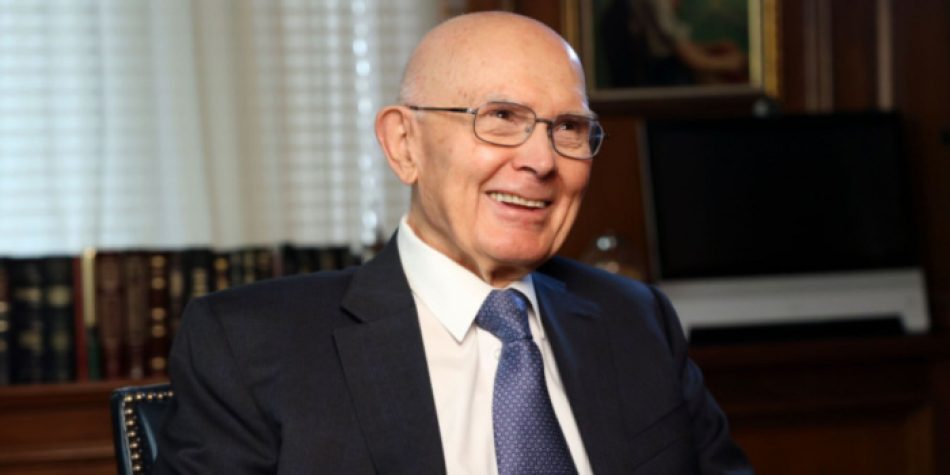

When President Russell M. Nelson passed away, I felt both grief and gratitude. He was a prophet whose warmth and vision expanded my understanding of the Savior. When President Dallin H. Oaks stood at the pulpit during General Conference and spoke tenderly of his “dear friend” President Nelson—his voice catching with emotion as he recalled learning of Christ through him—I saw a man feeling the full weight of both loss and legacy. It was the first conference he attended without the companion apostle who had served alongside him for decades.
I know the anticipation of his presumed imminent ascendancy to the Presidency of the Church has some feeling joy and excitement, while others feel anxiety or frustration. That tender moment when President Oaks opened his heart as he opened General Conference sets the tone for how I want to invite you to approach him as the probable new leader of the Church: with empathy, curiosity, and a willingness to see not only his divinely-appointed office but his humanity.
A Ministry of Law and Love
These stories and insights show how President Oaks’ seriousness about sacred things reflects not coldness but reverence. They flow naturally from his lifelong effort to balance love and law—firm in conviction yet humble enough to be guided by the Spirit.
President Oaks’ seriousness about sacred things reflects not coldness but reverence.
Throughout his academic, professional, and religious pursuits, President Oaks has wrestled with the same paradox he invites us to confront: how to combine uncompromising truth with unconstrained love. In his many addresses on Love and Law, he insists that divine commandments and divine compassion are not enemies. “We must be soft on people,” he said once, “but firm on principles.”
When his critics accuse him of harshness, they often stop reading before they reach the part where he pleads with us to treat each other tenderly. It’s true: it is all too easy to call out sin. It is far harder to move beyond professing love to practicing it—leaning in, reaching out, and staying committed without reservation. Yet that is exactly what he asks of us—and what he tries, however imperfectly, to model himself.
These glimpses into his private spirituality show how his devotion to divine law deepens, not diminishes, his capacity for love. A poignant anecdote from Richard Turley’s biography of him adds further insight. Early in his calling as a member of the Quorum of the Twelve, he gave a 45-minute talk to a local congregation in New Zealand that was peppered with personal stories and humorous asides. The audience ate it up (as I would have), but he later recorded in his journal feeling rebuked by the Spirit (“never do that again”), warning him to focus more on preaching and testifying of Jesus Christ.
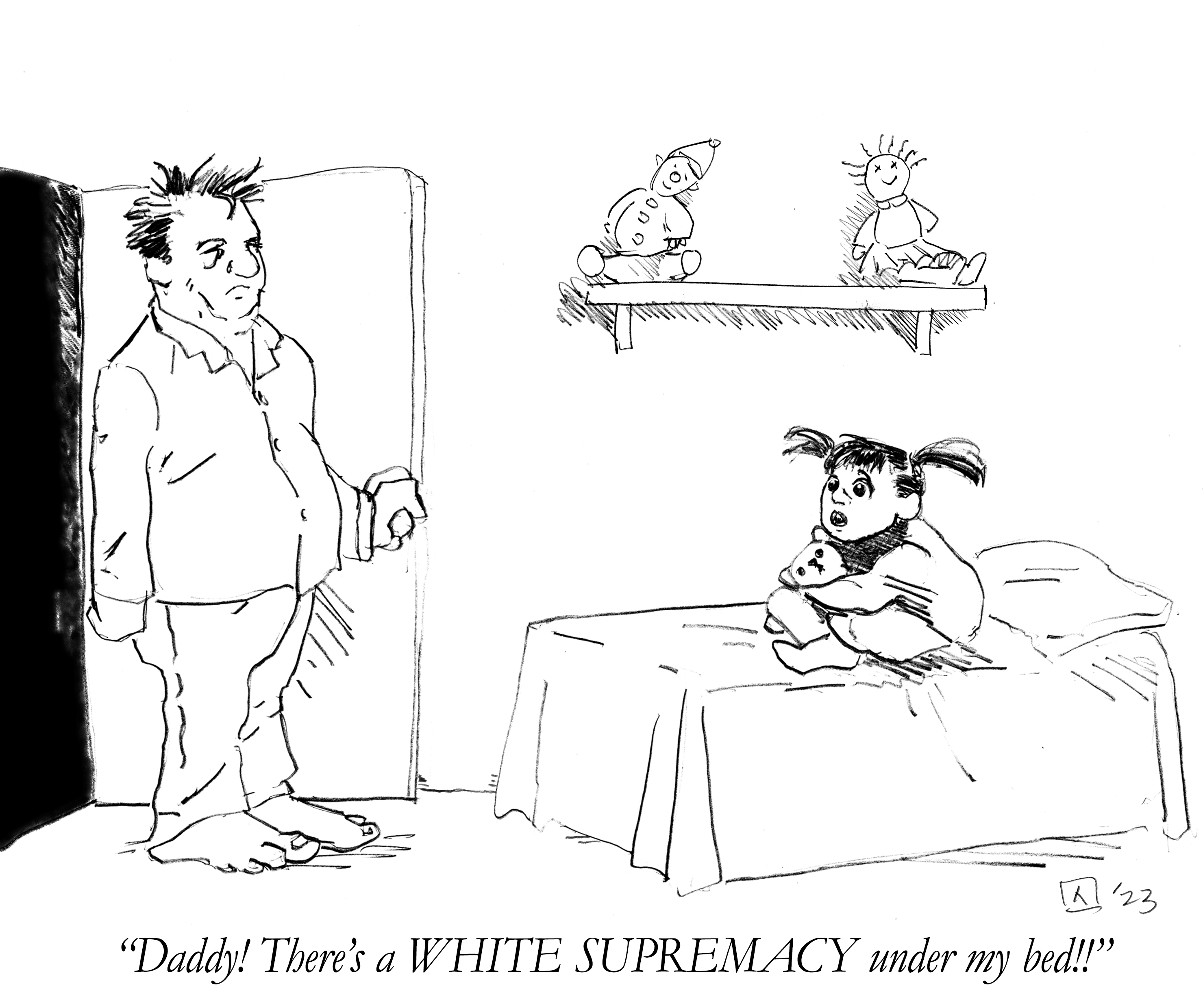
His current wife, Sister Kristen Oaks, remarked to Turley that one of his daughters said to him, “Daddy, you look like you are mad sometimes when you speak.” But Sister Oaks explains, “he was never angry or irritated, just somber as he shared sacred truths.” It seems like in President Oaks, we have the inspired leader the Lord needs us to have, even if we may not always realize it or appreciate it.
The Purpose of a General Authority
President Oaks once explained, “As a General Authority, it is my responsibility to preach general principles. When I do, I don’t try to define all the exceptions.” He was describing not cold detachment but duty—the call to declare doctrine broadly and trust members to apply it individually; in the same address, he quotes Joseph Smith: “I teach [people] correct principles and they govern themselves.” I believe the perceived firmness we sometimes hear in his addresses grows out of that stewardship, not a lack of compassion. In private, he is always described as gentle, personal, approachable, even playful, and cracking jokes. (When my friend met him at his local Church meeting, he introduced himself as “Brother Oaks.”) I think understanding this difference between his public General Authority ministry and his personal ministry “to the one” helps us broaden our perspectives and judgments about him.
Seeing Beyond the Headlines
President Oaks’ comments about sexual and gender minorities have often stirred controversy. Some hear his warnings about “gender confusion” as a lack of understanding or criticism of people. But careful attention to his words suggests otherwise. I believe he is expressing doctrinal and civilizational concern
That distinction matters. It may not erase the pain some have felt from his words, but it clarifies the intent behind them: to preserve a pattern he believes God established, not to belittle the people he knows God cherishes.
Private Encounters of Warmth and Humor
Those who have met him describe a different side than his public reputation, as stern, aloof, and detached. One of my friends, a man who experiences same-sex attraction, met privately with President Oaks years ago. He expected formality; what he got was warmth and humor. President Oaks cracked jokes, asked penetrating questions, and listened with real interest. Another friend saw him after a controversial address and mentioned the online uproar. President Oaks simply smiled and said he paid no attention to it before asking for personal details about my friend, wanting to get to know my friend, rather than (as I likely would have) getting distracted by and sucked into the drama about himself. His focus on what truly mattered in that moment struck me—it wasn’t indifference, but a refusal to let outrage define his ministry, or allow controversy to detract from connection with the person in front of him.
Recall that other incident when he visited my other friend’s downtown ward: he introduced himself not as “Elder Oaks,” but as “Brother Oaks.” That single word change encompasses a world of meaning. It said, in effect, I am one of you. He did the same thing when he visited my Stake a few years ago—showing that this is not a one‑time gesture but a pattern of humility. Whatever else one may think of his expository style, humility is part of his discipleship.
Stories of Compassion and Bridge‑Building
One of President Oaks’ relatives and a friend of mine within the North Star community (an LDS-focused ministry for sexual and gender minorities and their families) once shared a moment that beautifully captures his heart. In 2019, at a family reunion, this friend’s gay son and his husband attended–though a bit hesitantly. President Oaks, then in his mid‑eighties, went out of his way to greet this family. With unmistakable kindness, he warmly greeted the son and his husband. That simple act sent a clear message to everyone there: we can always choose to be kind, loving, and welcoming—no matter what.
This North Star friend also recalled that an attorney involved in the Utah “Fairness for All” legislation described how pivotal President Oaks’ behind‑the‑scenes efforts had been. And those efforts did not stop in Utah. People close to the process of the federal Respect for Marriage Act confirm that he worked relentlessly—quietly but personally—to safeguard both religious liberty and LGBT dignity. His conviction was steady: religious freedom and civil respect can and must coexist. I can confirm this—I heard the same thing from more than one employee at Church Headquarters.
We can always choose to be kind, loving, and welcoming
Similarly, I know of another person who struggles with persistent gender dysphoria and hears from President Oaks often, asking questions and offering support and encouragement.
These two examples also suggest that those who assume President Oaks is unaware of the personal and private pain experienced by sexual and gender minorities—and that if he knew more, he would speak differently—may want to reconsider that assumption.
A Broader Pattern of Growth and Change
Prophetic callings often bring new emphases. Ezra Taft Benson was famous as a fierce anti‑communist throughout the time he was an apostle. Yet, once he was ordained President, he became the prophet of “flooding the earth with the Book of Mormon” and warning about pride. I cannot predict what themes President Oaks will be inspired to emphasize as president, but we should not assume that the themes he has dwelt upon during his apostleship will extend to his presidency. His legal mind may still prize order, but his heart, refined by years of listening to those who hurt, seems relentlessly focused on healing and unity. Whatever happens, his record shows consistency in one thing: he deeply and lovingly respects people, even when he cannot agree with them.
A Personal Connection to the Family-Centered Gospel
In his concluding remarks at the October 2025 General Conference, President Oaks emotionally recounted the pain and grief he experienced as a young boy upon learning from his Grandfather Harris that his father had died of tuberculosis. Fleeing to his room, he collapsed on his bedside and cried out to God. This personal tragedy gave President Oaks a firsthand understanding of the profound impact on children when families are fragmented. He acknowledges that few families fully embody the ideals presented in the Proclamation on the Family, often due to circumstances outside our control. However, his own experience as a suddenly fatherless child highlights the suffering that arises when those ideals are not achieved. That burden is primarily borne by the most vulnerable—our children. It is likely that his own experience of fatherlessness has made the ideals expressed in the Proclamation, particularly the statement that “children are entitled to birth within the bonds of matrimony, and to be reared by a father and a mother,” especially meaningful to him.
An Invitation to a Fresh Start
Some may still struggle with his tone or with the weight of his words—both past and their fears of his future words. That is understandable. I get it. I have been pricked by his words more than once myself. But perhaps the challenge is not to turn away from him, but to walk beside him—to practice the same discipline he preaches: loving without surrendering conviction, and holding conviction without losing love. When I’ve tried to do that with his words or other leaders’ words, the spiritual struggle has always been worth it. Practice the same discipline he preaches.
If, as I expect, President Oaks will soon rise to lead the Church, then we will also have the chance to rise a level as well. To accept the challenge he’s set before us, to prove that disciples of Christ can hold truth and tenderness in the same outstretched hands, that we can disagree with courage, clarity, and love. I pray we will enter this new season of the Church not with fear or cynicism, but with faith: faith that God can continue to work through imperfect servants to do perfecting work. I know He has done that with me, and I am very far from perfect. If we can try to trust that divine pattern, then perhaps, under President Oaks’ leadership, we will all have opportunities to increase our ability to love boldly, speak truly, and walk humbly before our Heavenly Father.
Further Reading
For those who would like to explore more of President Oaks’ compassionate and faith‑filled teachings, consider reading or watching these talks:
- He Heals the Heavy Laden (October 2006) – A deeply empathetic message about how the Savior heals our burdens and sorrows.
- Love and Law (October 2009) – His foundational statement on how divine commandments and divine compassion work together.
- The Paradox of Love and Law (BYU–Idaho Devotional) – A more conversational address on the same theme, rich with examples of humility and understanding.
- Love Is the Great Commandment and the Law Is the Great Framework (October 2024) – His most recent treatment of this balance, emphasizing empathy and faith.
- Helping the Poor and Distressed (October 2022) – Focused on compassion, ministering, and the Christian call to lift the vulnerable.
- Always Remember Him (April 1988) – An early talk reflecting his tenderness and reverence for the Savior’s atonement.