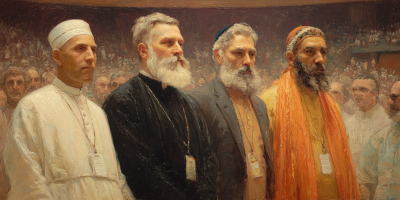

The story of the Trojan Horse is a reminder of the possible, hidden destructive power of a great gift. After a decade-long war, the Greeks gave the city of Troy a gift of a massive wooden horse and pretended to sail away. The priest of the city warned the people to “fear Greeks even when they bear gifts.” But the people would not listen. Inside the horse was a group of warriors. That night, while Troy slept, the Greek fleet returned under cover of darkness. The warriors hidden inside the horse emerged, opened the gates, and allowed the returning army to enter the city, resulting in the sack of Troy.
Most people have already let the Trojan horse of AI into their homes, opening their gates to something that they do not completely know or understand. We still do not completely know what is hiding inside AI and how it will affect humankind’s future. Is it good or is it bad? Probably both. Many faith leaders are like the priest of the city of Troy, trying to warn people that we, as humanity, should use restraint around AI while also encouraging people to take advantage of the benefits it has to offer.
In this article, I focus on what the General Authorities of the Church of Jesus Christ of Latter-day Saints have said about artificial intelligence (AI), and the warnings they have given to Latter-day Saints and the world.
Statements from Leaders of The Church of Jesus Christ of Latter-day Saints
A clear theme across recent statements from leaders of The Church of Jesus Christ of Latter‑day Saints is that artificial intelligence (AI) can be a helpful tool, but it must never replace divine inspiration, human relationships, or moral responsibility. Their comments emphasize spiritual grounding, transparency in AI use, and ethical use of AI, not as a weapon or a substitute for a person’s own thoughts and creativity.
Elder Bednar: A Warning about Technology Use
On November 3, 2024, Elder David A. Bednar, a member of the Quorum of the Twelve Apostles of The Church of Jesus Christ, spoke at a worldwide devotional for young adults on the subject “Things as They Really Are 2.0,” a reference to his 2009 talk on “Things as They Really Are,” focusing on technology use. He pointed to previous prophetic statements, such as President Brigham Young, the second church president, who said, “Every discovery in science and art…has been given with a view to prepare the way for the ultimate triumph of truth, and the redemption of the earth from the power of sin and Satan.” David O. McKay, a president of the Church from the 1950s and 60s, prophesied that our modern-day discoveries would have “limitless perils, as well as untold possibilities.”
But truth is more than facts.
While Bednar said that AI is “not inherently bad,” he went on to give specific warnings about the potential use of AI to obscure our sense of identity as children of God. The addictive use of AI companions can distort human relationships and our relationship with Deity. Elder Bednar told us all to beware of the supposed accuracy and intelligence of AI. But truth is more than facts. Truth is understanding eternal concepts which AI can never understand. We are agents with the opportunity to choose to act and follow our Savior, Jesus Christ. We must not give up our divine possibilities to AI. Bednar reminded us: “[P]lease always remember – we should not sell our spiritual birthright of ‘know[ing] the joys and glories of creation’ for a mess of technological ‘pottage.’”
General Handbook of Instructions
Church leaders have affirmed that AI has limits when it comes to spiritual matters by adding AI usage as a part of the General Handbook of Instructions for The Church. In 2025, the Church updated the General Handbook (2025) to address AI usage stating that AI “cannot replace the gift of divine inspiration or the individual work required to receive it.” The handbook further cautions that “interactions with AI cannot substitute for meaningful relationships with God and others.” While AI may support learning and communication, it cannot replicate the spiritual processes of personal revelation, communication with God, and learning from the scriptures by reading the Word.
The Church also published “Principles for Church Use of Artificial Intelligence.” While these principles are for church leaders to use in their responsibilities, it can highlight wise principles. It lays out four guiding principles: Spiritual Connection, Transparency, Privacy and Security, and Accountability. Under those principles, the Church says it will use AI to “support and not supplant” the connection between God and His children, clearly identify when people are interacting with AI, safeguard sacred and personal information, and regularly test and review AI outputs for accuracy, truthfulness, and compliance.The Church is neither rejecting AI nor embracing it uncritically. Rather, it is seeking to use AI in ways that are measured, ethical, and spiritually grounded.
Elder Gerrit W. Gong on Responsible Use of AI
Elder Gerrit W. Gong, another apostle for The Church of Jesus Christ, has been a visible voice on AI. He has spoken internationally to the general public, as well as directly to members of the Church. He has also introduced guiding principles for Church employees, teaching that AI can help spread the gospel when used appropriately, but must be grounded in moral and ethical safeguards. These principles, cited above, were first shared in March 2024.
AI has been and will continue to be a tool to move the work of the Lord forward in wonderful ways.
During BYU Education Week (August 19, 2025), Gong made it clear that we must not confuse man’s wisdom and the intelligence of AI with the understanding of the Lord. Through the Lord, not AI, we can begin to see as He does. Many of his points were similar to those he had shared at a conference in Istanbul weeks earlier. He said: “Artificial intelligence is not God and cannot be God. We can consciously choose and intentionally use AI as a tool for good [and]… we can invite leaders and citizens across industry, research, civic and government bodies, and faith leaders to align rapid AI developments and enduring faith-base principles and moral values.”
In October 2025, Gong spoke at the Rome Summit on Ethics and Artificial Intelligence. He focused on three areas: (1) framing perspectives, (2) guiding beliefs regarding AI, and (3) faith and ethics AI evaluation to embed moral grounding within AI. Profit-driven companies should not be determining AI’s moral compass. There are core relationships that connect us in communion with God (Thou), community (They), harmony with nature (It), and self (I). Keeping these in society balance is what faithful people should be involved in. He ended with “We need humility, not hubris. …Made in the image of God our Creator with covenant belonging defining our core relationships, we have everything to look forward to – if and as we live with the gratitude, openness, authenticity, generosity of spirit, and joy of which we are humanly and divinely capable in an age of artificial intelligence.”
At the Organized Intelligence Conference in November 2025, he explained that general conference messages are “divinely inspired, not artificial” and that the Church will not use AI to prepare conference talks or create images of Jesus Christ.
Elder Quentin L. Cook: Follow the Prophet
Most recently at a BYU devotional on March 3, 2026, Elder Quentin L. Cook, another apostle for The Church of Jesus Christ, focused on the importance of integrity, eternal principles, and hearkening to the voice of living prophets in the AI age. Truth should be grounded in gospel principles. We need to focus on the words of the Book of Mormon, rather than listen to academic and/or supposedly knowledgeable voices that disparage these sacred words. Artificial Intelligence will never be a substitute for the Holy Ghost and personal revelation. Technology should be a servant, not a master. You need to choose truth rather than deception. Instead, focusing on truth and righteousness will allow all of us to go forward. Technology has been significant in furthering both missionary and temple work.
Cook pointed to past experiences when prophets have helped the Saints avoid societal problems if they followed prophetic guidance. He used the example of the revelation of the Word of Wisdom. Society pushed smoking and drinking in movies and advertisements as a common practice all adults should enjoy. Yet, years later, after the addiction and bad health resulting from these substances became apparent, society has now acknowledged the harmful effects of these habits.
Following personal revelation and prophetic guidance will save us from specific problems that artificial intelligence will bring and has brought to the world. In this uniquely challenging time, we would be wise to study the scriptures and follow the Lord’s prophet and Jesus Christ. The Savior also lived in a volatile world, and we should follow His example.
Using AI as a Positive Tool for Good
Even with these prophetic cautions on AI use, AI has been and will continue to be a tool to move the work of the Lord forward in wonderful ways. At Roots Tech 2026, exciting new advances in AI, technology, and digital experiences for family history enthusiasts were presented that will revolutionize how fast one can find one’s ancestors and the connections we can make with past generations. Missionary work has also been quickened with the improvements in media generation through AI applications
On a personal note, my husband has worked in AI for 50 years as a computational linguist for IBM Research, Microsoft Research, and currently as a professor at Brigham Young University. I have seen my husband make it possible for other languages, even low-resource languages, to have a “voice” on the BYU and The Church websites. These AI translation tools are enabling the gospel to be preached in all the world to all people in their own language. The Lord has said: “For my soul delighteth in plainness; for after this manner doth the Lord God work among the children of men. For the Lord God giveth light unto the understanding; for he speaketh unto men according to their language, unto their understanding” (2 Nephi 3:13). The technology of AI is helping this Book of Mormon prophecy come to pass.
Old Testament Warnings
I use AI every day to accomplish my work faster. I appreciate the goods of this technology. Society also needs to carefully restrict and review how new innovations affect, hurt, and curtail our and the next generation’s learning and emotional growth.
In the Old Testament, society became so prideful that they tried to make a tower that would reach up to God. When God saw the tower and society’s hubris, he said: “Nothing will be restrained from them, which they have imagined to do” (Genesis 11:6). In response, God decided to “scatter them abroad upon the face of all the earth” (Genesis 11:9). The pursuit of Artificial General Intelligence, may be a similar kind of quest if pursued without appropriate safeguards.
To safeguard ourselves and our families, we should listen to Church leaders and heed their warnings for ourselves, our families, and society as a whole. If kept as a human-controlled tool, AI can be used for good. Without AI restrictions or regulations, human relationships and learning may be stunted, and the next generation may suffer. The warnings and invitations from Latter-day Saint leaders are clear. Spiritual flourishing should be our mantra, and our use of AI should always fall under that umbrella.