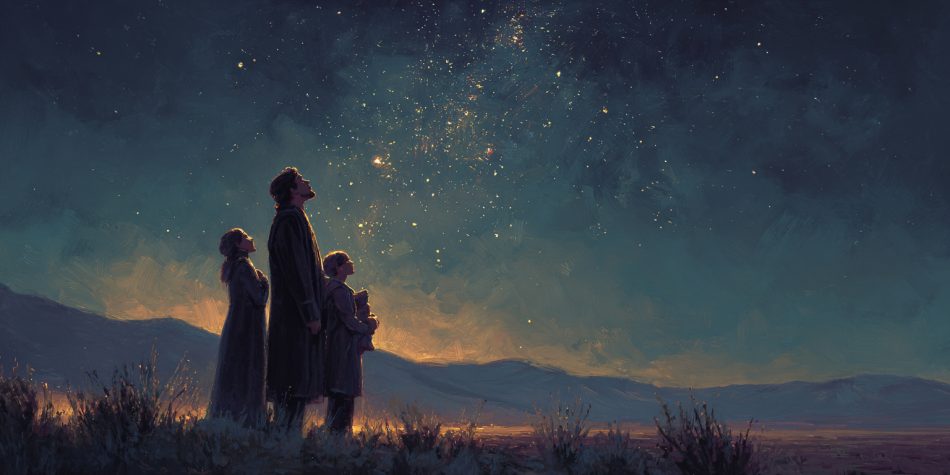
The age of flying saucers has returned.
But today it has taken on a more bureaucratic feel. The old “UFO” has become the “UAP,” an unidentified anomalous phenomenon. The phrase feels less theatrical, but the fascination is the same. Americans still want to know whether the strange lights in the sky are drones, balloons, sensor errors, secret aircraft, or something stranger.
But while these conversations have historically been sidelined as conspiracy theories that serious people don’t engage in, that has changed. Former President Barack Obama recently made headlines for saying he believes aliens are real. Congress held public hearings on UAPs, including a 2024 hearing titled “Unidentified Anomalous Phenomena: Exposing the Truth,” followed by continued congressional requests for records and video files in 2026. NASA convened an independent UAP study team and concluded that the subject deserves a rigorous, evidence-based scientific approach. Since 2010, up to 70 planets have been discovered that are in the “habitable zones” of their star systems. The 2025 documentary “The Age of Disclosure” included interviews from military pilots, Department of Defense officials, Congressional Representatives and Senators, a Former Director of National Intelligence, and the Secretary of State. And the Pentagon began its release of UFO files.
The sudden official sheen to this conversation has intensified the cultural imagination. While there have been no likely or definitive conclusions that extra-terrestrials have visited Earth, the question is being taken seriously in a way it never has before.
Aliens and Religion
A 2021 Pew survey found that just over half of Americans said military reports of UFOs were probably or definitely evidence of intelligent life beyond Earth. Religious Americans were somewhat less likely than the unaffiliated to say intelligent extraterrestrial life exists.
For many, the religious question is obvious: What would happen to faith if we discovered we are not alone?
What would happen to faith if we discovered we are not alone?
At the same time, the most careful surveys complicate the popular assumption that religion would collapse under the weight of alien life. Ted Peters’ “ETI Religious Crisis Survey” tested the idea that contact with extraterrestrial intelligence would produce a religious crisis, and found that most religious respondents did not expect their own tradition to collapse. Interestingly, religious people were often less worried about their own faith than secular respondents were about religion in general. In other words, the people most confident that aliens would destroy religion were often people outside religion looking in.
But if intelligent life exists elsewhere, how could aliens and religion fit together? How would faith survive this change to our paradigm of life and creation?
I want to explore that question within the context of my own tradition, The Church of Jesus Christ of Latter-day Saints.
In my view, Latter-day Saints are unusually well-suited to think about the possibility of alien life. That does not mean we should credulously accept every sensational claim or canonize every blurry Pentagon video. Our faith does not depend on crashed saucers, whistleblower testimony, or the latest congressional hearing. But, if extraterrestrial life were discovered—microbial, animal, or intelligent—it would not require Latter-day Saints to rebuild their theology from the foundation up. In many ways, the foundation is already there.
Latter-day Saint scripture has never pictured creation as a small, sealed human stage with Earth alone under the eye of God. It teaches “worlds without number,” heavenly parents, faraway stars, and an infinite atonement. The Restoration certainly did not shrink the Christian cosmos.
A Cosmos That is Already Full
The first reason Latter-day Saints need not panic over the possibility of extraterrestrial life is simple: our scriptures already teach that God’s creations extend far beyond this earth.
In the Book of Moses, Moses is shown a vision of the earth and its inhabitants and then learns that God has created “worlds without number” through the Only Begotten. The scripture does not explicitly state, but heavily implies, that many of these worlds were inhabited by children of God (and the chapter summary states that). It implies that these many worlds are part of God’s plan to bring to pass the immortality and eternal life of His children.
Doctrine and Covenants (D&C) section 76 is even more direct. In Joseph Smith and Sidney Rigdon’s vision of the degrees of glory, they testify that by Jesus Christ “the worlds are and were created,” and that “the inhabitants thereof are begotten sons and daughters unto God.” This is the most direct reference in Latter-day Saint scripture to inhabitants of multiple worlds. It does not merely say that God made stars, planets, or matter. He made inhabitants. And it places those inhabitants in a familial relationship to God. D&C 93 similarly teaches that worlds were made by Christ.
D&C 88 describes that Christ is the light that is the sun, moon, stars, and earth, and the light that “fills the immensity of space.” Scripture then teaches that God created other worlds, they have inhabitants, those inhabitants are children of God, and it is Christ’s light that is on all of them.
It doesn’t say what our relationship is or will be with those inhabitants of other worlds.
Modern Church leaders have repeatedly returned to this theme. Late Church President Russell M. Nelson taught that the earth is only one of many creations over which God presides, and he cautioned that our knowledge of the Creation is limited and will be augmented in the future. President Dieter F. Uchtdorf of the Quorum of the Twelve Apostles has used the vastness of the universe to emphasize not human insignificance, but divine love; the God who created worlds without number still knows and values His children.
Elder Neal A. Maxwell, who also served in the Quorum of the Twelve, made the same point. He taught that the Restoration explicitly affirms a plurality of worlds and that God’s universal majesty does not make Him less personally involved in our individual lives. He said, “How many planets are there with people on them? We don’t know. There appears to be none in our own solar system, but we are not alone in the universe. … God is not the God of only one planet!”
These scriptural statements, and the interpretation from Church leaders, establish a basic theological posture. Latter-day Saints do not approach the universe assuming that human beings on Earth are the only rational creatures God has ever loved.
Creation is Not Random
Latter-day Saint theology does not treat these worlds as mere divine trophies. The God of Moses creating these many worlds does not do so merely to display his power. He creates because He is a Father. This is the center of Moses 1. The scale of creation makes divine parenthood feel inexhaustible.
This is crucial for thinking about alien life. If there are living organisms elsewhere, they are not theological clutter. They are part of creation. If there are intelligent, morally accountable beings elsewhere, they are not an embarrassment to Christian doctrine. They would be evidence that God’s family is as large as we imagined.
Abraham 3 gives Latter-day Saints a distinctive vocabulary for this question. It speaks of intelligences, of differing degrees of intelligence, and of God as greater than them all. Whatever else this passage means, it resists the idea that human life is a late accidental spark in a meaningless universe. Intelligence, agency, hierarchy, progression, and divine governance are built into reality.
The God who created worlds without number still knows and values His children.
This matters because the discovery of life elsewhere would not mean the same thing. Microbial life on Mars would not raise exactly the same theological questions as intelligent beings with language, moral law, family, ritual, and a longing for God. A Latter-day Saint response should be proportionate. Bacteria would enlarge our sense of creation’s fertility. Animals would enlarge our sense of life’s abundance. Rational, moral beings would enlarge our sense of God’s family.
But none of these possibilities would make God smaller.
Are They Children of God?
The hard theological question is not whether extraterrestrial life could exist. In Latter-day Saint thought, it clearly can. The harder question is what kind of life it would be.
Latter-day Saint theology distinguishes between different forms of life. Plants, animals, mortals, and resurrected beings do not occupy the same moral or salvific category. So if life exists elsewhere, the first theological question would not be “Are they aliens?” It would be, “Are they God’s spirit children?”
D&C 76 provides the strongest reason to believe that at least some inhabitants of other worlds are indeed sons and daughters of God. President Joseph Fielding Smith, a former prophet of The Church of Jesus Christ, similarly taught that the Father, through His Only Begotten, created worlds without number and that these worlds are peopled by His spirit children.
That does not require us to assume that every organism in the cosmos is spiritually equivalent to human beings, but it implies we should be open to the idea that some are. It also doesn’t answer whether other worlds are populated now, were populated in the past, or will be populated in the future. But it does mean that Latter-day Saints already have a category for non-earthly persons who belong to the family of God.
This is where Latter-day Saint theology differs from a thin human exceptionalism. We do believe human beings are made in the image of God. We do believe this earth has sacred significance. We do believe Jesus Christ was born, died, and rose here. But we do not believe God’s love is provincial. The fact that He is our Father does not prevent Him from being Fathers to others.
As anyone who is not an only child knows, a sibling does not reduce the love you receive from a parent.
One Savior, Many Sheep
One of the more difficult questions about extra-terrestrials and traditional Christianity has often been the Incarnation. If Christ was born on this Earth, does that make Earth cosmically unique? Would He need to be incarnate, suffer, die, and rise again on every inhabited world? Are there multiple falls, multiple redemptions, multiple atonements?
Latter-day Saint leaders have generally answered by affirming both the local reality of Christ’s mortal ministry and the cosmic scope of His redeeming work.
Nelson taught that the Atonement of Jesus Christ is infinite, not merely in duration, but in scope, extending to all humankind and to the infinite number of worlds created by Him. This gives Latter-day Saints a powerful doctrinal framework. We do not need to imagine a weak, local Christ whose saving power stops at the atmosphere. Nor do we need to multiply incarnations beyond what has been revealed. We can affirm what scripture and prophetic teaching affirm: Jesus Christ is the Only Begotten of the Father in the flesh, the Creator of worlds, the Redeemer, and the Lord of the universe.
That does not resolve every mechanics-of-salvation question. But questions remain even without the addition of extraterrestrial life. If intelligent beings on other worlds fall, how is Christ revealed to them? What ordinances do they receive? Do they have prophets? Do they have scriptures? We don’t know.
The Book of Mormon prepares Latter-day Saints for the idea that God’s dealings with one people are never the whole story.
In 3 Nephi, Jesus tells the Nephites that He has “other sheep” who are not of Jerusalem and not of the Nephite land, and that He must go show Himself to them. I’m not suggesting Jesus was implying he was visiting other worlds, but underlining the idea that there are always more children of God for Christ to minister to.
Christ’s self-disclosure is not limited to the records we presently possess. There are divine visits not recorded in our canon. Latter-day Saints have an open canon. If God has had dealings with other worlds, that would not offend the structure of our faith.
Do we know? No, but not being told is not the same as being trapped. Latter-day Saints are comfortable with revealed patterns and unrevealed details. We know enough.
What If They Are More Righteous Than We Are?
Latter-day Saints should be cautious about imagining ourselves as cosmic tourists or missionaries. We have been given commandments, covenants, priesthood keys, and missionary obligations for this world. We do not possess a revealed commission to carry ordinances to hypothetical civilizations in another solar system. If God has children elsewhere, He is capable of revealing Himself to them, calling prophets among them, appointing ordinances suited to His law, and gathering them in His own order.
The fact that He is our Father does not prevent Him from being Fathers to others.
The aliens say that they love Jesus, and that He comes to visit every few years.
The pope is shocked. “Every few years, but He hasn’t even come a second time yet?”
The aliens feel bad, and try to help, “Maybe He doesn’t like your chocolate.”
The pope confused asks, “Chocolate? What does chocolate have to do with anything?”
“Well,” the aliens explain, “every time he comes we give him a big basket of chocolate. Why, what did you give to Him?”
Jokes aside, another possibility is exactly what the joke posits, that intelligent extraterrestrial beings do exist, and they are not invaders or monsters or lost pagans waiting for us to teach them about God. They might be more obedient, unified, humble or righteous than we are.
Again, Latter-day Saint scripture leaves room for such a possibility. Abraham 3 teaches that intelligence differ and that God is greater than them all. This should help discipline our imaginations. Much of our alien fiction is really human self-projection. Sometimes aliens are our fears, sometimes our aspirations. Latter-day Saint theology gives as a less sentimental and more serious possibility. Other beings could simply be God’s children. Some wicked, some innocent, some righteous.
What if There is No Alien Life?
A sound theology must also account for the other possibility: that we may never discover intelligent extraterrestrial life. The current evidence certainly does not prove alien existence, let alone alien visitation. Serious Latter-day Saint thinking should not build spiritual excitement around speculation that may collapse under scrutiny.
If no alien civilization is ever found, however, Latter-day Saint theology remains untouched. “Worlds without number” does not need to mean that human scientists in 2026 can identify, contact, or verify those worlds. God’s creations may be distant in space, separated by time, hidden by limits of observation, or simply beyond our stewardship.
This helps protect us from two opposite errors. If the skeptic says, “If aliens exist, religion is false,” and enthusiasts say “If UAPs are real, my religion is confirmed,” Latter-day Saints should reject both. Our faith is grounded in Jesus Christ, his covenants, and the witness of the Holy Ghost—not in the newest unidentified object.
The Restoration gives us a capacious cosmos, but it does not require gullibility.
A Theology Big Enough for Discovery
So where does that leave us?
No matter what we discover, or don’t discover, the theological center holds. The Latter-day Saint doctrine of creation is already cosmic. The doctrine of God is already parental. The atonement of Christ is already infinite. And our understanding of revelation is already open.
Not every speculation has, or even needs, an answer. We do not know whether any UAP represents extraterrestrial intelligence. We do not know what they look like, we do not know what their history is, or what their relationship is like to Christ.
But we know enough that we do not need to fear that a discovery of aliens will upend our theology or understanding of the cosmos. We already know our Earth is small, but important eternally.
The discovery of alien life would not make the gospel any less true. It might just remind us that God’s household is larger than we suppose. That wouldn’t upend our beliefs. In fact, it sounds quite familiar.