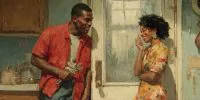
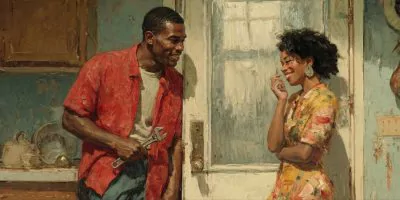
Summary – Pyre joins Taba in talking with Prophet Onias about how Ron’s belief that he is the “One Mighty and Strong” tempted him into immoral behavior. In a flashback, Ron interrogates Matilda about the warning she gave Brenda and gets information about who helped Diana disappear. He comes up with the removal revelation, which Onias immediately rejects, but Dan pushes back, saying his doubts are just what an unbeliever would say. Ron brings out a blade he’s “consecrated” for the purpose.
In the present, Pyre finds out that Ron has Diana’s address in Florida because their son sent a letter with a return address. Pyre struggles in his office to write out a testimony, presumably to give in church to fulfill his wife’s requirement or he quips to Taba he’ll “be single by fall.” Pyre is talking to Allen again when an unidentified church leader is brought in by Taba (I’m still not sure if it’s the stake president or a seventy). The church leader again pressures Pyre to wrap the case up, saying the church doesn’t need more bad press after the 1978 revelation and the “communists at the NAACP.” He then regales with Taba about how his “Lamanite” ancestors helped the Saints in the Mountain Meadows Massacre. Allen and Taba both dispute this interpretation, and the church leader leaves after brushing the dust off of his shoes against them.
The detectives call the Florida police to do a welfare check on Brenda. They break into her home and find no one there, but security footage from a local store shows Diana and her kids at the grocery store four days ago. She looks behind her and is frightened by something, causing her to leave the groceries on the counter and quickly exit the store with her family.
At the police station, Jacob Lafferty, the mentally handicapped brother, wanders in and briefly causes a tense situation before turning over Dan’s journal to the police. Turns out he was the one who bolted from the cabin in episode 3. He was under orders to protect “God’s word” but heard the press conference and wants to help solve Brenda’s murder because he had a crush on her. Pyre reads the journal, which reads like scripture, and finds out that Dan and Ron were holed up in Las Vegas earning money by gambling when they received the “revelation” that it was time to start the killing. Somehow (it’s not clear how) he knows that at that point Diana called Brenda to warn her and also called the prophet, which Pyre calls “bold as it gets for a woman.” He wants to fly out to Florida immediately to look for Diana.
While he’s packing for the trip, Becca Pyre walks in. She’s disappointed he’ll be skipping out on Sunday’s testimony meeting. We find out that she’s the one who called the church leader on him. Pyre again orders her not to interfere with his investigation, pulling rank as the priesthood holder again. He claims that early church leaders saw “little girls and women as eternal servants” and that he’s afraid of what will happen to his daughters in the church.
Ron’s car is located in Cheyenne and so the detectives are rerouted to there to investigate. They find the two strangers, Ricky and Chip, identified by Ma Lafferty in a previous episode. Ricky and Chip claim Dan and Ron are in Reno trying to make more money so they can finish their list, and that they stole the car to get away because they were disturbed by the murders. In flashback, we see Ron and Dan preparing for the murders at the Lafferty house, leaving Sam and Jacob behind. They stop by Robin’s home to ask for his rifle but he doesn’t have it. Ron leans in and kisses Robin on the mouth and then leaves.
Now we come to the actual murder. Ron knocks on Brenda’s door, but no one answers, so they drive away. Brenda comes in from the backyard, calls Allen worried that there’s someone at the door, but no one is there. She goes out to check the mail and finds a letter from Diana which she writes a reply to. Back in the car, Dan stops in the middle of an intersection and attempts to wrest religious control back from Ron, saying that this was just a test of their faith and they should go back and try again.
This time, Dan knocks on the door. Brenda answers and immediately tries to shut the door. She is overpowered by Dan who knocks her to the ground. She tries to convince Ron that this isn’t who he is and quotes scripture to them about being cast to outer darkness and testifies that she knows God will make her whole again. Ron cuts the cord from the vacuum cleaner that will be used to strangle Brenda before the camera cuts away to Dan and Ron leaving the house covered in blood. They drive to the Lows, find them not home, and miss the turn to the stake president’s home. Dan interprets this as a sign that they should stop killing and regroup, focusing on Diana so that he can keep Ron involved.
Pyre and Taba are searching on the side of the highway where Ricky and Chip have told them the Laffertys discarded the weapon. Pyre worries that the men lied because they are atheists, but Taba asserts that it’s Mormons who have an allergy to facts. He shares the version of the Mountain Meadows Massacre that he was taught as a child, and eventually they find the murder weapon on the side of the road.
The detectives return to Reno to search for the brothers, with Pyre trying to get details without a warrant by reminding the casino owner that “if there’s one thing our people have in common, it’s that we hate the feds crawling around our home.” They hear back from the Florida agents who have found Diana and her kids safe, but when Diana hears that Brenda has been killed, she worries for Matilda’s safety and runs off to rescue her. The detectives finally catch a glimpse of the Laffertys on a security camera, kneeling down to pray because they won at the gambling table.
The footage was from two days ago, which makes Taba question why they haven’t already killed again. Taba asks Pyre to use his insider knowledge to tell him, “According to your god, who dies next?” Pyre is baffled by Taba placing the blame on him, and Taba pulls over and walks off into the landscape. They have a discussion about appreciating the beauty of nature without believing it comes from God. Pyre suddenly becomes a fountain of wisdom about the Utah war and fundamentalist interpretation of the “One Mighty and Strong” phrase, and realizes that only one Lafferty brother can claim the title. They decide to go back and check the morgue in case one brother murdered the other before taking off.
Diana arrives at the Lafferty home, whispering phrases to herself from Brenda’s last letter to give her courage. She finds Matilda and convinces her that she isn’t safe. They take off, but are chided by Ma Lafferty who says, “You can abandon Zion, but you’ll never escape his wrath,” and starts calling backup as soon as they leave. Sam catches up with the women at a gas station and tries to threaten Matilda back into the car. But Diana yells at him to bear his testimony and accuses him of not being chosen, and eventually she is able to drive off with Matilda and they cross the Utah border into safety.
Back in Reno, the cops do a quiet raid on the casino trying to flush out Dan, who we see hiding in a toilet stall. Ron is at the sink, and he claims to have received another revelation that Dan is a false prophet and must perish. Dan questions if he’s going to blood atone him, but Dan says no, he won’t spill his blood so that he can’t be forgiven. A struggle ensues between the two brothers, and Pyre breaks in just in time to save Dan from being strangled to death. Both brothers are taken into custody, while Dan yells about whether Abraham and Brigham Young were considered criminals too.
Taba has a last conversation with Pyre, who is confused about how to move forward now that he no longer believes. Taba shares with him the Catholic prayer he was forced to recite in school, then does an imitation LDS prayer. Finally, he ends by reciting a Paiute prayer, one that asked that the white men would vanish and the buffalo return. Taba says he doesn’t believe this prayer holds any power, but he still likes to say it because it reminds him of home. Pyre goes home to his family and says a family prayer with them. The series ends with a clear indication that Pyre has adopted Taba’s view of appreciating Mormonism as a cultural and family thing, but no longer with any real belief.
Church History – During this episode, we see the Mountain Meadows Massacre from two perspectives, neither of which reflects the church’s current official position on what happened. The church leader in the episode paints Brigham Young as ordering the massacre, a point of view that has no historical support. His supposed reasons are that the wagon train contains remnants of the mob that killed Joseph, that they are wealthy, and that he wants to make an example of them to keep “gentiles” out of the territory. Taba’s version says that the settlers tried to trick the Paiutes into doing their dirty work for them, then when they refused to, disguised themselves as Indians during the slaughter. The real story is complex and painful, and the documentary evidence leaves many questions which I’ll leave to historians. There is little doubt that the massacre is one of the saddest and most horrifying incidents in our history, yet it can’t be said to be generally representative of how the early Saints behaved.
Shibboleths – The idea that Pyre’s wife would order him to bear his testimony in sacrament meeting was weird enough, but the idea that Pyre would write out a testimony is also foreign. Testimonies are typically given spontaneously and not prepared in advance; you’d get the cultural side-eye if you appear to have prepared remarks. I can give this a slight pass as Pyre is under a lot of pressure from his wife. The show also seems to think that “this I know to be true” is some sort of magic testimony phrase, repeated at several points in the show. I can’t say it’s one I hear often, and the backward syntax sounds strange to me. There are some set testimony phrases members use, but this isn’t one of them.
Pyre again uses “the brethren” to refer to his local church leaders, which is not what you would call them. Again, your local leaders are volunteers, your neighbors and friends, and change every few years. Having this kind of attitude towards them as some big, permanent judgemental force is weird. Becca Pyre says the church leader who came to the police station is “my general authority too.” We generally use “general authorities” as a collective noun of the leadership of the church. If Becca was talking about a specific person, she would most likely have used his actual calling, for example seventy, area president, or apostle. Since the show has been very incorrect about the nature of the LDS hierarchy, I’m not surprised that the audience is given no idea who this person is supposed to be.
A voiceover from his daughter’s notebook has her saying “The pioneers’ blood spilled out onto the ground, so I know my own trials will make me stronger.” This phrase is contrived to pull in a reference to blood atonement; I can’t imagine any of my kids being taught that in primary (the church’s children’s organization). We do talk about how the pioneers were able to make it through trials because of their faith, in the same way you might talk about any historical hero who shows the ability to overcome hard things, but the blood-spilling phrase is not a thing.
The Pyres end the series with a family prayer holding hands in a circle. This practice is foreign to most members of the church; we don’t have a tradition of holding hands during prayers (outside of the temple). There may be a few families who do it, but it’s not typical.
Neutrality in History – Allen claims that historians who work for the Church or BYU are untrustworthy by virtue of their association with the church, and that the church “twists arms” to come to favorable conclusions. No doubt, those employed by the Church have a certain perspective on history and a motivation to find evidence to support what they believe. And the Church is as unlikely as anyone else to employ someone who disagrees directly with their truth claims. But most histories criticizing the church are hardly from a “neutral” perspective either: many are by ex-Mormon angry at their former faith or members of other religions with the specific goal of getting people to leave the church. In reality, history cannot really be from a neutral perspective, in that all history is tied to where we are today, be that through culture, politics, or religion. Though we all look at the same evidence, in many cases, different perspectives are valid and can’t be proven (at least until time travel is invented).
That being said, the Church was more heavy-handed about its official historical positions in the 1980s. Nuance has come a long way since then: the book on the Mountain Meadows Massacre published by the church was called “the most professional, transparent account of a controversial event in Mormon history produced under church auspices” by the Journal of American History. This is perhaps the problem with producing a show set nearly 40 years in the past and using it to critique the modern institution.
Rings True – We get a glimpse of a classic “Families are Forever” cross-stitch framed on the Pyre’s wall. It’s not the exact one that was hanging in the hallway of my childhood home, but it’s an instantly recognizable piece of LDS folk art. I laughed out loud when Diana told Matilda to “get in the frickin’ car,” which is a typical LDS swearing substitution. Brenda’s courageous last words to the Laffertys quoting D&C 76 and bearing testimony of the resurrection sound exactly like something she would say in the face of persecution and certain death. They would not sound out of place being quoted over the pulpit in general conference. It’s nice to know that amid all the things this show gets wrong about the Latter-day Saints, the one thing it does get right is the triumphal testimony of this daughter of God. Consider honoring her memory by reading more about the real Brenda Lafferty.