If you attend a religious school, receiving a scholarship from your state might be harder than it’s been to find toilet paper during this pandemic.
But that’s not the way it should be (for either commodity).
The reason for scholarship scarcity has little to do with supply or demand and a lot to do with discriminatory provisions found in many state constitutions. Known as Blaine Amendments, these provisions prevent state funding from making its way to religiously affiliated entities. At first glance, such restrictions might seem consistent, even mandated, by the First Amendment’s Establishment Clause, which prohibits Congress from making laws “respecting an establishment of religion.”
The problem is that Blaine Amendments prohibit funding solely on the basis of the entities’ religious affiliation and without consideration of the funding’s actual purpose, such as education.
Blaine Amendments have been controversial since their rise in the late 19th century, so why raise the issue now? Because a decision the Supreme Court will deliver this year could finally settle their constitutionality.
The upcoming decision of Espinoza v. Montana will address the cancellation of a Montana scholarship program that allowed the application of state-provided scholarships to primary and secondary schools of choice, including religious schools. The Montana Supreme Court struck down the program because it violated Article X section 6(1) of Montana’s Constitution (Montana’s Blaine Amendment) by indirectly providing aid to religiously affiliated entities.
The Espinoza case raises the question of whether Montana’s Blaine Amendment and others like it violate the U.S. Constitution in the first place. It’s time for the Supreme Court to stop skirting the issue and be clear: Blaine Amendments are unconstitutional.
Blaine Amendments infringe on individuals’ free exercise of religion and discriminate against religious institutions and those who choose to attend them.
While government and religion certainly need some separation for their own sakes, Blaine Amendments unnecessarily restrict government and religion from even interacting with each other. They conflate constitutionally appropriate forms of funding with the establishment of religion. They deny individuals from receiving publicly available benefits, such as education, simply because individuals obtain those benefits through entities with religious affiliation. And they inhibit individuals’ free exercise of religion by unnecessarily constraining choices, such as where a student can attend school.
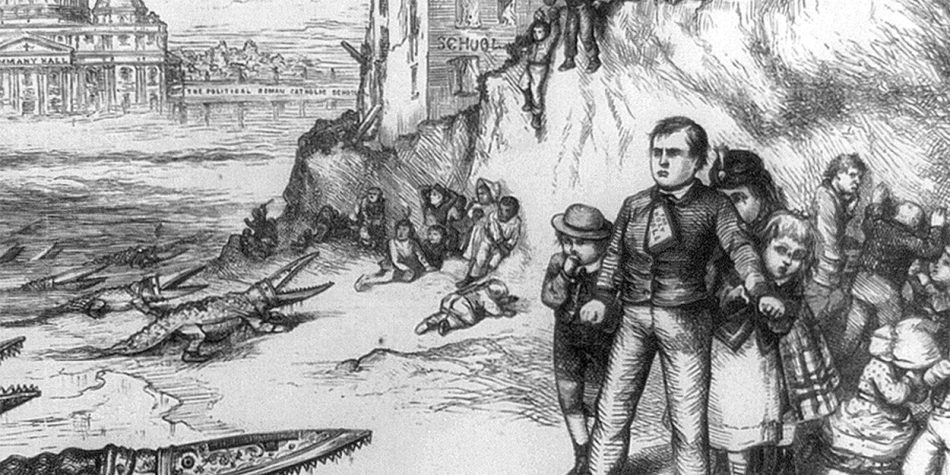
A cursory glance at the history of Blaine Amendments reveals their root in 19th-century anti-Catholic bigotry. In the mid-19th century, Catholic immigrants began establishing private schools as alternatives to public schools (which incorporated Protestant Bibles, hymns, and other traditions at the time). Anti-Catholic political forces, particularly President Ulysses S. Grant, insisted that Catholic “sectarian schools” not receive any government funding, making them less competitive with the public yet Protestant-influenced schools.
At President Grant’s urging, House Speaker James Blaine proposed a federal amendment in 1875 that implemented Grant’s anti-Catholic intent by prohibiting any state funds from flowing to religious schools. The proposed amendment wasn’t ratified, but it spurred a wake of state Blaine Amendments. The political pressure that Blaine Amendments be included in a state’s constitution for the state to be admitted to the Union likely influenced their nationwide proliferation; today, nearly three-quarters of U.S. states have one, according to the Institute for Justice.
The historical record is clear that Blaine Amendments emerged with discriminatory intent. But bigoted history aside, is there any merit in their provisions? After all, the government constructing churches, sponsoring proselytizing efforts, or paying pastors—forms of direct funding from state to church—seem in obvious violation of the Establishment Clause. However, the Court made clear in Trinity Lutheran v. Comer (2017) that “denying the Church an otherwise available public benefit on account of its religious status” is unacceptable. There must be other reasons, such as evidence that the funding would establish religion (as the examples above would seem to indicate), to deny religious institutions the opportunity to apply for funding. Blaine Amendments, however, prevent religious entities from being able to apply in potentially permissible cases.
Of more concern than prohibitions on direct funding, however, are the prohibitions on indirect aid that many Blaine Amendments carry. This restriction results in consequences where students who are eligible for scholarships cannot apply them at religious schools.
To think about this another way, imagine your teenage daughter needs a new pair of shoes. Remembering how she detested your “horrible” fashion sense the last time you bought her a pair, you offer a different option: You’ll provide a reasonable amount of money to accomplish the task on the condition that she buys comfortable and high-quality shoes.
As long as she actually spends the money on shoes that meet your requirements, you don’t really care what they look like (well, at least not that much) or where she got them. Nor would you say that her choice means you’ve endorsed the trendy teenage store she found them at (which you probably didn’t even know existed). Your interest was not in where she obtained the shoes but rather that she obtained them.
Likewise, when the government provides scholarships to students, the schools that students choose to attend do not inherit status as government-preferred or endorsed. What the government has established is not religion but educational opportunity. So long as the religious schools meet the educational standards set by the state, they need not be deemed ineligible for the application of state-funded scholarships.
Therefore, when a government indirectly aids a religiously affiliated entity, particularly through a scholarship, “establishment” of religion is not happening. The Supreme Court made this clear in Zelman v. Simmons-Harris (2002), writing that when “government aid reaches religious institutions only by way of the deliberate choices of numerous individual recipients,” the aid is constitutional.
Furthermore, a student’s choice to attend a religiously affiliated school may have little or nothing to do with a student’s religious beliefs, so denying a state-funded scholarship on the notion that the individual’s choice establishes religion is ironic and unfair.
On the other hand, the decision to attend a religious school may be highly motivated by an individual’s religious beliefs. Although attending the school is often not essential to observe one’s religion, the religious motivation to attend and the freedom to do so can reasonably be considered part of an individual’s “free exercise of religion,” a claim protected by the First Amendment. But Blaine Amendments infringe on this exercise.
Supreme Court precedent is clear that there are situations where state funding can constitutionally flow to religious entities, especially when the aid is indirect. But Blaine Amendments get in the way, infringing on individuals’ free exercise of religion and discriminating against religious institutions and those who choose to attend them.
Unlike the toilet paper crisis, this is an issue the Supreme Court can solve. It’s simple: call out Blaine Amendments for what they are—unconstitutional.