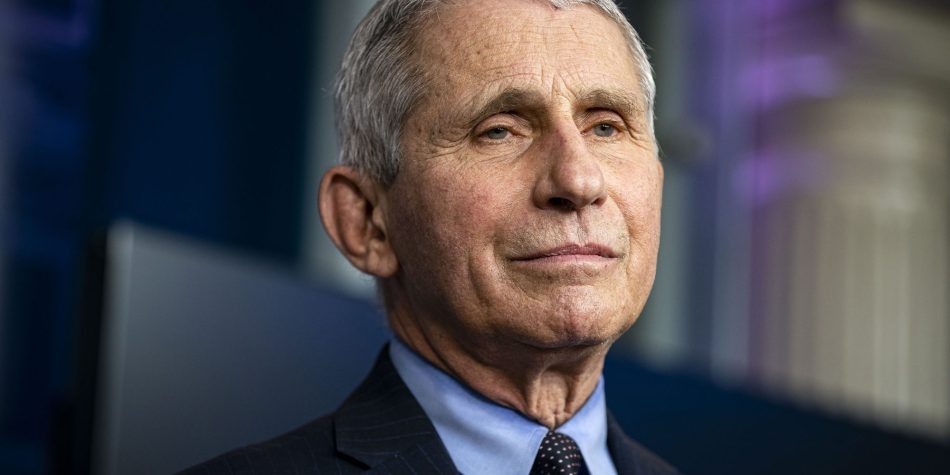
When Dr. Fauci’s emails were released last week, it should have surprised no one to see the reaction well-known to everyone—on virtually every issue.
Deep disagreement on what something means runs along strict partisan lines. With Fox News et al., showcasing the email dump as a “smoking gun,” and MSN/CNN/Wapo doing a great job of conveying the “nothing to see here … move along” opposite, can you blame many Americans for being confused at what it all means?
One thing more and more people are agreeing on during this week of political news, however, is that the lab-leak theory deserves more respect than has been given to it. When people began raising this idea earlier in 2020, they were widely accused of being either bigoted or conspiracy theorists—with social media bans swiftly following.
Yet even Facebook is regretting that decision and reversing course—which makes this, in our view, a valuable moment to consider another question overarching this whole situation—and the entire last year.
On one hand, are those who see misinformation (about COVID, or vaccines, or the election) as the most significant threat to our ability to talk in healthy ways together. On the other hand are those who see censorship (about all these same issues) as the most significant threat to our ability to talk in healthy ways together.
Which of those describes you? If the former, you are likely encouraged to see social media companies step in to limit the expression of those raising serious concerns about prevailing policies or decisions. If the latter, you are likely troubled, even horrified by the same.
Whether you celebrate ongoing restrictions on political and health speech online—or whether you see them as a modern threat to crucial freedoms—depends on how you answer this question.
So, what is it that leads people to arrive at such different conclusions? And what differentiates between these groups? These two groups of Americans look for their answers and guidance from very different places.
So, in other words, these differences cannot simply be written off yet another reflection of partisan differences. If there was some way to force-choice Americans to divide into these two groups—“Misinformation is the great problem” and “Censorship is the great problem”—what main differences (and commonalities) would you find?
Who and what we trust. Compared with the latter group, the former group seems to still place a great degree of trust in “official” pronouncements. For these people, a statement from someone associated with the WHO, CDC, FDA (or any number of professional organizations) is as trustworthy as you can get.
By comparison, the latter group sees these “official” pronouncements as more suspect—not less —in terms of validity. If not some grand malicious conspiracy (which increasing numbers do insist upon), these people still see “something more than science” (or good governance) going on —with the influence of power and money in the execution and interpretation of research, and the making of policy, not far from their minds.
As a result, these two groups of Americans look for their answers and guidance from very different places. Rather than awaiting the next update from the CDC to “see what I can do,” the censorship-worried Americans are relying on their own sense based on conversations with loved ones and their own study.
To others, of course, this kind of epistemology feels downright reckless. Why would you trust your own intuition over the collected wisdom of dozens or hundreds of subject matter experts each with decades of experience? Thank goodness for those who’ve dedicated years to learning these subjects so they could lead us right.
Rather than a merely left-right divide, then, this reflects a divide in who and what we trust. One woman went so far as to suggest that this may be among the greatest divides in America today: essentially, who trusts mainstream media to deliver accurate and valid information today?
We’ve said a lot here about this divide between those emphasizing misinformation versus censorship as the central problem, but we end now with what should perhaps be obvious, (but which is very not in this hyper-polarized environment). Namely, that it’s possible to be concerned about both. And, indeed—many clearly are.
Yet isn’t it interesting in a reactive atmosphere how we get sorted out into respective teams—with public messaging then bifurcated strictly along the “who’s rooting for the Yankees?” versus “who’s going for the Red Sox” sort of divide?
“No,” someone says, “I really see real value in both teams—and find good things I like in each.”
Ummm, what?!! That’s about how more nuanced commentary on these kinds of questions is received today—with many seemingly unable to grasp how someone couldn’t simply be rooting for “their team” (in this case, the “misinformation is the great problem facing America” team— or the “censorship is taking over America” team).
Misinformation and censorship are both problems in America.
If all you care about is winning a championship, that makes a lot of sense. But if it’s truth we’re actually after—the full truth, and nothing but that—it might be time to breathe deep and rethink how we’re doing this whole thing. When it comes to the truth we shouldn’t root for a team, we should be attempting to build an all-star team.
Misinformation and censorship are both problems in America. Rather than solving the misinformation problem by turning a blind eye to censorship (or trying to solve the censorship problem by winking at misinformation), maybe it’s time to do something entirely different. Let’s first remember we’re on the same actual team (Americans, human beings on the same planet, children of God—and hence, brothers and sisters).
Maybe then, we could put aside the games we’re playing, and figure out how to grapple with both problems with wisdom and generosity.