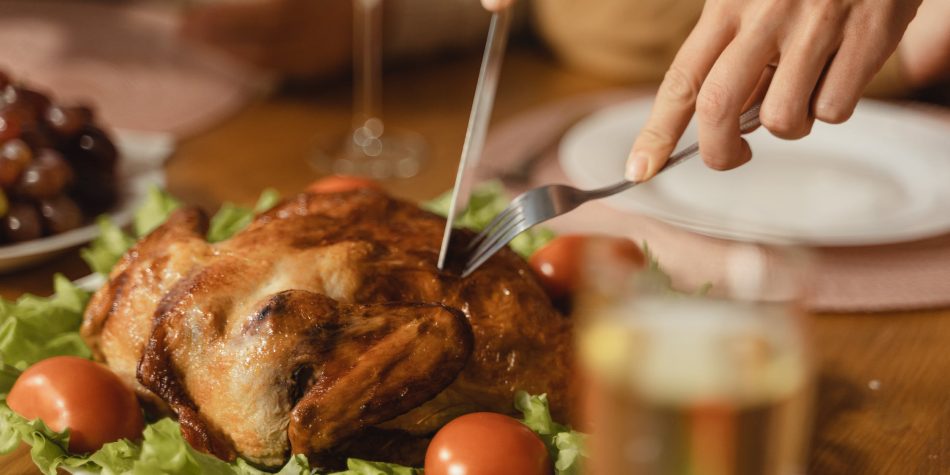
Every Who Down in Whoville Liked Thanksgiving a lot … But staring down with a sour frown at the warm lighted windows below in their town, emerged something on Holiday Eve, snarling with a sneer.
Growling, with fingers nervously drumming, this thing said “I MUST find some way to stop Thanksgiving from coming!”
For soon, the Whos, young and old, would sit down to a feast. And they’d feast! And they’d feast! And they’d FEAST! FEAST! FEAST!
They would feast on Who-pudding, and rare Who-roast beast. Which was something this monster couldn’t stand in the least! [Adapted from How the Grinch Stole Christmas, Dr. Seuss]
******
Next week is Thanksgiving in the U.S.—a ritual at least as special to many as anything else that happens all year. And like everything else important this year, COVID-19 is threatening to unsettle—even cancel—the whole affair.
That’s already happened for a large number of Americans who altered their holiday plans weeks earlier. But many others are still grappling with what to do—especially in the wake of new CDC guidance, stating that “the safest way to celebrate Thanksgiving is to celebrate at home with the people you live with.” An open letter from major medical organizations also said, “We are all weary and empathize with the desire to celebrate the holidays with family and friends” while encouraging Americans to wash hands and maintain distance—“celebrat[ing] responsibly in a scaled-back fashion.”
Citing such guidance and a growing COVID-19 case count across the country, state executives have taken one step further than encouragement alone, to issue a wave of new mandates and restrictions.
Governor Cuomo restricted public and private gatherings in New York to 10 people aside from residents—with New Jersey and Connecticut issuing similar rules. Michigan banned indoor gatherings of more than two households; and Vermont and Washington State barred indoor gatherings outside of immediate households. Several cities and towns, including Philadelphia and Chicago, have also enacted gathering limits.
As holiday-specific restrictions began to be announced in New York, some public officials likewise dissented.
As a result, AAA Travel said last week that it anticipates at least a 10 percent drop in travel this Thanksgiving—with car trips projected to fall 4.3 percent.
The push-back. Others have expressed hesitance—and even open resistance: “Yeah, that’s not gonna happen, sorry sir. I will see my family and do our normal traditions.” Another commentator, Eric Betsicola, said, “Hmmm, after consideration … I’ll take my chances.”
As holiday-specific restrictions began to be announced in New York, some public officials likewise dissented. One sheriff’s office said it would never interfere with “the great tradition of Thanksgiving dinner”—with another sheriff vowing that his deputies would not go “peeking in your window” to count the faces around a table. A third New York sheriff said that entering residents’ homes “to see how many Turkey or Tofu eaters are present is not a priority.”
Some law enforcement have admitted they simply don’t have the resources needed to check on Thanksgiving gatherings or to wait for the search warrants that would be required to enter homes. Others object at a deeper level. As one sheriff said, “This national holiday has created long-standing family traditions that are at the heart of America, and these traditions should not be stopped or interrupted by [government] mandates.” One police commissioner said the Police Department was “not planning on breaking up Thanksgiving celebrations” with another telling the public, “Don’t feel a need to hide cars, cover with leaves or walk 3 blocks so your house doesn’t become a target of the Governors [executive orders].”
That same sheriff questioned the constitutionality of Mr. Cuomo’s mandate, adding that he could not “in good faith” defend it. One elected leader in New York said he believed the mandate was “unconstitutional as does pretty much every sheriff I’ve spoken to.”
It’s not just law enforcement balking. Justice Samuel A. Alito Jr. told a prominent conservative legal group that the pandemic had brought “previously unimaginable restrictions on individual liberty.”
The push-back on the push-back. Others, of course, suggest these restrictions are sensible expectations to protect public health as a whole. One commentator said, “Thanksgiving dinner, Christmas funeral. Why would anyone want to take such a chance when a vaccine will be available in a few months?” And another commentator, Charissa West, said, “I’m not going near anyone but the people in my household.” A third, Olivia Bylund Smith, said “I’ll listen to the expert. Sure don’t want to be the client of the funeral home.”
Other law enforcement officials are warning they will be responding when the public alerts them to larger gatherings happening—with one sheriff saying, “There’s nothing wrong with people fearful of the police coming to your house if that’s what’s going to keep you from having 30 people over at a super-spreader event.”
Another commentator remarked, “My 86 year old mother, who lives alone, has insisted that we not do Thanksgiving. We were going to take tests, quarantine, etc., but she feels it is best to postpone this year’s holiday. If my mom can do it, why on earth can’t other families limit their gatherings?”
To that, another responded, “The point is, I think, that it should be up to people like your mom to make this decision; not the heavy hand of the Governor’s office. Each region, in fact, each family, is in a different set of circumstances and should make the decisions on gatherings for themselves.”
As one woman, Kim Rabenhold agreed: “Listen and learn as much as you can, make your own decision. And as long as everyone is honest about how they’re taking precautions, you can decide for yourself if you want to have them in your home and at your table. Keep an open mind, respect others’ wishes, and do the things that make you comfortable.”
Caution and thoughtful care can go a long way. Linda Maire added, “People, just use some common sense. … Don’t invite everyone and their brother. Keep it small and close. Just those in your circle. Be safe. There’s no reason not to have the holiday; just don’t over-invite.”
Holding competing ideals in balance. Rather than oversimplify this to a debate between safety and connection, we would argue this is about the difficulty of holding competing ideals in a healthy balance.
It’s true that we must grapple with public health. COVID-19 is certainly the dominant public health concern. But there are other health concerns that can’t be simply dismissed either. For instance, at a time when many young people are grappling with mental health, college students returning home for the holiday are being told:
They should isolate themselves and limit interactions with friends on campus before their return. Once home, they should try to limit interactions with family members, interact outside rather than indoors, and wear masks indoors if a family member has a chronic condition that places them at risk.
Certainly, we shouldn’t be surprised that the clash between these important values of safety and connection.
And one public health official admitted his own parents are “imploring him to come home” after not seeing family for many months, but that “he himself is not going to visit his parents.”
By contrast, Dr. Scott W. Atlas has argued against excluding older people from Thanksgiving gatherings, saying that isolation “is one of the unspoken tragedies” of the pandemic.
At what point does the lack of connection hurt us compared to the health risks themselves?
And in the other direction, at what point does the insistence on connection compromise and harm our health?
No one knows perfectly, of course—and these are hard questions to answer in the aggregate.
Certainly, we shouldn’t be surprised that the clash between these important values of safety and connection (which has been here from the beginning) is accentuated during the holidays.
A Holiday Spirit Transcending Any Distance
We might ask, what does it mean to celebrate Thanksgiving? Does it really require everything we are accustomed to? Would it be ruined without being together in person?
For some, the answer to that will likely be yes. And for others, they will find creative ways to preserve the holiday spirit even while being away from each other (this won’t be the first time people will try to show love across required distances—something our Latter-day Saint missionaries appreciate well).
Of course, in the end, the Grinch was astounded to learn that the spirit of the Christmas holiday wasn’t in the material aspects he had tried to steal. It was something that transcended what he had robbed.
Maybe that can be the case here—regardless of the decisions families are making about the gathering, and even if different people are making different decisions.
Perhaps the true spirit of Thanksgiving (and soon-to-be Christmas) can prevail over this all. As the revered story ends:
Christmas Day will always be
Just as long as we have we.
Welcome Christmas while we stand
Heart to heart and hand in hand.