Originally published Dec 22, 2020, at TheFamilyProclamation.org as “Why Seeing Christ as an Unborn Baby Will Change Your Christmas Forever”
Before the manger. Before the star. Before the shepherds. There was a mother and her unborn baby.
On a day that would not only change her life but the lives of countless others throughout eternity, Mary learns that she is chosen by God to be mother to the Savior of the world. After faithfully accepting the most important call in human history, she conceives through the power of the Holy Ghost (Luke 1:35).
The angel also tells her that her cousin Elisabeth is miraculously expecting a baby and is “in her sixth month” of pregnancy (Luke 1:36). And in haste, Mary prepares for a trip to the hill country of Judea to visit this older cousin Elisabeth—the one person in the world who would understand and the one person who God had prepared to help her. The Greek translation of the word “haste” or “speed” is spoudē, which also means “diligence,” “eagerness,” and “earnestness.” This tiny, unborn baby knew he was in the presence of the Messiah.
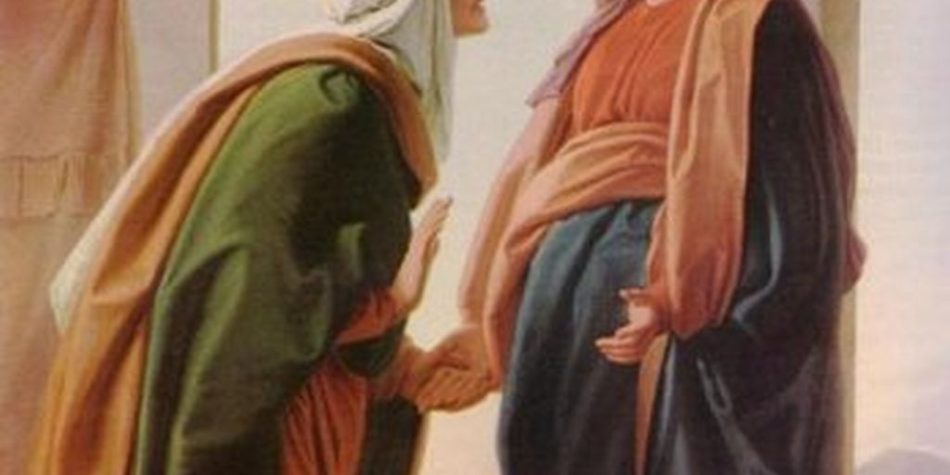
An unborn baby leaping for joy. At the end of this faith-filled journey, Mary goes to the door of Elisabeth’s home and calls out to her. What happens next is remarkable:
And it came to pass, that, when Elisabeth heard the salutation of Mary, the babe leaped in her womb; and Elisabeth was filled with the Holy Ghost: And she spake out with a loud voice, and said, Blessed art thou among women, and blessed is the fruit of thy womb. And whence is this to me, that the mother of my Lord should come to me? For, lo, as soon as the voice of thy salutation sounded in mine ears, the babe leaped in my womb for joy (Luke 1:41-44).
We often speak of this element of the story in passing. But, think of the significance: the baby in Elizabeth’s womb leapt for joy when he heard the voice of the mother carrying the Christ-child. This tiny, unborn baby knew he was in the presence of the Messiah.
Throughout this chapter, these remarkable women testify about the divinity and mission of the babies they were carrying, as they embarked on a journey with a story unlike any other.
‘Before I formed thee … I knew thee.’ Dr. Betsy Barber, associate professor of psychology at Biola University, shares the following insight about this joyful response:
Jesus and his cousin, John, … are yet both clearly present as themselves. Baby John the Baptist is leaping for joy in his mother’s womb at the presence of the Lord, whom he will follow and die for. Here we see the apostle already established as a person by God and recognized by his parents, acting with intention: “leaping for joy” inside of his mother. And Jesus the Messiah is established as himself, too, with Elizabeth calling Mary “the mother of my Lord.”
“Established as a person”…”leaping for joy.” The implications of these passages in Luke for important issues we are grappling with in society today are powerful. But there are many more that teach us this same truth:
- “Before I formed thee in the belly I knew thee; and before thou camest forth out of the womb I sanctified thee” (Jer. 1:5).
- “For I know the plans I have for you,” declares the Lord, “plans to prosper you and not to harm you, plans to give you hope and a future” (Jer. 29:11).
- “The Lord … made thee, and formed thee from the womb, which will help thee. … He that formed thee from the womb, I am the Lord that maketh all things” (Isa. 44:2, 24).
- “For you were created in my inmost being; You knit me together in my mother’s womb. I praise you because I am fearfully and wonderfully made; Your works are wonderful, I know that full well. My frame was not hidden from you when I was made in the secret place, when I was woven together in the depths of the earth. Your eyes saw my unformed body, all the days ordained for me were written in your book before one of them came to be” (Psalm 139:13-16).
- “Did not he that made me in the womb make him? And did not one fashion us in the womb?” (Job 31:15).
- “John [was] filled with the Holy Ghost from his mother’s womb” (D&C 84:27).
Seeing the Savior like never before this Christmas. These scriptures can teach us so much. Mary knew she was carrying her Savior even before He was born. The tiny baby in Elisabeth’s womb (John) knew His Savior even before He was born. And how about us?
If these ancient icons had this awareness before they even knew the Lord in the flesh, can we as well? When was the last time you felt His presence? Would we know Him if He were close by?
Every Christmas, believers all over the world lovingly worship Christ as a baby born in Bethlehem. Yet, perhaps there’s even more to discover. Maybe it’s time to see the story of the unborn Christ-child as an extended part of the Christmas story.
After a period of years that has been tumultuous like no other, may we relish now this season of joy and see Him differently. If even an unborn baby felt joy when he was in the presence of his Messiah, maybe we too can feel joy any time we bring ourselves into the presence of the Savior.
As we sit down with our families this Christmas Eve, consider making this a new tradition: adding Mary and Elisabeth’s remarkable experiences in Luke Chapter 1 to our reading of the Christmas story in Luke Chapter 2. In different ways, perhaps imagining our Savior as an unborn baby can change the way we view Him as a newborn baby this Christmas.