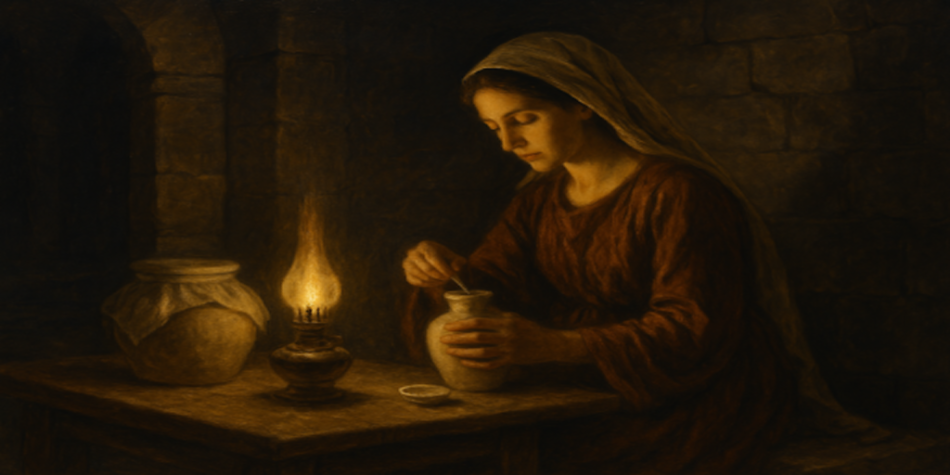
A woman prepares sacred burial oil, foreshadowing Christ’s sacrifice in a Christ-centered Easter reflection.

What Mary Knew: Burial, Resurrection, and the Second Coming

Before the cross, Mary understood the resurrection. How does her devotion help us better understand His return?

Download Print-Friendly Version

In recent years, observing the events of Holy Week has increased in importance for Latter-day Saints. Social media influencers and BYU professors like John Hilton III speak more noticeably about the Easter season. A notable invitation from Elder Stevenson said, 

How do we model the teaching and celebration of the Resurrection of Jesus Christ, the Easter story, with the same balance, fulness, and rich religious tradition of the birth of Jesus Christ, the Christmas story? It seems we are all trying. I observe a growing effort among Latter-day Saints toward a more Christ-centered Easter.

This change is necessary in these latter days if we are to become a people who “talk of Christ, rejoice in Christ, and preach of Christ” (2 Nephi 25:26).

Typically, mentions of Easter exclusively include the most key moments from the Holy Week: “7 stories for the 7 days” of the week, including: 

  • The Triumphal Entry on Palm Sunday (Matthew 21:1-11, Mark 11:1-11, Luke 19:28-40, John 12:12-19) 
  • Jesus’ Prayer in Gethsemane (Matthew 26:36-46, Mark 14:32-42, Luke 22:39-46) 
  • His Crucifixion on Good Friday (Matthew 27:27-56, Mark 15:16-41, Luke 23:26-49, John 19:16-30) 
  • And the crowning moment of His literal resurrection on Sunday (Matthew 28:1-10, Mark 16:1-8, Luke 24:1-12, John 20:1-18)

All of these events are central to the meaning of Easter and Holy Week in the Christian tradition worldwide.  

However, in pondering personal “lessons from Holy Week” in preparation for Easter, my mind immediately went to a story that is lesser known, yet significant in the grand story of Easter and the mission of Jesus Christ. I thought of Mary of Bethany anointing Jesus Christ with oil. She was the ultimate example of “eyes to see and ears to hear.” She seemed to know what the twelve apostles did not yet fully grasp: Jesus Christ would die to be resurrected and become the Savior of the world.

Mary knew exactly what she was doing … her anointing was a prophetic act preparing for burial.

While the timing varies slightly between the three Gospels, a reader can easily connect the dots to the Easter Story. A close reading of the Bible places the story shortly before Holy Week, six days before Passover, as noted in the Gospel of John. This event is also mentioned in the Gospels of Matthew and Mark, but not Luke, as leading up to the Crucifixion and burial––making it part of the broader narrative of Holy Week.

Mary of Bethany was the sister of Martha and Lazarus, living in the village of Bethany near Jerusalem. She is known in another story for sitting at Jesus’ feet and listening to His teachings while her sister was busy and “cumbered about much serving.” The event that caught my pondering also took place at a dinner in Bethany, though later in Christ’s life. As an act of deep love and reverence for the Savior, Mary anointed Jesus’ feet with oil and wiped them with her hair; symbolic as both an honor to Him and a preparation.

The Bible tells what type of oil was used. The text refers to “nardos” (νάρδος). “Nard” in the Greek New Testament refers to spikenard, a plant native to the Himalayas. It was rare and costly, which is why Judas Iscariot criticizes the act: 

Why was not this ointment sold for three hundred pence, and given to the poor?

This [Judas] said, not that he cared for the poor; but because he was a thief, and had the bag, and bare what was put therein.

Then said Jesus, Let her alone: against the day of my burying hath she kept this. For the poor always ye have with you; but me ye have not always (John 12:5-8).

Mary knew what Judas and others would not, and Jesus Himself was confirming Mary’s thoughts and personal revelation. This oil, spikenard oil, was known in the ancient world for both its medicinal properties and its use in burial rituals. It was a key component used to prepare the dead for burial. She used the oil because she seemed to understand that Jesus was heading toward a sacrifice and burial. Many others, including his apostles and disciples, did not fully grasp this concept even after several attempts by Jesus to explain so (Matthew 16:21-23 & 17:22-23, and Mark 8:31-33 & 9:30-32, among others). His disciples often seemed oblivious to or confused by His prophecies. I don’t know why the disciples “missed the mark,” but it is clear Mary knew exactly what she was doing. Christ recognized that her anointing was a prophetic act, preparing His body for burial. Mary had a remarkable understanding of Jesus’ mission and impending death, so she felt the need to prepare him by performing a burial ritual. 

I observe that Mary had “eyes to see and ears to hear” what Jesus was trying to teach all along. He had a mission, and it was different than what most supposed. Instead of being a political/military leader and victorious Messiah rescuing the Jews from Roman rule, Christ came to fulfill the Atonement. He came to pay the price for our sins and sufferings so we would be clean to live with our Father in Heaven again.

We can show faith by action, show our devotion like Mary, and instead of anticipating His death, we can anticipate His return.

How can we apply Mary’s Easter story to our day? We can be the ones to have “eyes to see and ears to hear” as we expect the Savior’s return rather than His death. Since 2020, I feel a shift in priorities has happened for many Latter-day Saints. President Nelson highlighted this priority in his April 2020 Liahona article, “The Future of the Church: Preparing the World for the Savior’s Second Coming.” Elder Christoffel Golden of the Seventy, in his October 2021 General Conference address, clearly tells us, “For those who have eyes to see, ears to hear, and hearts to feel, more than ever before, we are required to confront the reality that we are getting ever closer to the Second Coming of Jesus Christ.” While some members of the Church may say President Nelson’s second plea in his 2024 General Conference address to prepare for the Second Coming of Jesus Christ is an attempt to fearmonger people into compliance, we can be comforted in knowing the blessings of trying to live and keep our covenants: it will be a glorious day!

What better example than Mary can we have as Latter-day Saint women? We can play an important role in knowing Christ and knowing what others can’t see. We can have a deep relationship with Jesus Christ and have more of an understanding of His mission. We can learn line upon line, precept upon precept. We can show faith by action, show our devotion like Mary, and instead of anticipating His death, we can anticipate His return. Even if others are in denial or unable to see it clearly, we can prepare our minds and our hearts for His Second Coming. 

Perhaps the greatest part about the Easter story and Holy Week is that the story isn’t over. He told his disciples that after His resurrection, He would be coming again (see textbox). May we be those disciples, those women, who are anticipating the great prophecies of old that when Jesus Christ returns, “the glory of the Lord shall be revealed, and all flesh shall see it together” (Isaiah 40:5).


About the author

Priscilla Davis

Priscilla Davis is a certified brain health and family life coach, and social media creator @SheSharesGoodness. She helps moms and their youth build emotional resilience through Christ-centered principles.
On Key

You Might Also Like

We need more than consent to have ‘good’ sex

America Magazine, a Jesuit publication, talks to Christine Emba, a Washington Post columnist, about why so many people are having miserable sex when second wave feminism, #MeToo, and the sexual revolution was supposed to fix it all. Her conclusion is that consent is not enough of a sexual ethic. And that our sexual ethic must expand to include empathy and considering the good of the other. Her remarks reminded me of Daniel Frost’s article which he published in Public Square Magazine making a similar argument: Consent is Good, But Not Enough

Man w/ Flowers, Looking at Tombstone in Cemetery | Make The Good Times Stop: Pop Culture’s Fixation on Eternal Oblivion | Public Square Magazine | Eternal Oblivion

The Life Arising From Death

Since my mother-in-law died ten days prior to a day many Christians call Good Friday, I have wondered what about the crucifixion of the Messiah is “good.” 

The Ordinary Saint’s Guide to Under the Banner of Heaven: Episode 4, “Church and State”

Summary — The episode begins with the detectives checking in on Bishop Low’s home, which they find ransacked and deserted. Pyre finds a letter written by Ron’s wife to the Prophet expressing concern about her husband’s refusal to pay taxes. The detective contacts the Church about the letter and is told the letter was handed down to one of the bishop’s counselors, LeConte Bascom, who works at the bank. Brother Bascom says he had to turn Ron down for a loan because his brother’s refusal to pay taxes made him a liability, though it’s heavily implied that the real reason is that his wife’s letter was seen as an embarrassment to the Church. In flashbacks, we see Dan marching in a Pioneer Day parade, shouting about the government’s illegal taxes, as well as smoking and kissing a woman who isn’t his wife. Dan’s father says he’s ashamed of his immoral behavior and anti-tax nonsense and advises him to study the scriptures to set himself back on the right path. This unfortunately drives Dan into researching more obscure history of the Church, including information on polygamy.  He makes a business trip down to Colorado City to visit the breakaway polygamist sect there and manages to get the name of a pro-polygamy pamphlet called “The Peace Maker.” He reads this pamphlet and brings up the idea to his wife Matilda, telling her she’s limiting his spiritual power if she doesn’t let him marry a second wife.  During this conversation, Dan is pulled over for speeding and refuses to cooperate with the officer, leading them on a police chase that ends with his arrest. At the jail, Dan’s brothers try to convince him to stop his resistance to the government. Ron feels it’s his responsibility to show Dan the error of his ways, but instead, Dan runs circles around him, leaving him speechless and admitting that he’s going to lose his business and home. Dan somehow turns this fact into evidence that his views are correct and ends up winning over Ron to his side. In the present, Detective Pyre is being leaned on by the Laffertys’ stake president to release them into his custody but refuses. The detectives have identified the car the killers were probably using and plan to hold a press conference to ask for tips when the police chief returns from vacation and demands that all mentions of fundamentalism Mormonism be scrubbed from the press briefing. (It’s implied he’s being leaned on by the Church.) Pyre tries to toe the line at the conference but eventually caves to a persistent reporter and admits that he thinks that the murders may have something to do with fundamentalist beliefs. The next day at church, the ward is shunning the Pyres, and a specific couple is assigned to keep an eye on their faith. Meanwhile, a police officer has located Bishop Low fly fishing in the mountains and safe. Church History — During Dan’s explanation of polygamy, we get flashbacks to the infamous scene where Emma finds out about the doctrine of polygamy for the first time and throws the revelation in the fire. Though church members will be familiar with this story, the tone is portrayed very differently than we are used to. Emma is shown as being absolutely skeptical of Joseph’s translation of the Book of Mormon and other prophetic acts, even though she firmly testified of the truth of these things even after her break with the Church after Joseph was murdered. Joseph is portrayed as proclaiming the doctrine of polygamy only for his own physical gratification, which is a common anti-Mormon trope with little evidence behind it. While it is true that one of Joseph’s wives was only 14, the facts behind the situation are more complex than portrayed in the show. The pamphlet “The Peace Maker” is portrayed by Dan Lafferty as an “essential LDS tract” written by Joseph Smith, and no one in the show ever corrects this perception. In fact, the tract was not written by Joseph Smith, and he repudiated it during his lifetime. This episode presents a slanted view of church history, giving only one side of the conversation and showing the modern church as trying to hush it up rather than having its own interpretation of events. Shibboleths — Pyre claims that writing a letter to the prophet is like writing to “Heavenly Father himself,” which is absolutely wrong. While members of the Church do revere the prophet and listen to his teachings, he is not God, and this equivalency is not one Saints would make (though outsiders think we do). The idea that doing business with fundamentalists is like “doing business with the mafia” is totally alien to me. They are regarded as somewhat of an oddity in Utah, but not dangerous like organized crime. One unusual phrase occurs when the stake president claims that the Laffertys need to be released into his custody for “healing prayer.” I honestly have no idea what this phrase refers to and have never heard it in an LDS context. And the formal type of shunning portrayed happening to the Pyres is not something we do. Though obviously, wards vary in their culture, there is no formal instruction not to talk to those who have questions. Rather, we are encouraged to keep being friends with those who are struggling with faith and support them however we can. Changing History — It is interesting to note that in the actual chain of events, it was Sister Low, not Bishop Low, who was on the Lafferty hit list. Sister Low was a Relief Society President who supported Dan’s wife as she sought a divorce. Why does the show change this? Perhaps the idea that the Church has female leaders doesn’t fit well with the show’s depiction of the oppression of women in the LDS church. Brenda Lafferty’s sister has also expressed her disappointment with the way the show is misconstruing her sister’s murder in pursuit of an

Subscribe To Our Weekly Newsletter

Stay up to date on the intersection of faith in the public square.

You have Successfully Subscribed!

Pin It on Pinterest

Share This