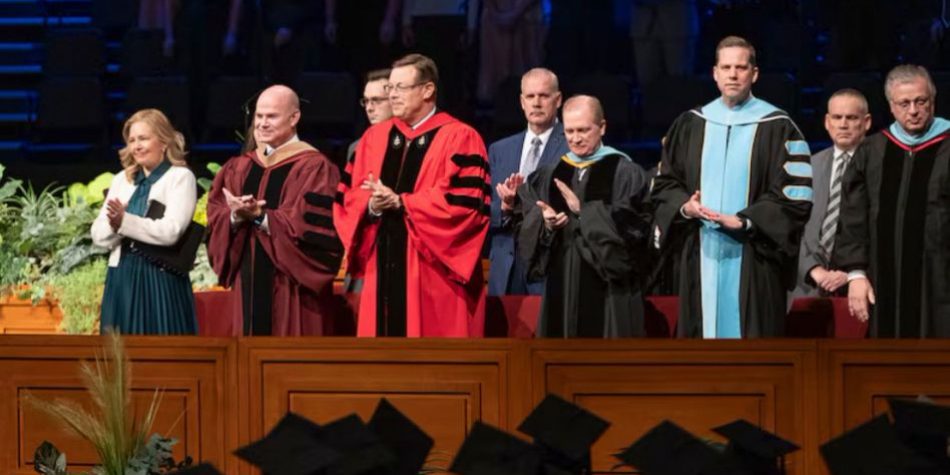

Attack dog. Enforcer. Culture warrior. These labels and more have been used to describe Elder Clark G. Gilbert, newly called apostle of The Church of Jesus Christ of Latter-day Saints. He has also been described as a “high-profile defender of doctrinal orthodoxy” and a proponent of “retrenchment.”
What’s all the fuss about? As Commissioner of Church Education, Elder Gilbert is accused of instituting a variety of measures to ensure that professors at BYU support the doctrine of the Church that pays their salaries—specifically on issues related to marriage, family, and gender. According to some, these measures have ushered in a culture of fear among faculty who have reservations about Church doctrine or policy. Other concerns have been mentioned, but this seems to be the heart of the issue.
Before I say a few words in defense of Elder Gilbert, I want to take a moment and recognize the difficult space that many Latter-day Saint scholars inhabit. The Church’s views on family, sexuality, and gender are (to put it gently) not popular in academia. Despite stated aspirations to diversity and inclusivity, there isn’t much room in academia for researchers who vocally promote the Church’s positions on family life. I have seen this first-hand in my nearly two decades in academic life. Those who support marriage as the union of a man and a woman and claim that sexual relations should only happen in such marriages are castigated as out of touch, prudish, ignorant, hateful, and bigoted. It’s hard to get along in your profession when your colleagues view you as little better than a racist.
There are intellectual resources to defend the Church’s positions on these matters (more on this below), but the opposition to such arguments is so loud, so confident, and so strident that often it’s easier to just keep quiet. Latter-day Saint scholars are generally trained in the same graduate programs, go to the same academic conferences, and are under the same pressure to publish in top journals as scholars who don’t belong to the Church. It’s hard to not imbibe the norms, expectations, assumptions, and conclusions of the culture, including revisionist views about gender, sexuality, and family. The implicit and explicit pressure to fall in line with the prevailing orthodoxy can be suffocating. Even Latter-day Saint scholars who want to resist the prevailing academic culture on these issues can feel bewildered about how to do so.
In an environment where so much of your professional success is influenced or determined by people who are hostile to the Church’s views, I can see why many people would feel concerned about Elder Gilbert’s efforts to align the faculty with the doctrine of the Church.
Believing that BYU’s distinctive religious heritage can be maintained without intentional efforts to preserve it is naive.
At the same time, I, like many other faculty and students, choose to study at BYU precisely because of its doctrine. I want to be at a university where I can “seek learning, by study and also by faith” (D&C 88:118). As Elder Gilbert has emphasized many times, institutional drift in academia is real, and many universities that start with religious aspirations end up abandoning them later. It’s tempting to say that this is the standard arc for religious universities in the United States. Believing that BYU’s distinctive religious heritage can be maintained without intentional efforts to preserve it is naive.
But perhaps it is not possible to run a quality university that is committed to religious beliefs? Indeed, many of the criticisms of Elder Gilbert presuppose that it is inherently wrong to try to get professors to align with Church teachings. The critique takes two forms: first, that any attempt to align (or more darkly, “impose”) views about any topic at a university is wrong; and second, that it is wrong for BYU to expect faculty to support the Church’s doctrine on marriage, family, and gender.
The first view is widespread but breaks down upon inspection. As I have explained in detail, it is neither possible nor desirable for a university to be completely devoid of commitments. Without well-known and agreed-upon standards, university life would descend into a cacophony of competing claims, none of which could be evaluated as better than any of the others. The scholarly practice of peer review presupposes that practitioners in the discipline know what counts as “legitimate” scholarship and can reject submissions that do not meet disciplinary standards. (A more blatant example of institutional gatekeeping would be difficult to imagine.) As I wrote in the previously mentioned article,
The point of academic study is to produce knowledge. This search is a winnowing process, as academic ‘disciplines’ (note the word) seek to separate the wheat of truth from the chaff of unsupported opinion and bias. Good scholars are committed to getting it right, which presupposes that truth is real and knowledge is possible, which in turn is premised on a host of philosophical and other presuppositions. Academic freedom cannot mean the freedom to be supported in whatever one believes; rather, it is the freedom to seek truth, which means being accountable to reality.
It may come as a surprise to some readers, but some people actually want to go to a university that includes religious beliefs among its commitments (see Elder Gilbert’s recent article on this in The Chronicle of Higher Education). A recent essay by prominent Catholic sociologist Christian Smith explains that he chose to teach and research at Notre Dame because he wanted more direct engagement with the Catholic intellectual tradition. But after 20 years at Notre Dame, Smith decided to leave because (in his view) the university was not living up to its potential. He writes: “When I came to Notre Dame, I believed the university was serious about its Catholic mission. I tried to make my contribution, I think with some success. But I also saw much of the institution absorbed by other interests that, in my view, were often irrelevant to or at odds with the Catholic mission.” I don’t have enough information to know if he is right about Notre Dame, but many people want something other than the standard secular university experience. In general, the world is enriched, not diminished, by religious universities that pursue truth in a distinctive way.
Some people actually want to go to a university that includes religious beliefs among its commitments.
To be clear, as Commissioner of Church Education, Elder Gilbert wasn’t some rogue actor trying to sneak something past Church headquarters. The family proclamation may be controversial in some quarters, but it is firmly established as Church doctrine. It would be hard to make this point more emphatically than President Dallin H. Oaks recently did: “Those who do not fully understand the Father’s loving plan for His children may consider this family proclamation no more than a changeable statement of policy. In contrast, we affirm that the family proclamation, founded on irrevocable doctrine, defines the mortal family relationship where the most important part of our eternal development can occur.”
Some critics might be concerned that Elder Gilbert’s efforts to align the faculty with the Church’s teachings diminish academic freedom. In my view, this gets it exactly wrong. There are hundreds of universities in the United States where revisionist scholarship about marriage, family, and gender is welcome and rewarded. The orthodoxy on these issues is clear and intolerant. There is a much smaller number of universities where one can pursue scholarship that is aligned with the family proclamation. If BYU became just like other universities, there would be less academic freedom than there currently is. (Attentive readers will realize that I’m using “academic freedom” in two senses here, individual and institutional, both of which are explained in detail in BYU’s Academic Freedom Policy.)
Though debates over marriage, sexuality, and gender are often framed as conflicts between “rigid defenders of orthodoxy” and proponents of love and authenticity, the reality is not so simple. At the heart of these conflicts are deep disagreements over personal identity, sexual morality, the meaning of human life, and the common good. There are many resources available to Latter-day Saints and others to think through these issues carefully. In my view, these are not issues on which one has to “blindly accept” Church teachings; the assumptions that lead to revisionist conclusions about marriage, gender, and sexuality are highly contestable.
Which brings us back to the idea of Elder Gilbert as a “culture warrior” or an “attack dog.” It’s strange that people on only one side of these controversies get called names like this—even when the university in question is clearly owned and operated by the Church. As my former teacher Robert P. George writes in a related context, “There is a culture war, alright, but supporters of the sanctity of human life and the conjugal conception of marriage are not the aggressors in it. It was people on the other side–those who reject sanctity of life principles and the idea of marriage as a conjugal union–who wanted to change longstanding legal and cultural norms.” In my view, Elder Gilbert took reasonable steps to ensure that BYU students get the education that is advertised in the BYU mission and aims, and I’m grateful for his efforts.
In a recent interview, Elder Gilbert recounts an important conversation he had with President Holland. Both the mandate from President Holland and his ultimate hope for BYU seem like a good way to conclude:
I remember I was talking to President Holland, and he was bemoaning that he could feel this drift happening to the university. And he’s like, ‘What have they done with our school that we love so much?’ And I felt awkward. I wasn’t even the commissioner yet. And I felt like I needed to defend them. And I said, ‘Well, President Holland, you know, we have the honor code, we have devotionals, we have religion classes, we have the academic freedom policy.’ And I said, ‘They’re like bumper lanes protecting us from bowling into the gutter.’ And he didn’t even let me finish. And he said, ‘That’s very different than bowling for a strike.’ And he said, ‘We need to bowl for a strike at BYU.’