
Sunday’s episode of Music & the Spoken Word, the weekly broadcast of The Tabernacle Choir at Temple Square, included the following description of the late President Russell M. Nelson. Nelson served as the 17th president of The Church of Jesus Christ of Latter-day Saints until his passing on the evening of September 27, 2025:
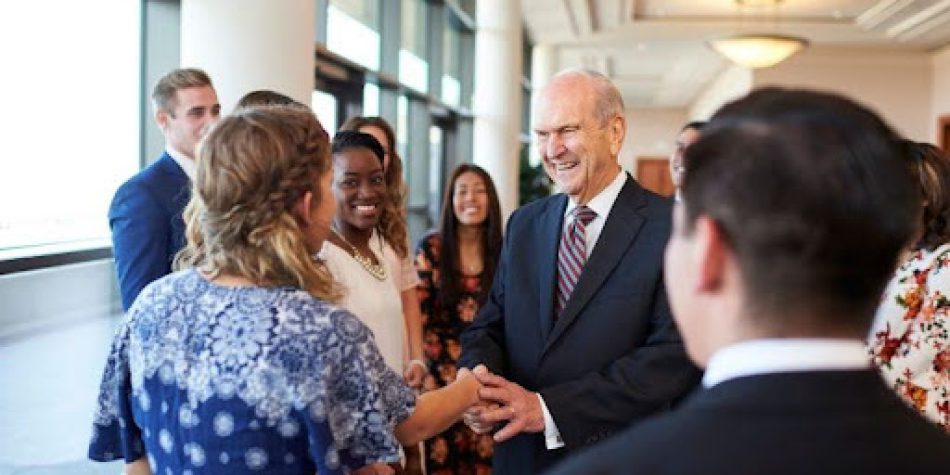
“President Nelson met with kings and presidents, queens and princesses. But he also knew and loved the common person. He was their friend.”
As I heard those words, they felt less like a description and more like a reminder of things I’ve seen and felt myself. There are countless other examples—some well known, many tucked quietly into people’s private memories.
I think too of a moment during Nelson’s Pacific ministry tour when he met a man named Mateo Lautaimi. Mateo had recently lost his wife, and his home had been destroyed by a cyclone. Nelson paused, listened, and in a private pastoral moment, told him simply, “Your wife is smiling at us.” Those were not the words of a visiting dignitary, but of a man willing to step into another’s grief and offer comfort.
Another story comes from Susan Cunningham, who met Nelson during a visit to San Antonio, Texas.
“My husband served as the stake Young Men president, so he attended the leadership session of the stake conference the day before. After a general session, everyone was invited to come and meet him. I went up.
“I had felt loved and cared for by his message, but I assumed that he was just doing this to be polite, because people get excited about being with an apostle. But I didn’t think there was any chance he would ever remember me.
“When I got to the front, he took my hand and asked my name. I confess my first thought was, ‘Why does he care what my name is? He’ll never see me again.’ There must have been more than a hundred people in line, but when I said my name, he responded, ‘Are you the wife of the stake Young Men president?’ He knew our family well enough to recognize who I was just from my last name.”
There are countless other examples—some well known, many tucked quietly into people’s private memories. Early in his ministry as president of the Church, he traveled not only to Vietnam but also to Kenya, Zimbabwe, India, and other countries where Latter-day Saints had rarely seen church leadership before. For them, his presence was more than ceremonial. It was a way of saying, “The Lord sees you here, too.” He was still teaching us the pattern of his life: to remember the one.
Perhaps the most poignant example came as he approached his 100th birthday. Instead of asking for gifts or honors, Nelson gave an invitation. He called it “99+1.” He asked each of us to think of someone who might feel lost or alone and to reach out—just as the Savior taught in the parable of the ninety-nine and the one. It was a birthday celebration not centered on himself, but on turning hearts outward. Even at 99 years old, he was still teaching us the pattern of his life: to remember the one.
When my son watched Latter-day Saints in Vietnam rejoice at Nelson’s visit, when Lautaimi felt comfort after his devastating loss, and Susan felt seen, the message was the same: President Nelson remembered the one. And in doing so, he showed us how to be like Christ.