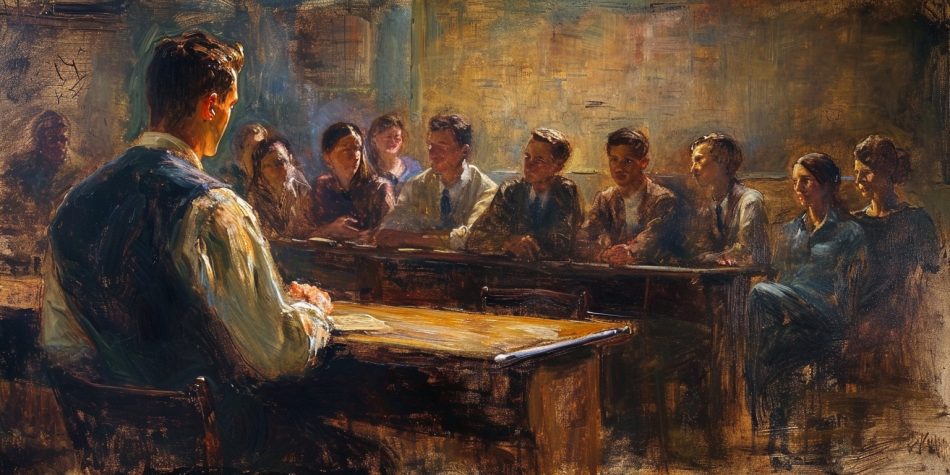
A professor practicing servant leadership in education by attentively listening to students.

How Humility is Becoming the Next Revolution in Higher Education

In academia, servant leaders impact student lives through ethical guidance, respect, and adaptability.

In Romans 12:8, Paul writes, “If it is to encourage, then encourage … if it is to lead, do it diligently.” Servant leaders are blessed with the spiritual gift of leadership and use it to glorify God by embodying the teachings of Jesus Christ, seeking to serve and find happiness in helping others. As servant leaders in higher education, we must be humble, ethical, and empathetic, and strive to empower others by encouraging and guiding our students so they can reach their highest potential.

What does servant leadership look like in higher education? How can we empower the next generation of servant leaders? Serving as leaders in higher education provides us with a vast opportunity to work as domestic missionaries, influencing students’ lives while focusing on their educational needs. To do this, we must earn students’ trust and enrich their lives by showing them compassion and respect, emphasizing the importance of hard work, honesty, integrity, and accountability. As servant leaders, we can assist in achieving a competitive advantage for our institution by building community relationships and improving student achievement and retention. We must support our students and practice flexibility in the classroom by utilizing various teaching methods to maximize students’ growth and learning potential to empower future generations of servant leaders. 

 Traits of Successful Servant Leaders in Higher Education

Respect for Others

Servant leaders respect others and treat everyone equally, regardless of their status in the workplace or community, which impacts our students’ lives, strengthens the institution, and makes the world a more compassionate place to live. As servant leaders in higher education, we should strive to become the type of leader that students want to follow voluntarily, despite our title or position. When we show our students respect, we create a unified culture in the classroom, and it encourages them to share their personal experiences and beliefs; students then put forth a more conscientious effort into their work so they can reach their greatest potential.

Ethical Character

Dwight Eisenhower once said, “The supreme quality of leadership is integrity.”  As servant leaders, we must consistently demonstrate exceptional work ethics and be held accountable for our actions in every decision we make. We must be forthcoming and display honesty and transparency when interacting with students, refusing to take advantage of opportunities for dishonest gain. Being influenced to possess highly moral and ethical characteristics allows students greater opportunities for lasting success, which motivates them to have a heightened sense of accountability toward their personal development and growth. A lack of integrity can be costly; therefore, ethical behavior must be practiced daily. It is the ethical characteristics we show students daily through our actions and words that empower our students to become future servant leaders. 

Balancing Focus with Flexibility

The world is constantly in motion and always changing; being flexible and willing to change is crucial for the success of institutions in higher education. Overcoming obstacles, such as COVID restrictions in 2020, revealed the importance of being flexible and willing to change to best serve students, as many institutions had to adapt the traditional classroom into an online learning environment quickly. Servant leaders must recognize the uniqueness of student populations so objective decisions based on current internal and external trends can be made. Servant leaders must also have the willingness to abandon any activities that prove to be futile. A one-size-fits-all approach to classroom management is not effective in maximizing the learning potential of our students. When determining the method for delivering lectures, we must consider the student demographics and classroom dynamics, as they affect a student’s ideal learning style. We must be flexible and willing to deviate from a lesson plan or alter a particular teaching style to provide a stimulating educational environment that can prompt a student’s understanding of the material being presented. Remaining versatile while leading is not always easy; however, building relationships with our students in the classroom can solidify trust where students feel they can share their own experiences, give their opinions, ask questions, and make mistakes without repercussions, which results in our students performing at their highest potential and ultimately empowering the next generation of servant leaders.

 Increasing Community Partnerships

As servant leaders in higher education, we should be active and consistently strive to build relationships with people in our community. Being engaged and committed to our community allows us to collaborate with other leaders and form community partnerships that will benefit our students. We can work closely with community partners to host events such as job fairs, where students can meet with employers in the community and apply for internships so they can gain real-world experiences in their field prior to receiving their degree. Students who form bonds in the community may choose to stay after graduation and seek jobs from a community partner or return to the institution for a graduation degree, thereby increasing student achievement and retention. The community partnerships formed will help students reach the goals they have worked so diligently to achieve while at our institution.  

Servant leaders should always remember we have been blessed by God with an invaluable gift. We must serve our students diligently as enthusiastic servant leaders have a contagious energy that drives student performance, and this impacts our institutional culture. All the knowledge in the world will not make anyone a great leader; it is the desire and willingness to help others and the love we show them that makes a great servant leader. True servant leadership lies in guiding our students to success, ensuring that they are all performing at their best, doing the work they are asked to do, and doing it well.


About the author

Melissa Kirby

Dr. Melissa Kirby is the Department Chair, Business Administration and Assistant Professor of Accounting at Shorter University in Rome, Georgia. She has a PhD in Business Administration from Liberty University.
On Key

You Might Also Like

A Better Conversation about HB 11

The problem with HB 11 was not its failure to reach compromise on the question of transgender athletic participation, but limiting its scope to a single question, where only one set of competing interests could be served in the end.

Under the Banner of Heaven Episode 5, “The One Mighty and Strong”

Summary – Pyre is interrogating Sam, who shouts scripture at him about the “one mighty and strong.” Pyre uses false details about the murder to trick Sam into revealing that he isn’t the murderer. The police chief is getting ready to release the brothers, so Taba stalls him while Pyre talks to Robin about his brothers’ involvement in the “School of the Prophets” and gets him to reveal two names: Bernard Brady, a Provo businessman, and Prophet Onias. The detectives follow up with Bishop Low and his wife, located at the end of the last episode, asking them about the excommunication of Dan and Ron. The bishop is reluctant to reveal details because of clergy confidentiality but eventually reveals that Dan was excommunicated based on the testimony of his daughters that he attempted to forcibly take them as polygamous wives. We get a flashback to a heartbreaking scene where Matilda has sex with Dan to distract him as her daughters escape out a window in the middle of the night. Dan was excommunicated, and the girls were placed with a family in the ward (as the bishop refused to call CPS) but later ran away, and now they and their brother are missing. At his daughter’s baby blessing, Ron confronts the bishop about his brother’s excommunication, not knowing about Dan’s attempted polygamy and thinking that it’s about his political beliefs. Brenda has a conversation with Sister Low and Diana, indicating that both know that Ron is abusing her but only Brenda is willing to do anything about it. In fact, Sister Low feeds Diana a line about how her only duty is “creating a home and environment to sustain and support our Priesthood holder.” To Detective Pyre, the bishop claims to have followed church procedure but eventually encouraged Diana to leave and gave her money to do so. The detectives follow up on Robin’s lead about Bernard Brady by arriving at his house in the foothills of Provo with a warrant. We find out that the Bradys sheltered Ron when he was having a hard time. In a flashback, Ron receives a summons to a church disciplinary court and blames Diana for it. He punches her in the face and begins throwing the food she’s preparing on the floor, saying he’ll starve her into obedience. Diana grabs a kitchen knife and drives Ron from the house, telling him not to come back. Back in the present, Bernard admits to being in the School of the Prophets study group and driving miles to pick up Prophet Onias and the Laffertys but denies being further into the group than that. But when he sends his wife out of the room to make lemonade, he produces a notarized letter he sent to himself with details of the Laffertys’ hit list, including that Diana is on the list because she wrote a letter that got Ron excommunicated. The detectives rightly chastise him for not taking this information to the police earlier. Brady reveals that he knows the location of “the farm,” a Lafferty compound. With Allen’s help in drawing a map, the detectives plan to stake out the property in the morning. Detective Pyre returns home for FHE and finds that his wife and kids have been invited to the bishop’s house for the evening and are spending the night there. Pyre believes this is an attempt to keep an eye on his family and control the narrative about the case. The next morning on the way to the raid of the farm, Pyre questions Brady about the details of Ron’s excommunication, which we see in flashback. He is indeed excommunicated after lashing out at the church leaders about them not following the “correct” doctrines of the church. When Ron returns home, he finds that his teenage daughter has cut the markings out of his garments, which he puts on anyway with only a sports coat and jeans over the top. He says goodbye to his kids and leaves the home. When the farm is raided, the only people inside are three teenage girls, who we learn are from a polygamous compound in British Columbia and were brought down by Prophet Onias to be Ron’s wives. The girls show the detectives a cupboard they had been forbidden to touch, which the detectives open to reveal a single shirt belonging to Ron with some papers in the pocket, a hit list, and a revelation directed at Diana commanding her to repent and return to him. Allen is in disbelief that Ron could have written these things, but Brady confirms that Ron is a violent man. He explains that Ron fled to his parents’ home after his excommunication, where his mother confirms his calling as “the one mighty and strong” and says he’s only a heartbeat away from his rightful place. His father is lying sick in bed and asks Ron to call a doctor, but Ron recalls his cruelty to them as children and refuses. It’s implied that he indirectly caused his father’s death in order to take over the leadership of the family. Church History—This episode contains the most fabricated piece of church history in the show. When Bernard Brady reveals that Diana’s information led to Ron’s excommunication, he makes an analogy to Joseph Smith’s martyrdom. He claims that while Joseph was in hiding after destroying the press of the Nauvoo Expositor, Emma wrote a letter to Joseph encouraging him. John Taylor intercepts this letter and adds a line meant to make Joseph turn himself in, thus indirectly causing the prophet’s death. Taylor’s motive is to put Brigham Young at the head of the church, instead of Emma’s young son, in order to continue the doctrine of polygamy, which he and Brigham are already heavily involved in. Reputable historians both in and out of the church say there is no evidence to support this interpretation of events, though the succession crisis between Brigham Young and the ten-year-old Joseph Smith III is real and

Subscribe To Our Weekly Newsletter

Stay up to date on the intersection of faith in the public square.

You have Successfully Subscribed!

Pin It on Pinterest

Share This