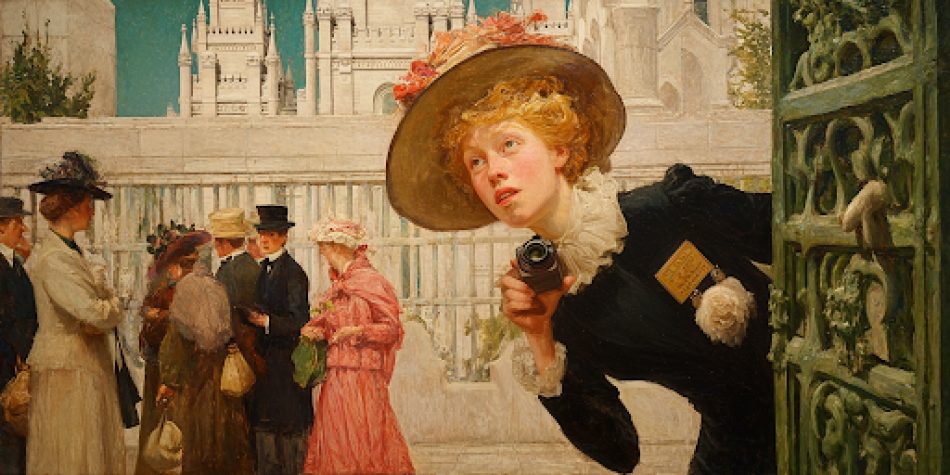
A modern female reporter in flashy clothes intrudes at a Latter-day Saint temple while others wait respectfully, illustrating journalism ethics.

Consent not Curiosity: WSJ’s Double Standard on the Sacred

Did WSJ cross ethical lines on sacred rites? Yes, consent prevails, context was missing, and naming rules were ignored.

Download Print-Friendly Version

The Wall Street Journal used to know the difference between covering a faith and staging it. In “‘Exmo’ Influencers Mount a TikTok War Against the Mormon Church,” that line isn’t blurred—it’s crossed. The piece does more than report on critics of The Church of Jesus Christ of Latter‑day Saints; it puts their reenactments front and center, including a posed photo of an ex‑member wearing sacred temple clothing and descriptions that turn baptisms, initiations, and other temple rites into shareable spectacle. What is sacred is not content. And when a national newspaper treats it that way, it isn’t tough reporting—it’s trespass dressed up as journalism.

What is sacred is not content.

There is a long, public record of how mainstream outlets (including the Journal) handle other traditions’ restricted rites: with restraint. When Catholics choose a pope, reporters don’t slip cameras past the Swiss Guard; they acknowledge the sealed conclave and cover the smoke and statements, not the oaths inside the Sistine Chapel (see the Journal’s own recent explainer and history features on conclaves and their secrecy: here and here). When monks on Mount Athos bar women from entering their all‑male peninsula, the Journal writes about the place and its rules—but does not break them (book‑review coverage). When Muslims perform the hajj, the paper uses official vantage points, not undercover intrusions; its recent reporting on the devastating 2024 heat deaths shows exactly that kind of distance and care (news report and video). In other words: consent is the difference between a tour and a trespass—and the Wall Street Journal knows it.

The Journal even said so when a boundary was breached elsewhere. In 2022, an Israeli TV reporter snuck into Mecca, a city non‑Muslims are forbidden to enter. The Journal’s opinion page ran the headline “Mecca Rules Are Up to Muslims” with the sub‑line that a “reckless Israeli journalist” had put others at risk. Another column debated whether Mecca should ever be opened to non‑Muslims (“Crown Prince Mohammed bin Salman Should Open Mecca”), and a third reflected on rare, leadership‑sanctioned exceptions (“The Secret Mission to Sneak Into Mecca”). The throughline wasn’t hard to miss: Mecca’s boundary is real, and crossing it isn’t a media stunt—it’s a violation. Respect for sacred limits isn’t a parochial ask; it’s a newsroom norm.

Now look back at the Journal’s Latter‑day Saint story. It spotlights ex‑members who re‑create or display elements from temple worship that practicing Latter‑day Saints treat as sacred and private. A decade ago, when the Church itself chose to explain its temple clothing and asked that the press treat it as other faiths’ vestments are treated, responsible coverage did exactly that—embedding the Church’s own explainer and letting the institution’s visuals carry the story (Church Newsroom; Washington Post story and video). The Journal chose the opposite: a promotional image of an ex‑member in sacred clothing, plus social‑video reenactments. If even HBO—a profit‑minded entertainment brand—apologized for offending believers when Big Love dramatized a temple scene in 2009 (LAT; Reuters), why is a flagship newsroom now lowering the bar?

Respect for sacred limits isn’t a parochial ask; it’s a newsroom norm.

Worse, the piece sells controversy without chronology. It touts “‘death oaths’ to protect temple secrets” as if that were a live feature of Mormon worship rather than a historical artifact that the Church removed in 1990—a change reported at the time by national outlets like the Los Angeles Times (here). Leaving out the date turns context into clickbait. Journalism 101: accuracy is the floor; context is the roof. Strip out the context, and readers get soaked.

When reached for comment, a Wall Street Journal spokesperson replied,

“The Journal’s reporting is accurate, fair and meets its established and trusted high standards. The Journal practices ‘no surprises’ journalism. As noted in the article, our reporter was in touch with the church, which declined to comment. We took great care in preparing this story and stand by our reporting.”

The Society of Professional Journalists’ Code of Ethics is unambiguous: provide context; avoid pandering to lurid curiosity; consider cultural differences; minimize harm (SPJ Code). It also cautions that legal access to information is not the same as an ethical justification to publish. You don’t earn trust by telling believers to brace themselves while you stage their sacraments. “No surprises” is not “no standards.”

The Journal insists its story is “accurate, fair,” that it practices “no‑surprises” journalism, that it contacted the Church, and that it “stands by” the reporting. But fairness isn’t a phone call. (Especially one that the Journal reporter has mischaracterized as “no comment.”) It’s the package: headline, art, framing, context. On all four, this piece comes up short. The Journal’s own public standards promise to “fairly present all sides of the story through rigorous, fact‑based reporting” and to uphold “appropriate professional conduct” (WSJ standards overview; Dow Jones Code of Conduct). By any normal test—especially the one the Journal applied when a reporter snuck into Mecca—this isn’t it.

The Wall Street Journal may stand behind their reporting. But they didn’t meet the accepted journalistic standards. They didn’t even meet their own journalistic standards. They acted less like reporters and more like a carnival barker telling the passersby that for the cost of a pageview they can come gawk at a secret religion. 

The Journal once set the curve on restraint. Yesterday it flunked it.

The fix is straightforward and overdue. Take the article down and apologize—specifically for publishing a staged image of sacred temple clothing and for promoting “death oaths” without clearly stating they were discontinued thirty‑five years ago. If the piece returns, remove the reenactment imagery; use neutral art or official church visuals; restore the missing chronology with a prominent editor’s note; and align naming with prevailing style. Then codify a sacred‑rites standard across the religion beat: when covering restricted practices—Latter‑day Saint, Catholic, Indigenous or otherwise—default to high‑level description and official imagery, not third‑party demonstrations.

The Journal once set the curve on restraint. Yesterday it flunked it. On matters of worship, judgment—not just facts—is the test. Here, the Journal didn’t just miss the mark. It moved the line. Pull the piece. Apologize. And then do what the best newsrooms do next: be better than your worst day.

About the author

C.D. Cunningham

C.D. Cunningham is a founder and editor-at-large of Public Square magazine.
On Key

You Might Also Like

Conference Run Down

Lots of coverage of General Conference for you to take a look at. The Associated Press had two articles: The first highlighted many positives of the event but mentioned the reduced attendance numbers while leaving out that the Church limited attendance because of parking concerns. But perhaps more problematically it mentioned Elder Neil Andersen’s remarks about being peacemakers, and talked about a Salt Lake Tribune op-ed he mentioned as a “dart,” but failed to mention that he only mentioned this in the context of the peacemaking efforts of Amos Brown in responding to that. And while the piece links to the first critical op-ed, it doesn’t mention or link to Reverend Brown’s response. The second AP article follows the most popular pattern of conference coverage, focusing singularly on LGBT+ or other issues that can be politicized in their piece titled, “Mormon Leader Reaffirms Faith’s Stance on Same-Sex Marriage.” On the news front, you can find the list of the newly called leaders including the new Primary and Relief Society General Presidencies at the Church Newsroom. The blog LDS Church Growth has a great conversation about the list of 17 newly announced temples. If you want some great quotes to remember and share, Meridian has you covered: General Conference Memes to Share with Your Friends   There are a number of great recaps to check out. Ours here at Public Square Magazine has our writers and editors identifying what themes stuck out to them. The Millennial Star talks about how President Nelson’s remarks touched them. While Junior Ganymede looks at stories of people not being where they were supposed to be and having it all work out anyway. If you’re more interested in the light side, This Week in Mormons has a fun and informative look at the ties worn during conference: April 2022 General Conference Tie Tracker On the detractor side Jana Riess questions, “It’s General Conference time. Remind me why we do this?” She largely complains that the Church hasn’t been as aggressive in making changes in line with what she’s published in the past. But to answer her question. We do this because me and millions like me believe that the Church is led by prophets, and that the words they choose to emphasize our of urgent importance and can help us better access and understand the divine.

Subscribe To Our Weekly Newsletter

Stay up to date on the intersection of faith in the public square.

You have Successfully Subscribed!