It is now commonly claimed that Americans are more politically polarized than ever before in the nation’s history. This may be true, and it is even easier to believe if your primary source of news is social media or cable television. However, this perspective probably underestimates the polarization during some of America’s other divisive episodes, particularly in the years leading up to the Civil War. It also fails to make the crucial distinction between ideological and affective polarization. Understanding this distinction can help identify what is truly happening in our country right now. For example, Rachel Kleinfeld, with the Carnegie Endowment for International Peace, writes that “American voters are less ideologically polarized than they think they are,” but “they are emotionally [affectively] polarized.”
The difference in America’s divisive episodes is not demonstrated by disagreeing more vehemently or that our populace has stronger, more politically polarizing positions. The difference actually lies in how we now vilify, hate, and demonize the other. In modern, contemporary times, it seems that we now think that people on the other side cannot be truly good or rational; they are more than merely misled—they are mendacious and malicious. Indeed, there is a strong case to be made that we are living through a time that is somehow unprecedented in the history of our nation, with potential existential implications for the American experiment in liberal democracy.
As we, therefore, undergo once again “the times that try men’s souls,” how can members of The Church of Jesus Christ of Latter-day Saints reflect their commitment to Christian values and gospel ideals while still demonstrating that degree of toleration, taste, and tact in politics that is becoming of those who profess to be disciples of the King of Love and giver of the two great commandments? What should Latter-day Saints do differently in periods of extreme political polarization? Should we become more or less partisan?
Part of the problem is that some people seem to think it goes without saying which political party Jesus ‘would have belonged to’ and to which party we, therefore, ought to belong. The funny thing is that both sides tend to think along these lines, including members of the Church. We should remind ourselves of Abraham Lincoln’s words from his Second Inaugural Address at that time in our nation’s history in which divisiveness led to much violence and war:
Both read the same Bible, and pray to the same God; and each invokes his aid against the other. It may seem strange that any men should dare to ask a just God’s assistance in wringing their bread from the sweat of other men’s faces; but let us judge not, that we be not judged. The prayers of both could not be answered—that of neither has been answered fully.
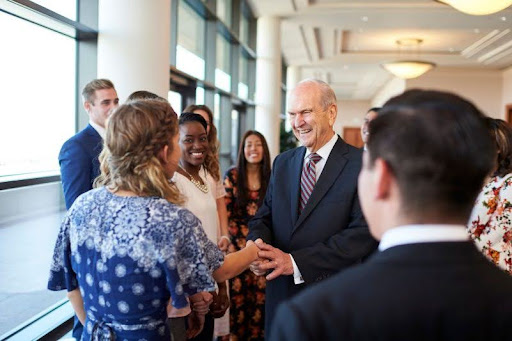
For a church that lives and dies with continuing revelation, I think the answer is simple: we do as the living prophets are currently teaching us to do. At different times in dispensational history, the solution to such problems as we face may have been different. For example, the Saints of God have repeatedly been commanded to “flee out of the midst of Babylon” and probably shall again. Most currently, our charge is rather to be reconciled unto Babylon herself. President Dallin H. Oaks recently taught: “On contested issues, we should seek to moderate and unify” [emphasis added].
In other words, we are still called to be peacemakers. We are not called to be the victors at all costs, not adamantly uncompromising in the name of righteous consistency, but moderators and unifiers and peacemakers. He did not even say to convince or persuade, a key aspect of the democratic marketplace of ideas! I believe this is implicitly a call to be anti-radicals or radical moderates; we cannot escape the implication of being moderate in President Oaks’ admonition that we moderate and unify. Could anyone other than a sincere moderate effectively moderate?
No matter what the issue nor how high the stakes, Jesus speaks unequivocally:
He that hath the spirit of contention is not of me, but is of the devil, who is the father of contention, and he stirreth up the hearts of men to contend with anger, one with another.
We must humbly refuse to join in on the contention of our times. Even when it comes to matters impinging on fundamental religious tenets, it does not seem that the ends (true laws) justify the means (prideful contention). In April 1989, then-Elder Russell M. Nelson wrote, in words as unequivocal as those of the Savior before:
Certainly, no faithful follower of God would promote any cause even remotely related to religion if rooted in controversy, because contention is not of the Lord.
This illustrates how the gospel of Jesus Christ does indeed demand something radical of us, something unthinkable, the sort of thing that would cause many of His disciples to “[walk] no more with Him.” We are radically required to refrain from political radicalization, or from radical behavior against our fellow man in political society. Jesus said, “It is better to offer the other [cheek] than to revile again. … For it is better that thou suffer thine enemy to take these things than to contend with him.” We are still called to be peacemakers.
This does not mean that we agree with all that is done with the force of law. It means that we obey the current law and use peaceful means to change it. … In a democratic society, we always have the opportunity and the duty to persist peacefully until the next election [emphasis added].
The prophets, seers, and revelators who constitute the First Presidency are clearly calling us to be moderate—or to exhibit the virtue of moderation, which is well-attested in modern revelation—in both our attitude and our methods while pursuing political change.
More demanding still, I believe we are invited to be moderate not only in our political attitudes and political behavior but also in our political beliefs. We must exhibit sufficient humility, recognizing that we approach objective truth only imperfectly and subjectively, to “consider it possible, in the bowels of Christ, that we may be mistaken.” If not mistaken about value-outcomes (such as the correctness of abortion), then at least about value-hierarchies (such as whether or not to make that issue the deciding issue of one’s vote or party identification).
President Oaks teaches that the Church will at times “exercise its right to endorse or oppose specific legislative proposals” but that “each citizen [must] decide which issues are most important to him or her at any particular time. Then members should seek inspiration on how to exercise their [political] influence according to their individual priorities.” We are specifically called to become issue-voters rather than party-voters, which “will not be easy [and which] may require changing party support or candidate choices, even from election to election.” This is itself a form of moderation, and specifically a moderation of belief about the holistic goodness of one party and depravity of the other, including their political adherents.
To put it simply, we cannot afford to believe that the other side is evil. Certainly, we should beware of secret combinations, but in a world chock-full of conspiracy theories, this is not where President Oaks has chosen to put any emphasis.

One other reason why we should be moderate in our beliefs is that the truth so often exists in the midst of apparent paradox and contradiction—better understood as balance. This is, I think, an interpretation of “opposition in all things” that is equally as necessary as that traditional interpretation, which focuses primarily on temptation and trial. This is the opposition of classic tragedy, of good against good, of truth against truth, of impossible choices and balancing acts. It is the opposition of opposites, but also of compliments—just as God embodies all contradictions: Alpha and Omega, the first and the last, eyes aflame and a voice as rushing waters, the Lamb slain from the foundation of the world and the firstfruits of the resurrection, and male and female. Indeed, Joseph Smith remarked that “by proving contraries, truth is made manifest,” and Brigham Young similarly said that “all facts are proved and made manifest by their opposite.”
Moderation in belief may be the surest road to true belief because the truth exists in the tension and contradiction between opposing sides. Thus, neither side is always entirely true. This is a conception of our increasingly accurate approximation of truth as a narrowing sinusoid rather than a rational function monotonically approaching its limit. This is the “dialectic of enlightenment.” However, this is probably only true for us fallible humans, because there is no ideological moderation or equivocation in omniscience; rather, God exhibits the balance of simultaneous superlatives (Anselm’s definition)—the ultimate contradiction.
If one cannot abide the ideas that have been conveyed and still insists that we should be radical with a righteous zeal in our political beliefs, integralistically declining to distinguish between religious and political truth or between ontological and practical reality—even then, I think the teachings of the Church are unambiguous in one final respect: that we should not be partisan.
Beginning at least with Brigham Young, the Church has taught that members of the Church in good will and good standing can belong to any/either of the major political parties:
Are we a political people? Yes, very political indeed. But what party do you belong to or would you vote for? I will tell you whom we will vote for: we will vote for the man who will sustain the principles of civil and religious liberty, the man who knows the most and who has the best heart and brain for a statesman; and we do not care a farthing whether he is a whig, a democrat, … a republican, … or anything else. These are our politics.
President Oaks similarly insisted:
We should never assert that a faithful Latter-day Saint cannot belong to a particular party or vote for a particular candidate. We teach correct principles and leave our members to choose how to prioritize and apply those principles on the issues presented from time to time. We also insist, and we ask our local leaders to insist, that political choices and affiliations not be the subject of teachings or advocacy in any of our Church meetings.
Can it be any mistake that we had a doctor during the pandemic, and we could potentially have a juror during the coming constitutional crisis? Recall that President Kimball instructed President Gordon B. Hinckley to “[c]all Nelson and Oaks to the Quorum of the Twelve, in that order.”
In President Oaks’ call for Latter-day Saints “to moderate and unify” is the fact that to sincerely and effectively moderate, we must be moderate—in attitude, behavior, and belief. Our role in doing so may very well prove indispensable to the preservation of the Constitution, the very passage of which President George Washington attributed to the Founders’ willingness to compromise with each other—even on fundamental moral issues like slavery—for the sake of union:
The Constitution, which we now present, is the result of a spirit of amity and of that mutual deference and concession which the peculiarity of our political situation rendered indispensable.
I do not think that a willingness to compromise politically requires compromising our convictions nor equivocating about absolute truth, but that is a topic deserving of an essay of its own. For now, suffice it to say that I think more of us should consider emulating Eugene England and becoming “radical middle-of-the-roader[s].”