painting-Abraham-Jozsef-Molnar-Hungarian-National-Gallery (1)

Imperfect Families and Covenantal Relationships

To those who are quick to assume that God’s loving support comes mostly to families without problems, I would recommend the story of Abraham, Isaac, and Jacob.
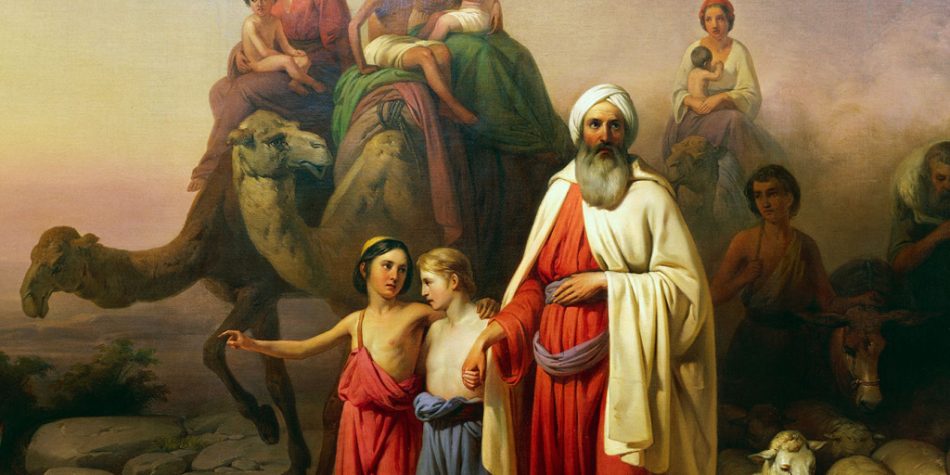
Image: The Departure of Abraham (1850), József Molnár, Hungarian National Gallery

For about the last month, those who have been following The Church of Jesus Christ of Latter-day Saints’ Come, Follow Me study schedule have spent time with the families of Abraham, Isaac, and Jacob. As is rightly highlighted in the lesson materials, these stories are, at their core, stories of covenant. When viewed collectively, the accounts of Abraham, Sarah, Hagar, Isaac, Rebekah, Jacob, Leah, Bilhah, Rachel, and Zilpah are an uninterrupted narrative about God and God’s willingness to reach down directly into the lives of the great patriarchs and matriarchs of the Judeo-Christian faith tradition. Through these Divine interactions, God forges covenant relationships with people, one-by-one, as part of God’s intention to bless (i.e. to make holy) all of creation.  Far from the image of the legalistic and jealous God that Marcion saw in the Old Testament, the God of Abraham, Isaac, and Jacob is patient, interactive, engaged, and deeply committed over multiple generations.  This is a God that is willing to meet these humans where they are and gently lead them into newness.

And it’s a good thing God is generous because the family dynamics that we encounter in these stories are (to say it gently) complicated. Consistent with the “warts and all” approach that is characteristic of the Hebrew Bible, the families of Abraham, Isaac, and Jacob are portrayed as far from idyllic. For example:

  • Abraham, at the behest of Sarah, throws Hagar (his wife) and Ishmael (his son) out of his household, presumably appreciating their risk of dying in the desert. 
  • Abraham and Isaac both pretend their wives (Sarah and Rebekah, respectively) are their sisters and offer them up to be married to other powerful men (at God’s urging in one instance) and as a way to save their own lives (Genesis 12:10-20; 20:1-14; 26:1-11 cf. Abraham 2:22-25).
  • There is intense conflict between Hagar and Sarah (Abraham’s wives) and between Leah, Rachel, Bilhah, and Zilpah (Jacob’s wives) when it comes to childbearing and the status it provides—along with painful conflict around the love of Jacob himself (Genesis 16:5-6; 21:10; 29:30-30:22).
  • Rebekah and Jacob collude to trick an old and nearly-blind Isaac into giving Jacob (who was Rebekah’s favorite) the firstborn’s blessing. While they were successful in this subterfuge, Esau is so upset that he threatens to kill Jacob who flees to Haran and lives with Rachel’s family for two decades. Rebekah recognizes her actions have damaged her relationship with Esau beyond repair. 
  • Reuben sleeps with Bilhah, Rachel’s servant (his “other mother” to use language from contemporary polygamous relationships), shortly after Rachel dies in childbirth.
  • Joseph is sold into slavery by his siblings out of jealousy. 

Perhaps because Latter-day Saints are familiar with the covenant-specific aspects of these stories it is easy to jump over those texts that expose the challenging family situations these stories present; situations that are filled with pain, hurt, duplicity, and selfishness.  And yet, I have come to believe that these family stories are just as important as the stories of covenant.  But why, you might ask, should we spend time talking about these difficult family stories?  The answer seems as obvious as it is profound: because the stories in Genesis are not only about covenants, they are also about families.  In fact, Genesis makes clear that any discussion about covenants also requires a discussion about the families through which these covenants were transmitted.  The two are intertwined.  Importantly, the stories of Abraham, Isaac, and Jacob are fully transparent in recognizing that complicated family dynamics are part of life—even for those who make and keep covenants with God.

God’s covenant relationship with humanity continues to move forward even through complicated family environments.

With the ideas clearly in mind that (1) covenants and families are both a part of everyone’s life (even if one is not married, they come from a family), and (2) covenants and families are deeply interconnected, a beautiful aspect of the family stories in Genesis comes into stark relief: these stories show that God’s covenant relationship with humanity continues to move forward even through complicated family environments.  We do not need a perfect family to partake in God’s covenant.  For instance, even though Abraham becomes the father of nations through covenant, the text seems to suggest a fracture in his relationship with his children: While Ismael and Isaac came together to bury their father, there is no record of Abraham ever speaking again with Ishmael after Ismael was forced into the desert, nor is there any record of Abraham speaking again with Isaac after the Akedah (the Hebrew term for what happened in Moriah in Genesis 22, it translates to “the binding”).  Or consider that Jacob, who was heir to the covenant (Genesis 28:10-15; 32:24-30) lived most of his adult life having no contact with his brother Esau (Genesis 31:38; 33:12-17). Though Esau and Jacob have a reconciliation of sorts, Michael Austin points out that Jacob seems content to be freed from the fear of conflict and is not really interested in an enduring relationship.  In fact, the Edomites (Esau’s offspring Genesis 32:3; 36:1) serve as antagonists to the Israelites (Jacob’s offspring) throughout their shared history.  Or despite the fact that Hagar, Bilhah, and Zilpah are expressly part of God’s covenantal intentions (Genesis 16:7-12; Genesis 49), there was obvious tension introduced through the cultural practice of “giving” one’s handmaiden (i.e. slave) to a husband.  Hagar and Sarah and Leah, Bilhah, Rachel, and Zilpah were women who might have been (and maybe should have been) friends, but the culture of the day pitted them against each other and created situations rife with exploitation and pain that played themselves out through their children.  These intrafamily conflicts may have been part of the reason Joseph was sold into slavery.

Though many of these complicated family situations didn’t seem to be resolved in this life, God’s covenantal interactions with these families continued nevertheless.  I realize this is not the way we usually talk about the families of Abraham, Isaac, and Jacob, but it is a perspective that is grounded in these biblical narratives and thus part of our sacred tradition.  And as we try to liken these scriptures to ourselves, we may be able to recognize some of these same (or other) complicated family dynamics in our own lives or the lives of our friends.  In fact, these stories make expressly clear—they even seem to embrace with both arms—the reality that every family has complicated forces at work.  Even families of the covenant.  Some families of the covenant have individuals whom they have effectively exiled into the desert, and others may feel like they have been exiled by their families; some families of the covenant have fractures in relationships among parents/children/siblings; some mixed marriage families of the covenant (but certainly not all) are marked by conflict between the adults, leaving children to struggle with navigating intrafamily relationships; and some families of the covenant have conflicts over inheritance with certain family members lining up against other family members.  The Genesis stories demonstrate that family relationships, even those bound by covenant, may not work out the way we might expect; this reality, Genesis seems to suggest, is part of life.  

As odd as it may sound, I find deep reserves of hope nestled in the Genesis narratives when it comes to families.  I find it comforting that the great patriarchs and matriarchs of our faith—those whose covenants serve as the foundational elements of our understanding of God’s relationship with humankind and the world—had less-than-perfect families which contained—alongside joy and happiness—moments of conflict, challenge, and discord.  They were imperfect, but this did not stop God from interacting with these families!  In fact, a central message of these texts seems to be that families of the covenant should expect to have challenges, but that does not mean that God is not with them.  Rather, God persists with these families anyway.  God embraces our families as they are—God does not demand (or even expect, it seems) perfect families—and God offers to walk with us as we struggle through complicated relationships.  In a culture where anything less than ideal is seen as a failure, the families of Genesis offer us a space for self-acceptance and self-compassion.


About the author

M. David Huston

Michael Huston (who has previously published in Public Square Magazine under M. David Huston) currently resides in central Maryland. He received degrees from Utah State University (Logan, UT), American University (Washington, DC), and Wesley Theological Seminary (Washington, DC). You can find him at wonder.annotated on instagram and Wonder Annotated on facebook.
On Key

You Might Also Like

Demanding Conversations About Violence

In the weeks since the premiere of the Under the Banner of Heaven miniseries, there has been a broad consensus that the show doesn’t quite work. Its attempt to paint Latter-day Saints as promoting violence just doesn’t land. And its depiction of Latter-day Saints simply doesn’t resonate because it’s too dissimilar. This of course must come as some disappointment to critics of the Church who had hoped the series would prompt more conversations around the issues they deem problematic such as how the Church promotes violence. Into this void comes a new argument made most prominently by Taylor Petrey, but also echoed by a student columnist at the University of Utah, and now promoted on Twitter by Benjamin Park—namely, that because there has been some violence done by some Latter-day Saints who use the language of their culture in perpetrating it, Latter-day Saints should watch the series with the intent to learn how to make their Church less violent. Both Petrey and Park had previously criticized the series for its poor job in portraying Latter-day Saints, but have since shifted. We don’t want to attack the Daily Utah Chronicle piece because it’s a student article. But Petrey and Park should know better. Some of us have been on the record defending Petrey as a serious scholar, despite the fact that his conclusions don’t often derive well from the available evidence. But Petrey seems to suggest in his article that any violence that uses the language of religion must have been inspired by that religion. We understand the temptation of this point of view. What else could we blame violence on if not the culture it arose in? But Petrey’s position assumes that human beings are naturally non-violent, and only become violent as a result of their culture. This is a major assumption in the Robert Orsi essay that Petrey relies on extensively. Parks’ tweets similarly assume that any conversation about Latter-day Saints and violence must concede that the faith contributes to the violence in some way. But the causes of violence are often complicated. Because of the importance of our innate nature in creating violence, even the most peaceful society would still produce fringe examples of extreme violence. Having a Latter-day Saint who becomes violent isn’t proof that the faith contributes to that violence, even if the perpetrator uses the language of their culture in perpetuating that violence. Cultural contexts can then increase or decrease the likelihood of that emerging, but no culture has discovered how to remove it altogether. And because Under the Banner of Heaven fails to present a clear picture of what most experience as Latter-day Saint culture, it doesn’t do much to establish whether a Latter-day Saint context is more prone to cause violence than others. Those who use Latter-day Saint or another religious language and context to perpetuate violence weren’t necessarily made violent by those cultures. But rather, violent individuals will leverage anything around them to perpetrate their violence. We’re aware of many other similar examples—of abusers, for instance, who used the language of therapy to perpetuate abuse. But it would be absurd to suggest that therapeutic culture caused that abuse. Even pacifist language has been known to be used to perpetuate violence by shaming survivors into silence. An abusive person will draw upon the most powerful language available within their given cultural context and weaponize that. This is not coincidentally the conclusion made by prosecutors in the Lafferty case, that the murder was about power and relationships and that religion was merely the pretext. Does the Church of Jesus Christ disproportionately create violent offenders? We’d be interested in reading any definitive social science research on the question, but unfortunately, those promoting this point of view or hoping to have this conversation have not yet presented any. And rather than attempt to answer this question clearly itself, Under the Banner of Heaven skips the question and takes it as a given. A study of this sort could start the conversation Petrey, Parks, and the student author hope for. Instead, we get a story about a 38-year-old murder that was notable mainly for how unusual it was among the Latter-day Saint community and perpetrated by someone who had recently been kicked out of the Church for their extremist views. It should not surprise anyone that it hasn’t prompted anyone to conclude there’s a problem with violence among Latter-day Saints.

Subscribe To Our Weekly Newsletter

Stay up to date on the intersection of faith in the public square.

You have Successfully Subscribed!