Our daily rundown of the articles from around the web that we feel our readers would enjoy and appreciate. We hope to highlight the best of what’s around.
Public Square Bulletin recommends:
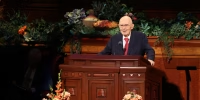
NPC Headliner Luncheon: Elder David A. Bednar
Elder David A. Bednar, an apostle of The Church of Jesus Christ of Latter-day Saints, presents to the National Press Club about the Church and how it helps people both from the outside in, but especially from the inside out and fields questions on many controversial subjects in a Q&A including why people leave religion. The Q&A begins at forty-two minutes.
Why do people abandon religion?
Moshe Taragin—The Jerusalem Post
While the conversation of leaving religion affects many denominations, this article from The Jerusalem Post looks at the question generally but from the perspective of Judaism. Certainly a worthy addition to the conversation.
Is God a Therapist?
Carl Trueman—First Things
In his latest, Carl Trueman laments our “childish age” and the way it oversimplifies God. He relishes in the hard complicated God that is worthy of worship.
Elder Perkins shares common values at a groundbreaking conference in Saudi Arabia
Mary Richards—Church News
The Muslim World League held its first-ever forum on Common Values of Religious Followers. The Church, which recently announced its first temple in the Middle East, has not had a leader speak in Saudia Arabia since the G-20 summit in 2020.
How an Army ethicist works to mold moral soldiers
Mary Beth McCauley—The Christian Science Monitor
A fascinating deep dive into the Baptist chaplain who is a leading figure in war ethics. The article looks at his background, beliefs, and day-to-day work teaching ethics to new recruits.