Raphael Isaiah Painting | Prophets Can’t Win | Public Square Magazine | Why are Prophets Rejected | Why do Prophets Suffer | Prophets Rejected in Their Hometown | Prophets

Prophets Can’t Win

People tend to seek information that affirms what they already think. But prophets are called to a very different task. And whether prophetic teaching is subtle or direct, the public reception is often sadly predictable.
The Prophet Isaiah by Rafael 1512

“I never did give anybody hell. I just told the truth, and they thought it was hell.”  ~Harry “Give ‘em Hell” Truman

The 2020 U.S. presidential election resulted in one of the most spectacular recent controversies in evangelical Christianity. A number of charismatic evangelical “prophets” proclaimed that God had provided for the electoral victory of Donald Trump. Following Trump’s loss in the election, evangelical discernment commentators like Justin Peters provided lengthy commentary cataloging their failures, treating them in some cases as evidence for the cessationist view that prophetic gifts ceased long ago.

For those seeking to discern true prophets from their counterfeits, flattering messages that affirm our political fantasies should constitute a bright red flag in the messenger.

Some evangelical preachers publicly repented of their false prophecies. North Carolina pastor Jeremiah Johnson apologized for his error, then publicly lamented the threatening and abusive messaging that was sent to him in response by people claiming to be Christians:

Over the last 72 hours, I have received multiple death threats and thousands upon thousands of emails from Christians saying the nastiest and most vulgar things I have ever heard toward my family and ministry. I have been labeled a coward, sellout, a traitor to the Holy Spirit, and cussed out at least 500 times. We have lost ministry partners every hour and counting.

Valuable lessons about prophecy can be gleaned from the ministry of Jeremiah Johnson’s namesake, the biblical prophet Jeremiah. Jeremiah had a sharp confrontation with the nationalist false prophet Hananiah, who in the name of Yahweh spoke the comforting lie, “I will break the yoke of the king of Babylon.” Hananiah, like others before and after him, gained an audience by telling people what they wanted to hear, answering their cravings for security and control in a world that is unpredictable and often frightening. Jeremiah, by contrast, told the people and the political and religious establishment that their turn to pantheism and idolatry was apostasy and forfeiture of divine protection from enemies.

For those seeking to discern true prophets from their counterfeits, flattering messages that affirm our political fantasies should constitute a bright red flag in the messenger.

One of the great brain teasers for Bible translators and interpreters is found in Isaiah 6. After Isaiah sees the Lord and expresses a willingness to represent the Lord to the people, he is given a message that seems to represent a legitimate thwarting of his own prophetic efforts:

Go, and tell this people, Hear ye indeed, but understand not; and see ye indeed, but perceive not. Make the heart of this people fat, and make their ears heavy, and shut their eyes; lest they see with their eyes, and hear with their ears, and understand with their heart, and convert, and be healed.

Isaiah seems to have been told to engage in prophetic obfuscation. At this time, the people’s spiritual senses were so dull that the prophetic message was to be offered in a way that was not aimed at their turning, their conversion, or their divine healing. Realistically, if the people were offered a message of redemption and spoken in clarity, it would not be valued appropriately. And to receive such a message and reject it in this way would further accelerate the people’s downward spiral away from God. This may help to explain why Isaiah’s communications often seem so cryptic and even confusing; he seems to have understood well the extent to which his message was to be crafted in a way that corresponded to the people’s level of spiritual receptivity.

Prophets are rejected because their style is too something: blunt, polite, vague, normal, eccentric, bland, provocative, cheery, corporate, abrasive, or any number of other descriptors

Jesus would later invoke Isaiah 6 as He explained the need for parables, rather than direct pronouncements,  in His own teaching:

And when he was alone, they that were about him with the twelve asked of him the parable. And he said unto them, Unto you it is given to know the mystery of the kingdom of God: but unto them that are without, all these things are done in parables:

That seeing they may see, and not perceive; and hearing they may hear, and not understand; lest at any time they should be converted, and their sins should be forgiven them. (emphasis added here and below). 

Rejection—even angry, violent rejection—by the majority of society has been part of the prophetic call throughout history. To accept a prophetic mantle is to accept persecution; it is to receive the word of God and undertake to share it while often mourning as people burn it in a bonfire of their rival commitments and worldviews. 

For example, the resurrected Christ knew that Saul of Tarsus would eventually become one of the most influential religious figures in history, but His words to Ananias in Damascus were a sobering, realistic view of Paul’s imminent ministry: I will show him how great things he must suffer for my name’s sake. The prophetic call is a call to suffer.

And then there is the “soft rejection” the Lord describes to Ezekiel:

They sit before thee as my people, and they hear thy words, but they will not do them: for with their mouth they shew much love, but their heart goeth after their covetousness.

And, lo, thou art unto them as a very lovely song of one that hath a pleasant voice, and can play well on an instrument: for they hear thy words, but they do them not. And when this cometh to pass, (lo, it will come,) then shall they know that a prophet hath been among them.

The soft rejection of prophets is often a function of their style. Prophets are rejected because their style is too something: blunt, polite, vague, normal, eccentric, bland, provocative, cheery, corporate, abrasive, or any number of other descriptors. The rejection of Ezekiel fits this pattern; Ezekiel lamented, “Ah Lord God! they say of me, Doth he not speak parables?”). Then there are also the artificially contrived criteria: some people of fundamentalist leanings claim, for example, that Latter-day Saint prophets no longer qualify for the title because they decline to preface their statements with “Thus saith the Lord …” and they almost never offer dramatic public predictions of future events. This is viewed by some as a problem despite the fact that, for example, Elijah and John the Baptist (regarded by Jesus as the greatest prophet to that point in time) spent their prophetic energy responding to present concerns, not unveiling apocalyptic visions of the future.

One salient example.  Fundamentalists aren’t the only ones among us who squirm and wrangle out of a commitment to prophetic teachings. Among Latter-day Saints, some reject the Family Proclamation by claiming it has never been formally canonized as if that has ever been the standard for determining whether or not a prophetic teaching is true or binding. Some use historical criticism, presenting the Family Proclamation and other prophetic teachings as products of a certain time and place and culture, in order to undermine the relevance of those teachings. When people are fully committed to subverting God’s message, prophets can’t win.

However we approach prophetic teaching, we have our reward: either a religion in our own image that fits our paradigms or a religion that points to soul-stretching realities beyond our paradigms.

But a good question for critics would be, what if the Family Proclamation were prefaced with a declaration that it is the product of revelation from Almighty God and then formally canonized? Would you, a critic, then accept it as binding and change your own views to be in line with it?

The obvious answer is no because critics of the Family Proclamation are not being honest when they pivot to questions of canonization. They have placed their bet on a rival religious ideology that revolves around the prioritization of sexual desire and the obliteration of gender. And in this bet, they are all in. This is why they are extremely careful to avert their eyes from realities like the recent study from Eric Kaufmann showing a rise in mental health problems among LGBT+ youth during a corresponding rise in social acceptance; avert their eyes from the strenuously-held delusion that male and female are meaningless social constructs, even among animals like chickens; and avert their eyes from the current wave of gender chaos fueled by social incentives. Rejection of the Family Proclamation requires denying multiple wide swaths of empirical reality. And if we are waiting for even one single critic of the Family Proclamation to candidly acknowledge these calamities, that looks to be an extremely long wait. Prophets can’t win because, in a sense, they are playing a game that has been rigged in advance by their hearers.

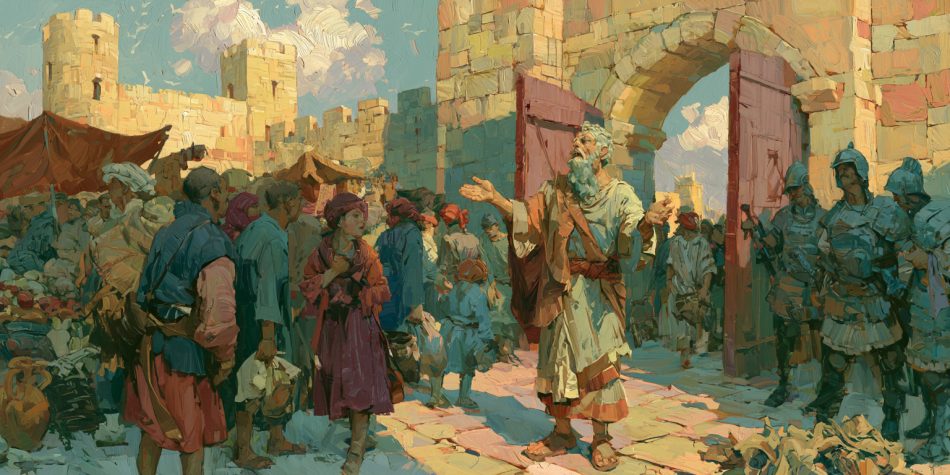
Man Ignored in a Busy Market | Challenges Prophets Face in Communicating Their Messages | Prophets Can’t Win | Why are Prophets Rejected | Public Square Magazine
Prophets face challenges in communicating their messages.

We live in a time when witness testimony of the prophetic mantle in the Church of Jesus Christ has become increasingly direct. Examples include Elder Dean Davies’ eyewitness account of President Gordon B. Hinckley’s selection of a precise temple site; Elder Quentin R. Cook’s bold witness testimony of revelation in the councils of the Church; and Sister Wendy Nelson’s specific testimony of her husband’s revelatory activity. Amid all this, critics of the Family Proclamation find creative ways to assert that this doctrinal statement is an entirely human fabrication not involving revelation at all. In light of increasingly potent witness testimony of the prophetic mantle, I find it far more plausible to believe that the Family Proclamation is exactly what we claim it to be: a universally-binding revelation that addresses problems that most of us could not have imagined when it emerged in 1995. Equally revelatory and binding are current prophetic statements that recognize people’s varied challenges in living the ideals of the Family Proclamation and the need for compassion toward those with varied life experiences and circumstances.

Critics of the Family Proclamation should perhaps consider the counsel given to their spiritual predecessors through Isaiah: “Behold, all ye that kindle a fire, that compass yourselves about with sparks: walk in the light of your fire, and in the sparks that ye have kindled.” In other words, we are welcome to whatever self-generated religion we desire.

In a self-centered religious paradigm, there can be no authentic encounter with God.

Affluent Westerners, and particularly Americans, bring a consumerist paradigm to prophetic teachings. “The customer is always right,” applied to questions of faith, results in a transition away from Abrahamic religion that authentically seeks to encounter God on God’s terms towards a therapeutic relativist popular religion that seeks to validate our religious consumer preferences. However we approach prophetic teaching, we have our reward: either a religion in our own image that fits our paradigms or a religion that points to soul-stretching realities beyond our paradigms. The latter is the strait and narrow way articulated by Jesus, which He frankly acknowledged would be chosen by a numerical few.

A prayer offered by Flannery O’Connor conveys this essential reality:

Dear God, I cannot love Thee the way I want to. You are the slim crescent of a moon that I see and my self is the earth’s shadow that keeps me from seeing all the moon.

…what I am afraid of, dear God, is that my self shadow will grow so large that it blocks the whole moon, and that I will judge myself by the shadow that is nothing. I do not know You God because I am in the way. Please help me to push myself aside.

Flannery O’Connor held deep spiritual wisdom that acknowledges that God is often obscured by our own assumptions and perceptions. In a self-centered religious paradigm, there can be no authentic encounter with God. And in times like Isaiah’s and our own, where people’s spiritual senses are dulled, the prophetic message is often spoken with a frustrating vagueness. This is by design, and in so many ways, it ultimately reflects our lack of receptivity. We must learn to, in the words of Flannery O’Connor, push ourselves aside. This presents both a challenge and opportunity for all of us who take seriously the prophetic mantle in our day.


About the author

Dan Ellsworth

Dan Ellsworth is a consultant in Charlottesville, VA, and host of the YouTube channel Latter-day Presentations.
On Key

You Might Also Like

“You’re Cordially Invited” Movie Review 2025

“You’re Cordially Invited” is a movie about terrible behavior before a wedding. In an intriguing riff on the premise, the brides are the ones on their best behavior. When Jim (Will Ferrell) calls the venue where he and his late wife were married to schedule the wedding of his daughter, the desk agent confirms,. However, her pen runs out of ink, and she falls over dead before she can replace it. So when Margot (Reese Witherspoon) calls to book the venue located on the property her grandmother used to live on for her sister’s wedding, the event is double booked. A year later, when both wedding parties arrive on the same day, explosions ensue. The screenplay tracks the goodwill between the parties cratering until it hits its nadir with Will Ferrell capturing an alligator, taking it back to the inn, and now that he’s hit rock bottom, deciding he shouldn’t actually release the gator into the other wedding reception. Phew! Character growth achieved, and crisis averted. Performances and Direction In terms of feel, quality, and laughs, I’d put this somewhere between “Bride Wars,” the clunker with Kate Hudson and Anne Hathaway also fighting over a wedding venue, and “The Proposal” the serviceable feel-good that places the relationship in a broader family dynamic. The players here are all high quality. Will Ferrell and Reese Witherspoon are professionals putting on a good show, and they have more chemistry then I would have guessed. Jimmy Tatro who plays one of the grooms, Keyla Monterroso Mejia who plays one of the bridesmaids/wedding planners, and Vinny Thomas, who plays Margot’s assistant, all bring energy and life to the script. And it’s clear that it’s being helmed by a steady hand, Nicholas Stoller, who has built a career on raunchy middle-of-the-road comedies of decreasing quality. And I’d say, of his films, this one is really only better than “Storks” or maybe “Neighbors 2.”  Weak Writing and Cultural Commentary The movie lacks any real zest or inspiration. It’s not unfunny, I just can’t imagine remembering any of the jokes in a few days. And while the film spends a lot of time trying to make fun of woke-scolds, the film also seems too scared of them for these jokes to ever really work.   The bigger problem is that the entire film is drenched in profanity. It’s as though someone wrote a perfectly fine middle-of-the-road rom-com. The studio said it needed to be ten minutes longer, so they decided to add ten minutes of F words.  They are pointless and degrading, and makes what is otherwise a fine if uninspiring film one that is decidedly worth avoiding.  The film is also a bit of a window into how culture views marriage, and it’s not all inspiring. The film concludes that a couple who dated for several years through college, and is happy moving in together across the country, with stable jobs, are better off getting their marriage annulled because marriage is just such a big step.  This film also continues the trend of promoting family reconciliation by processing psychological trauma, by blaming whatever generation is older than whoever wrote the movie. It’s long been a trope to blame the parents, but now we’re reconciling with the parents by blaming the grandparents. “Encanto” did it well, but the new variation of the trope is already starting to wear thin. I think the only people who will truly love this film are those who buy in to the Witherspoon-Ferrell chemistry so much they are willing to watch it go anywhere. I wouldn’t watch this movie with children.  One and a half out of five stars. “You’re Cordially Invited” releases on Amazon Prime on January 30, 2025. Related Articles  In Pursuit of the Perfect Family Movie Heretic in Real Life: A Missionary’s True Story of Survival and Faith Is There Anyone Who Shouldn’t Watch “Rule Breakers”? Public Square Magazine Film of the Year: Corpus Christi 

The Ordinary Saint’s Guide to Under the Banner of Heaven: Episode 4, “Church and State”

Summary — The episode begins with the detectives checking in on Bishop Low’s home, which they find ransacked and deserted. Pyre finds a letter written by Ron’s wife to the Prophet expressing concern about her husband’s refusal to pay taxes. The detective contacts the Church about the letter and is told the letter was handed down to one of the bishop’s counselors, LeConte Bascom, who works at the bank. Brother Bascom says he had to turn Ron down for a loan because his brother’s refusal to pay taxes made him a liability, though it’s heavily implied that the real reason is that his wife’s letter was seen as an embarrassment to the Church. In flashbacks, we see Dan marching in a Pioneer Day parade, shouting about the government’s illegal taxes, as well as smoking and kissing a woman who isn’t his wife. Dan’s father says he’s ashamed of his immoral behavior and anti-tax nonsense and advises him to study the scriptures to set himself back on the right path. This unfortunately drives Dan into researching more obscure history of the Church, including information on polygamy.  He makes a business trip down to Colorado City to visit the breakaway polygamist sect there and manages to get the name of a pro-polygamy pamphlet called “The Peace Maker.” He reads this pamphlet and brings up the idea to his wife Matilda, telling her she’s limiting his spiritual power if she doesn’t let him marry a second wife.  During this conversation, Dan is pulled over for speeding and refuses to cooperate with the officer, leading them on a police chase that ends with his arrest. At the jail, Dan’s brothers try to convince him to stop his resistance to the government. Ron feels it’s his responsibility to show Dan the error of his ways, but instead, Dan runs circles around him, leaving him speechless and admitting that he’s going to lose his business and home. Dan somehow turns this fact into evidence that his views are correct and ends up winning over Ron to his side. In the present, Detective Pyre is being leaned on by the Laffertys’ stake president to release them into his custody but refuses. The detectives have identified the car the killers were probably using and plan to hold a press conference to ask for tips when the police chief returns from vacation and demands that all mentions of fundamentalism Mormonism be scrubbed from the press briefing. (It’s implied he’s being leaned on by the Church.) Pyre tries to toe the line at the conference but eventually caves to a persistent reporter and admits that he thinks that the murders may have something to do with fundamentalist beliefs. The next day at church, the ward is shunning the Pyres, and a specific couple is assigned to keep an eye on their faith. Meanwhile, a police officer has located Bishop Low fly fishing in the mountains and safe. Church History — During Dan’s explanation of polygamy, we get flashbacks to the infamous scene where Emma finds out about the doctrine of polygamy for the first time and throws the revelation in the fire. Though church members will be familiar with this story, the tone is portrayed very differently than we are used to. Emma is shown as being absolutely skeptical of Joseph’s translation of the Book of Mormon and other prophetic acts, even though she firmly testified of the truth of these things even after her break with the Church after Joseph was murdered. Joseph is portrayed as proclaiming the doctrine of polygamy only for his own physical gratification, which is a common anti-Mormon trope with little evidence behind it. While it is true that one of Joseph’s wives was only 14, the facts behind the situation are more complex than portrayed in the show. The pamphlet “The Peace Maker” is portrayed by Dan Lafferty as an “essential LDS tract” written by Joseph Smith, and no one in the show ever corrects this perception. In fact, the tract was not written by Joseph Smith, and he repudiated it during his lifetime. This episode presents a slanted view of church history, giving only one side of the conversation and showing the modern church as trying to hush it up rather than having its own interpretation of events. Shibboleths — Pyre claims that writing a letter to the prophet is like writing to “Heavenly Father himself,” which is absolutely wrong. While members of the Church do revere the prophet and listen to his teachings, he is not God, and this equivalency is not one Saints would make (though outsiders think we do). The idea that doing business with fundamentalists is like “doing business with the mafia” is totally alien to me. They are regarded as somewhat of an oddity in Utah, but not dangerous like organized crime. One unusual phrase occurs when the stake president claims that the Laffertys need to be released into his custody for “healing prayer.” I honestly have no idea what this phrase refers to and have never heard it in an LDS context. And the formal type of shunning portrayed happening to the Pyres is not something we do. Though obviously, wards vary in their culture, there is no formal instruction not to talk to those who have questions. Rather, we are encouraged to keep being friends with those who are struggling with faith and support them however we can. Changing History — It is interesting to note that in the actual chain of events, it was Sister Low, not Bishop Low, who was on the Lafferty hit list. Sister Low was a Relief Society President who supported Dan’s wife as she sought a divorce. Why does the show change this? Perhaps the idea that the Church has female leaders doesn’t fit well with the show’s depiction of the oppression of women in the LDS church. Brenda Lafferty’s sister has also expressed her disappointment with the way the show is misconstruing her sister’s murder in pursuit of an

Subscribe To Our Weekly Newsletter

Stay up to date on the intersection of faith in the public square.

You have Successfully Subscribed!

Pin It on Pinterest

Share This