Are Demographics Destiny for Latter-day Saints?

Lutheran demographer Lyman Stone wrote for the Institute of Family Studies today a fascinating article about fertility rates between religious groups.

His main takeaway is that the religious have much higher fertility rates:
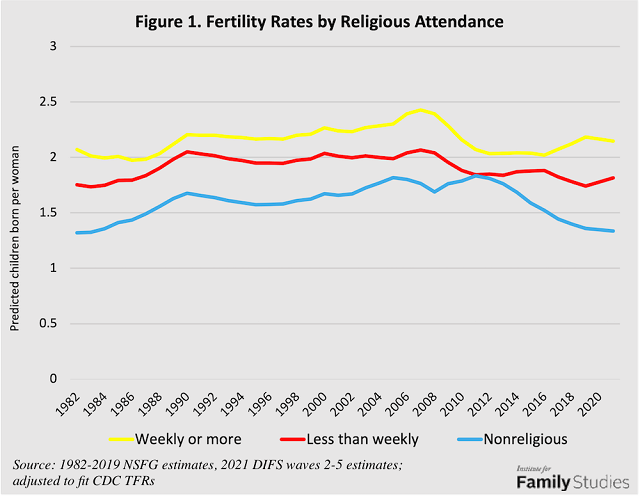
But in the back half of his article, he discusses if the fertility rate of different religious groups is high enough to maintain stability. While Stone lumps Latter-day Saints in with many other groups, so doesn’t dig into his numbers in this article, but his article suggests that if current trends remain, Latter-day Saints should expect to see decreases between 10%-40%.




On Key

You Might Also Like

Is it Okay to Disagree about THAT?!

While most Americans love to talk about the high value of “pluralism” and “free speech” when push comes to shove they usually have a red line—an issue on which it’s NOT okay to disagree openly. At least not publicly. What’s yours?

Hebrew Summer Camps, Utah Jazz, and a Helplessly Biased “Journalist”

Last week the Times of Israel asked, “Why do the Utah Jazz, in the Mormon capital, play ‘Hava Nagila’ after wins?” The answer is complicated. The song was first written in 1918, and the author soon moved to Cincinati where he played a role in planning Jewish summer camps, where the song quickly became associated with athletics. By the 1970s the song was being played at professional sporting events. Having been in the sports milieu for more than 50 years, it shouldn’t come as a surprise that so many sports team use the song, and that some of them use the song regularly as the Jazz do. The complicated history could be an occasion to celebrate our multi-cultural nation. But Emily Kaplan took it another way. Kaplan has tried to represent herself in the past as a neutral journalist interested in covering Latter-day Saints. Her first effort left much to be desired, marginalizing most Latter-day Saint voices in favor of her own narrative about a regressive church. When confronted by these critiques Kaplan grew very defensive, doubling down on her right to repurpose Latter-day Saint faith, culture, and history, to fit her narrative. So it might come as some surprise her response to the question Times of Israel proposed: Not only does Kaplan descend into outright insults “garments in a twist” she concludes that the Jazz’s use of the song is somehow part of a weakness of Latter-day Saints rather than related to the larger sports culture, where it’s inspiration clearly comes. Kaplan’s effort to shoehorn a criticism against Latter-day Saints complete with slurs in a place where it doesn’t belong, firmly establishes that she is not the neutral journalist about Latter-day Saints she attempted to portray herself as. I agree that something offensive and absurd has happened here, I just don’t think it has much to do with sports anthems.

Dune: Part Two

I can’t wait to watch Dune: Part Two with my kids. Dune: Part Two is so good it lodges itself (and retroactively lifts its predecessor) into the pantheon of great epic movie trilogies. Depending on whether or not the third and final installment can stick the landing, I suspect it will be spoken of in the same breath as Lord of The Rings, The Dark Knight, and Star Wars.   Like the first two of those trilogies, however, the film is not right for young children. Dune deals with serious themes such as drug use, religion, violence, colonialism, gender, and terrorism. It does so in a way that avoids the overly simplistic explanations appropriate for younger kids, but that is honest and thought-provoking. The film provides easy access to difficult conversations with teens while telling a thrilling story, and adults will leave feeling satisfied and contemplative about some of the film’s broader implications.  The film picks up in the aftermath of the Harkonnen’s capture of Arrakis from House Atreides, and Paul Atreides (Timothée Chalamet) taking a place among the local Freman. For a part two, the film is remarkably well contained with a clear beginning, middle, and end. I wouldn’t recommend coming into this film without watching the first, but if you did, you would certainly enjoy the story on its own merits.  For Latter-day Saints, the film’s most poignant themes revolve around the nature and abuse of power. Among the Fremen, Paul is believed to be the Mahdi, a Messianic figure they expect will return them to control of their lands. Paul is torn between seeking vengeance for the defeat of his family and moving on by integrating into the Fremen society. The faction of Fremen who view Paul as the Mahdi complicates this by holding out the opportunity for the power he needs to seek out revenge. The ethics of how Paul wields that potential power are among the most potent themes of the film, one sure to be further explored in the trilogy’s final installment. The director, Denis Villeneuve, is in top form here. His shots are each expertly crafted art pieces on their own merits. They lend weight to the themes he’s exploring, and he weaves them together like a composer weaving together the themes of a symphony. He even includes an extended black-and-white motif that just works. You don’t even question it.  The script is well paced. It never lags like sometimes happened in the first installment, but also gives plenty of space for its beats to breathe. It’s never confusing, but also doesn’t feel the need to over explain to its audience. Just as in the first film, the sci-fi is absurd—dragonfly-like helicopters, giant worms, and magic yelling. But the imagination here makes them feel completely authentic. You can’t help but buy in. Perhaps the most fun new element—riding the sandworms—is so thoughtfully considered it feels obvious, quite a feet for a film that wants you to buy the reality of riding a worm.    Chalamet leads a stellar cast here that has added Florence Pugh, Christopher Walken, and Austen Butler. Butler in particular inhabits the grotesque Harkonnens in a way that feels both terrifying and authentic. As for the returning cast, Javier Bardem, Rebecca Ferguson, and Stellan Skarsgård are standouts. A lot of weight is put on Zendaya in this film and she is substantially up to the task. Dune: Part Two is a great story wrapped in a world class sensory experience executed by artisans at the top of their craft. It is certainly not a film for kids, but I imagine many parents connecting to their teens over it, and I would heartily endorse it to them. Five out of five stars.

Subscribe To Our Weekly Newsletter

Stay up to date on the intersection of faith in the public square.

You have Successfully Subscribed!