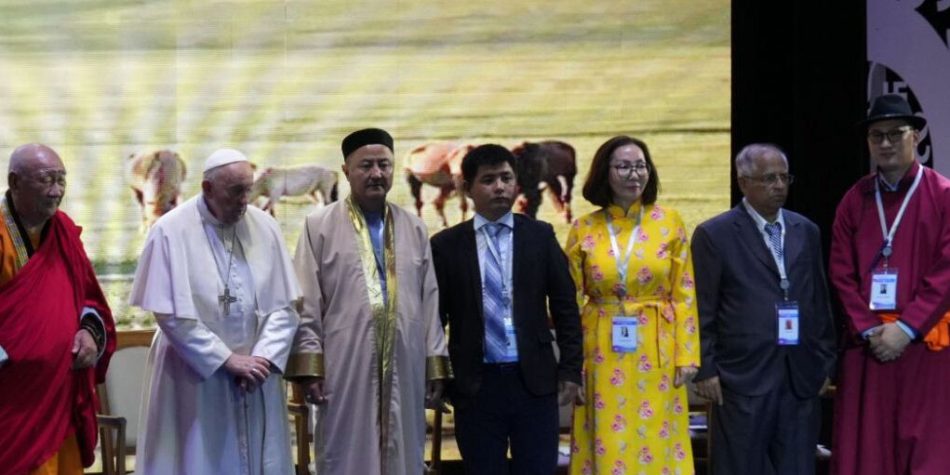
Tuvshin Gombo at an interfaith event with Pope Francis, representing the prominence of Latter-day Saint women.

Shattering the Stained Glass Ceiling: A Latter-day Saint Woman and the Pope

At the Mongolia interfaith gathering, Tuvshin Gombo stood as the sole female envoy, showcasing the Church's forward-thinking approach to women, echoing Mongolia's own culture.

From my early days as a convert to The Church of Jesus Christ of Latter-day Saints, I’ve been deeply moved by the Church’s recognition of the indispensable and unique role of women. Latter-day Saint women, both within the Church and in secular arenas such as businesses and charities, demonstrate our boundless potential.

In my most recent article for Public Square, I gave examples of this work in the arena of maternal health. A recent event in Mongolia presented another example of the expansive good Latter-day Saint women do and how the Church of Jesus Christ leads in an international context on women’s issues in culturally aware and sensitive ways.

The scriptures and teachings of the Church continually underscore the significance of women. Women serve in various capacities, from missionary work to teaching the gospel and caring for the needy. Every woman in the Church is entrusted with the responsibility to understand and champion her divine roles, whether as a mother, daughter, sister, or friend.

Central to her message was the figure of Jesus Christ.

Furthermore, women lead and serve throughout the Church—leading men and women in primary callings, administering welfare programs for families, and participating in the highest Church councils. Their voices are not just heard; they are sought after. From personal experience, I can attest to its teachings: Every righteous desire will be fulfilled, and blessings await all, regardless of gender. The divine plan of happiness is for men and women alike.

A Woman in Mongolia

On September 3, in Ulaanbaatar, Mongolia, Pope Francis hosted an interfaith gathering bringing together representatives from diverse religious backgrounds. From Mongolian Buddhists to Jews, Muslims, and adherents of the Shinto tradition, each shared their unique perspectives and teachings.

Sister Tuvshinjargal “Tuvshin” Gombo represented The Church of Jesus Christ of Latter-day Saints. As I reflect on her participation, I’m filled with a sense of pride and admiration. Tuvshin emphasized the universal kinship of humanity, stating, “We are brothers and sisters, all children of the same Eternal Father.” Central to her message was the figure of Jesus Christ, described as “the way, the truth, and the life,” whose teachings act as a beacon guiding the faithful. She urged all to “love one another, seek understanding and compassion, and strive for harmony amidst our diversity.” Drawing from Mongolian culture, she likened the shelter of the Mongolian ger, a traditional home, to the commitment of Latter-day Saints in Mongolia to follow Christ, seeing Him as the source of unity and peace. Her vision of a world “where love prevails, where families are strengthened, and where all God’s children find hope, acceptance, purpose, and peace” resonates deeply with the core teachings of the Church.

Among the many powerful messages Tuvshin delivered was her presence—the sole female representative at the event. In a gathering of this magnitude and importance, our Church was the only one to send a woman as its ambassador. This decision, while seemingly simple, speaks volumes. It underscores the Church’s recognition of the vital roles women play, not just within our congregations but in representing our faith on global platforms to speak about the power of Jesus Christ. 

Women of Mongolia

Mongolia has long been a nation that is progressive in the role of women. During the era of the Mongol Empire, women shouldered responsibilities alongside men, from tending to animals and setting up camps to childrearing and food production. Their rights, surprisingly progressive for the time, allowed them to own property, participate in religious ceremonies, and even ascend to the roles of shamans. The voices of women, especially those in elite ranks, were heard and valued. Some even reigned as regents. Their expertise in managing camps was pivotal in the logistics of Mongol warfare.

Historically, Mongolian women enjoyed a status often higher than their counterparts in other Asian societies. When Tuvshin drew parallels between the safety of Christ and the traditional Mongolian ger, she called on this long history of deep-rooted respect for women in Mongolian culture and their significance in the Church.

In this context, the Church’s decision to send a woman representative to Mongolia is profound. It not only aligns with Mongolia’s historical respect for women but also underscores the Church’s commitment to elevating the voices of women on global platforms in ways that are culturally appropriate in a worldwide context. 

Elevating Women in Interfaith Dialogues

Tuvshin’s vision of a world ‘where love prevails, where families are strengthened, and where all God’s children find hope, acceptance, purpose, and peace’ is a testament to the Church’s commitment to elevating women. Her words not only represent our Church’s teachings but also echo universal values that transcend religious boundaries.

The Church of Jesus Christ made a statement by sending Tuvshin as the Church’s representative. This decision, while perhaps subtle to some, speaks volumes about the Church’s egalitarian stance on women’s roles. It’s a visual testament to our belief in the equal capacities of men and women. They have the knowledge, the conviction, and the spirit to represent our teachings on any platform, be it local or international.

In a world where the roles of women in religious settings are often underrepresented, the Church’s decision is a beacon of hope. It reaffirms our commitment to elevating women, recognizing their invaluable contributions, and ensuring that their voices are not just heard but celebrated.

A Global Faith

The Church of Jesus Christ of Latter-day Saints has always recognized the unparalleled influence of women in forwarding the gospel kingdom. When women unite in purpose, their collective influence for good knows no bounds.

This legacy continues as more sister missionaries assume leadership roles, actively shaping the future of our faith. The Church continually encourages its members to recognize the power and influence of women, not just in scriptures and history, but in daily life—families, communities, and the world at large.

Meaningful progress often requires understanding and patience.

In a global context, many regions still grapple with fundamental women’s rights. While some in affluent Western societies express concerns about the Church’s structure, it’s essential to recognize the broader challenges women face worldwide. If the Church were to fully align with every aspect of Western feminist ideals, it might hinder its ability to function effectively in diverse cultural landscapes. However, this doesn’t imply the Church is indifferent to women’s issues. On the contrary, the Church’s approach is to gently navigate these complexities, meeting a worldwide culture where it is while also lighting a sustainable path forward.

Tuvshin’s emphasis on ‘love, understanding, compassion, and the teachings of Jesus Christ’ during the interfaith event in Mongolia serves as a reminder of the Church’s global mission. Her words resonate with the Church’s efforts in championing women’s rights and roles, demonstrating that meaningful progress often requires understanding and patience rather than imposing a singular Western perspective.

In sum, while the Church, like any global institution, faces challenges and criticisms, its commitment to elevating and empowering women is unwavering—a testament to its foundational teachings and the ever-evolving role of women within its fold. Tuvshin’s call to “emulate Christ’s example, an exemplar of love, forgiveness, and selflessness” encapsulates the Church’s vision for all its members, regardless of gender.


About the author

Morgan Anderson

Morgan Anderson is a full-time parent of three and a part-time writer and designer. Morgan is a long-time advocate for feminist causes and women’s health.
On Key

You Might Also Like

Mother Figurine Holding a Baby | Public Square Magazine | Meaning of the Lyrics Peace on Earth, Goodwill to Men

Now is the Time for Peace on Earth, Goodwill to Men

You’ve heard it before: “Peace on earth, goodwill to men.” Whether viewed as prophecy for a hopeful future, as rebuke to a fallen world, or as the deep aspiration of many human hearts, these words invoke wonder still today, especially at a time like 2020. I believe these words point towards legitimate reasons for great hope in humanity’s future, even in the midst of our current distress. A closer look at their meaning provides a glimpse into bright possibilities. The modern-day enshrinement of these words was penned by the hand of Henry Wadsworth Longfellow during a time of deep personal sadness and grief in his 1863 poem “Christmas Bells.” Subsequently, these words have been sung by millions as the hymn “I Heard The Bells On Christmas Day.” Sadly, few choirs will sing this popular carol during the Christmas season this year as many of our most cherished traditions are disrupted by the continuing, unprecedented epidemic.  Notwithstanding the familiarity of these words in the modern context, their first recorded rendering came anciently in a most unusual setting. It was one of the few instances in all of secular or religious writings where an entire host of heavenly beings—angels—came to deliver a message to a few lucky ones on earth. Their entire message as recorded in Luke 2:14 of the New Testament was “Glory to God in the highest, and on earth peace, good will toward men.” If there was more to the message or not, we don’t know. But this was the message that was recorded and handed down over thousands of years since that momentous event.  It was this short heavenly song of praise that Longfellow was referring to when he lamented that “hate is strong and mocks the song of peace on earth goodwill to men.” Then as now, we join Longfellow in observing a world stricken with contention, tragic death, and human suffering with no clear end in sight. As a bold counterpoint, however, his poem and the hymn conclude with a resounding proclamation of hope that indeed there will be yet “peace on earth and goodwill to men.” Is it possible to find for ourselves this same hope of which Longfellow wrote so long ago?    Some might assume that the author had somehow arrived at more pleasant circumstances and material conditions. Yet in describing his world that Christmas morning in 1863, Longfellow was feeling the weight of personal tragedy in the death of his wife and the strife of a hot civil war spreading devastating carnage across the land. In such a heavy time, he couldn’t help but underscore how much the surrounding hate he saw in the world seemed to mock the idea of peace and goodwill – a word that suggests to “tease or laugh at in a scornful or contemptuous manner.” The hate he was referring to, and which has the power to infect us in our own day, was between groups of people and between individuals who looked at each other with scorn and contempt. In an environment that fosters hate, any suggestion that feelings of scorn and contempt might be replaced with feelings of peace and goodwill can seem to be almost laughable (another reason it’s powerful to have a heavenly host delivering this message to the world).   We sometimes think of peace and goodwill as synonyms. They are not. In fact, they represent very different human conditions – either one by itself being incomplete. But together they weave a social fabric of heavenly dimensions. There are many examples of one without the other, but relatively few of both existing and being sustained for any great length of time.  In its simplest form, peace could be defined as the absence of conflict. When this kind of peace is voluntary, due to an underlying feeling of goodwill toward all, it is a wonderfully satisfying human condition.  However, a “peaceful” absence of conflict can also be achieved through coercion, even in the notable absence of goodwill. In that case, it comes at the obvious, and dear price of freedom and liberty and represents a most cruel form of the human condition. Coerced peace is usually a political construct as it requires overwhelming use of force to constrain human behaviors. There have been modern examples of peace without goodwill in the recent past. One can reflect on Yugoslavia, Libya, Iraq, and other nations. For example, Yugoslavia was created after World War II as a federation of six different ethnic regions. A strong central governing party ensured that conflicts were resolved emphatically and quickly. There was “peace,” but without the underlying goodwill among the different ethnic groups. Under Josip Broz Tito the country experienced an extended period of prosperity characterized by enforced peaceful interaction among the various ethnic groups. In many ways, it was considered a model of economic success.  But after Tito died in 1980, the ability to continue the peaceful climate through coercive means declined, and the unresolved conflicts among the different ethnic groups emerged with frightening consequences in human suffering for the whole country and region. In a relatively few years, the region completely lost both its peace and prosperity.  Similar events have unfolded in other countries where peace was enforced despite the absence of “goodwill toward men.” As the power to enforce coercive peace diminishes, people are subsequently often subjected to tragic suffering that can take decades and even generations to overcome to a point of regaining a semblance of stability. In short, peace without goodwill has a terrible historical record for producing great human suffering in the end.  Unlike “peaceful” conflict suppression, goodwill to men cannot be coerced. It is almost by definition an innate feeling of each individual human heart. It can be contagious, and it often seems to be either in large supply or in short supply in a particular family, community, or nation. It would seem that goodwill to other human beings is something that would be a universal good. However, once again we find that

Mike Lee at Public Speaking Conference | Who is Utah Senator Mike Lee? | Does Mike Lee Represent LDS Principles & Values?

A Latter-day Saint Case for Mike Lee

Senator Lee is guided by constitutional principles and a pragmatic approach to national issues and former President Trump. I trust his character and know that he sees the real threats from the radical left.

Hypatia" by Julius Kronberg | Who Was Hypatia and Why Does She Matter? | Facts About Hypatia of Alexandria

We Are Hypatia

Elaborating the rationale for agreeing to a group pseudonym to be used in select articles in the days ahead.

Subscribe To Our Weekly Newsletter

Stay up to date on the intersection of faith in the public square.

You have Successfully Subscribed!

Pin It on Pinterest

Share This