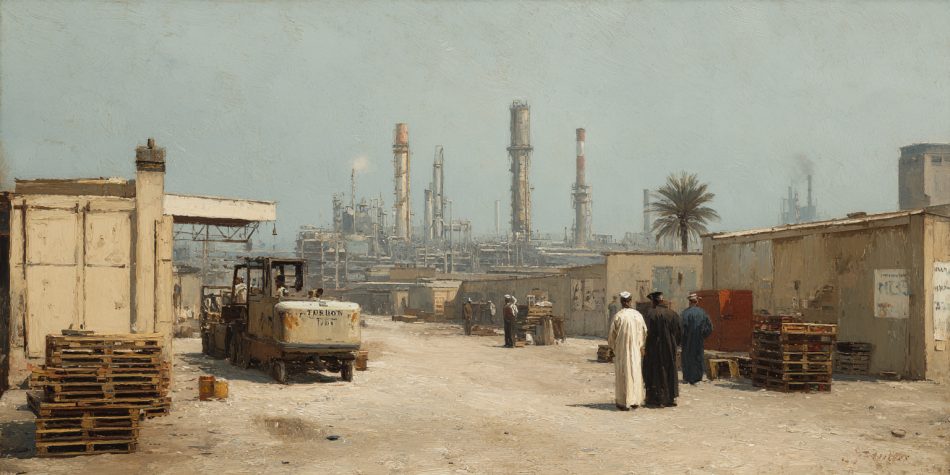

For years, living in Iran, I heard the same explanation repeated with certainty: the people in power were incompetent. Corrupt, shortsighted, incapable of governing a country with this much talent, history, and natural wealth. If outcomes fell short—if industry stagnated, if the economy destabilized—the conclusion seemed obvious. It was mismanagement.
That explanation endured not only because it was plausible, but because it was comfortable. Incompetence suggests error. It implies that the system has deviated from its purpose, and that with better decisions—or better people—it could still produce a livable future. It leaves intact a deeper assumption that is rarely examined: that the system is meant to work for those living within it.
Questioning the Assumption of Incompetence
As an engineer and entrepreneur, I tried to place myself outside politics. My work was technical. My goals were practical. I thought that if I focused on building something real, something useful, I could remain at a safe distance from the machinery around me.
That assumption did not survive contact with reality.
Over time, it became impossible to reconcile the logic I understood with the logic of the system I was living under. Cause and effect no longer aligned. Outcomes did not seem to matter. Decisions that produced damage were repeated without correction. What appeared inconsistent at first revealed itself as something more durable: a system operating by a different logic altogether.
Resilience became the business model because volatility had become the governing condition.
I watched projects with clear technical and economic value stall or collapse without explanation. Priorities shifted abruptly. Sanctions and currency instability amplified the damage, but internal volatility ensured it. The private sector absorbed the consequences of decisions it neither made nor could influence. You could do everything right on paper and still operate inside a system where predictability was an exception, not a condition.
At first, I relied on the same explanation everyone else used. The people in power are incompetent.
But that interpretation began to erode under observation. I remember laying out, in precise operational terms, the long-term cost of certain policies—economic degradation, institutional decay, loss of future capacity. These were not ideological arguments. They were straightforward projections. Yet they were met with indifference, as if the criteria being applied were entirely different from the ones being discussed.
That was the first real fracture in the narrative.
I stopped analyzing decisions individually and began looking at the structure itself.
My company changed with me. I no longer organized it for growth in the conventional sense. I organized it for endurance. The goal was not optimization, but shock absorption. Not scale, but survival. Resilience became the business model because volatility had become the governing condition.
Even then, I resisted abandoning the explanation of incompetence. It is a durable idea because it protects a deeper assumption: that the system has deviated from its purpose, rather than forcing us to confront the possibility that its purpose was never what we believed it to be.
I did not arrive at this conclusion through theory, but because politics became inseparable from daily life—professional constraint, private anxiety, ambient uncertainty—leaving no choice but to study it, as the economy itself had become political.
The more unsettling explanation was also the more coherent one: the system was not failing. It was operating according to a logic many of us had refused to name.
A Matter of Ideology, Not Execution
To see that logic requires abandoning a central assumption of modern political life—that governments are primarily organized around improving the material conditions of their populations. Many are not. Some systems are organized around ideological continuity, strategic positioning, internal control, or elite preservation, and they will accept broad social cost if those objectives require it.
Recognizing this is not only an analytical shift. It is a civic one. It forces a reconsideration of how individuals, communities, and societies interpret what they are seeing—and what they choose to do with that understanding.
Iran is not an anomaly in this regard, but a particularly visible instance of a broader class of systems in which stated objectives and operating priorities diverge in systematic ways.
In Iran, power cannot be understood apart from ideology.
The Iranian regime is not merely authoritarian; it is political-theological. Authority is not justified through performance, but through doctrine and continuity. Legitimacy is anchored not in outcomes, but in preservation.
In this sense, ideology does not replace geopolitics; it structures it—defining which strategic objectives are pursued, and which costs are considered acceptable.
Incompetence implies correctable error. Intent implies structural alignment.
The ambition is not geopolitical in the conventional sense. It is theological—rooted in the conviction that Shia Islam represents the final and most legitimate expression of divine will, and that this carries not just spiritual authority, but an obligation to translate that authority into worldly power.
That orientation extends beyond national borders. For decades, the state has invested in regional influence, strategic depth and ideological alignment. Whatever language is used—deterrence, projection, expansion—the implication is the same: domestic welfare has never been the primary constraint on decision-making.
Once that becomes visible, much of what appeared irrational becomes internally consistent.
Resources are not misallocated by accident. They are directed elsewhere. Economically viable activity is sidelined not because it is misunderstood, but because it is secondary. Public exhaustion is not necessarily evidence of failure. It is evidence of where the system is willing to place the burden.
This is the distinction many people resist. Incompetence implies correctable error. Intent implies structural alignment.
It is more comfortable to believe that the system I grew up inside was broken than to accept that it was functioning—just not for me, not for people like me, not for the population it claimed to serve. That reorientation did not happen all at once. It required setting aside an explanation I had once found genuinely consoling.
Once that shift occurred, the pattern became difficult to ignore. I began to recognize the same structure in places that had nothing to do with Iran.
Confronting the Real Objectives
In contemporary political discourse, incompetence has become the default explanation for systemic outcomes. When wars expand, when economic strain deepens, when instability spreads, the reflex is to assume failure in execution.
Sometimes that is true. But its repetition across fundamentally different systems should raise a harder question: what if the outcomes are not mistakes, but expressions of underlying priorities?
A system cannot be evaluated if its objectives are misidentified. Yet this misidentification persists because it is easier—and because it is useful. It preserves the assumption that stated goals remain aligned with public expectations, and that deviation is accidental rather than embedded.
At the level of public life, this has consequences beyond policy. It shapes how people assign blame, where they direct their attention, and whether they see themselves as observers or participants in the systems around them.
I remember the moment that realization shifted from analysis to recognition. What followed was a kind of disappointment that does not fade, only settles.
For years, I watched world powers—despite access to intelligence—either refuse to confront this reality or avoid it altogether, as acknowledging it would require action and carry real cost. Instead, they responded in familiar terms, treating the system as if it were malfunctioning: applying pressure, offering incentives, pursuing negotiation.
But if the system is operating as designed, those strategies begin from a false premise. They attempt to correct behavior that is structurally reinforced. What appears as failed diplomacy or ineffective pressure is often something else entirely—a mismatch between reality and the assumptions used to interpret it.
If a system is structurally aligned against the outcomes external actors seek, then strategies built on inducing alignment are not just ineffective—they are misdirected from the outset.
Over time, that mismatch produces consequences of its own. What is not understood is not contained. Pressure accumulates, conditions harden, and the system adapts without changing direction.
At that point, instability is no longer episodic. It is structural.
Iran has lived within that accumulation for years. What was once assumed to be contained is no longer contained. Conflict, economic disruption, and strategic instability now extend outward, shaping risks far beyond its borders. This is no longer a distant system under strain. It is part of the environment others must now operate within. It is no longer somewhere else. It is at everyone’s doorstep.
For years, that trajectory remained visible but unaddressed—not because it was misunderstood, but because confronting it carried a different kind of cost. Treating the system as if it could be corrected allowed for continuity: of policy, of expectation, of response. It preserved the assumption that pressure would eventually produce alignment, even as evidence suggested otherwise. What was deferred was not recognition, but consequence. And over time, that deferral became its own pattern—one that allowed the system to persist without interruption, while the cost accumulated beyond it.
And so, the pattern held.
Pressure accumulated. Adjustments were made at the margins. Each cycle resolved nothing and carried forward more instability than the one before it.
The Cost of Misreading Intentions
What is different now is not the pattern, but the cost of continuing to misread it.
Yet the instinct remains unchanged. Even now, the dominant response is to identify visible actors, assign failure, and move on. It is a form of understanding quick enough to avoid recognition: that repeated outcomes are rarely the product of repeated mistakes. They are the product of stable structures operating as designed.
Not all systems are meant to correct themselves.
Breaking that pattern does not begin with louder judgment. It begins with precision. The tools most often used—naming failure, assigning blame, demanding correction—have already demonstrated their limits. They assume convergence where none exists. A system structurally oriented elsewhere does not change direction under pressure. It redistributes cost and continues.
What follows is less intuitive and more demanding. At the level of policy, it requires abandoning the expectation of alignment and proceeding from sustained divergence. At the level of public judgment, it requires something more difficult than outrage: discipline. The refusal to collapse structural dynamics into familiar language. The willingness to sit with conclusions that offer no immediate resolution.
This is where the failure extends beyond the halls of power and into the streets. The instinct to explain away systemic outcomes as mere incompetence is not just an analytical error; it is participatory. It functions as a psychological safety valve, allowing societies to remain loud and ‘engaged’ without ever being truly unsettled. We trade the terrifying clarity of intent for the comfortable noise of outrage—filling the air with demands for better ‘management’ while the structure itself continues its work, unexamined and undisturbed. It produces a theater of certainty in place of the discipline of understanding.
Repeated outcomes are rarely the product of repeated mistakes. They are the product of stable structures operating as designed.
To recognize that is not to endorse those structures, nor to accept their permanence. But it does remove a particular illusion: that escalation of the same responses will eventually produce a different result.
The more uncomfortable implication is this: misreading is not neutral. It carries a cost. It delays adaptation, distorts decision-making, and extends the lifespan of the very dynamics it fails to understand.
This is not only a question of governments or policy. It is a question of how societies see, interpret, and respond to power—and of the limits they place, often unconsciously, on what they are willing to confront.
If there is a point of departure, it is not in speaking more loudly, or more frequently. It is in seeing more clearly—and accepting what that clarity demands.
Not all systems are meant to correct themselves. Some persist precisely because the expectations placed upon them were never aligned with what they were built to sustain.