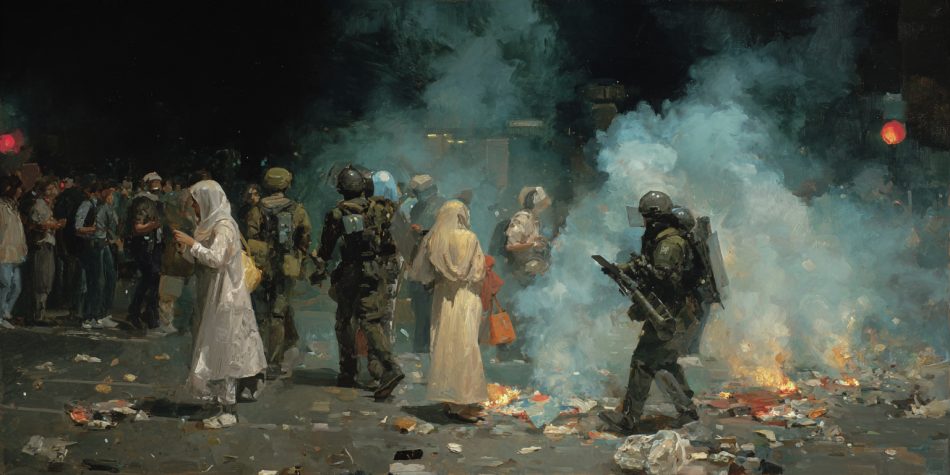
Civil unrest in Iran is depicted. Foreign intervention debates begin when visibility is forcibly erased.

When Law Lacks Teeth: The Question of Foreign Intervention

Many views on interventionism are shaped by failures in the Middle East. But is intervention the cause of systemic failure, or the consequence of it?

Imagine living in a country where the internet is cut, phone service disappears, and contact with the outside world is severed. Gunfire echoes through the streets. People scream. Bodies appear. No one knows who will be next or whether anyone beyond the borders even knows what is happening.

This is not a metaphor.

This is the lived reality for millions of Iranians during periods of nationwide internet shutdowns. These blackouts are not technical failures or temporary security measures. They are deliberate instruments of control, designed to suppress coordination, erase evidence, and delay international response. Repression combined with enforced invisibility has become a defining feature of modern authoritarian governance.

Confronted with this reality, many observers turn instinctively to international law. Surely there must be institutions, treaties, or legal mechanisms capable of protecting civilians when their own government becomes the threat. The post–World War II order was built precisely to prevent such abuses.

Yet that expectation misunderstands how international law actually functions.

International law is largely declarative rather than coercive. Its enforcement depends on state consent, diplomatic pressure, reputational costs, and political will. These mechanisms fail precisely when a regime is willing to use violence against its own population and absorb international condemnation. This is not an anomaly in the system; it is the system.

International law is largely declarative rather than coercive.

The international order constructed after World War II sought to constrain sovereign power through universal norms. The United Nations, international human rights law, and collective security arrangements reflected an unprecedented attempt to replace raw power politics with rules. But sovereignty remained the system’s organizing principle. Human rights were universal in theory, conditional in practice.

The UN Security Council institutionalized this contradiction. Designed to preserve stability among major powers, it granted veto authority to states whose cooperation was deemed essential, even when those states later became enablers or perpetrators of repression. Today, Russia and China routinely block meaningful action against internal atrocities. Their support for regimes such as Iran’s is not ideological sympathy alone; it is strategic. Iran provides energy access, sanctions-evasion networks, regional leverage, and a partner in balancing U.S. influence. Venezuela plays a comparable role in the Western Hemisphere.

These cases illustrate a broader reality: the rules-based order has limited capacity to act against well-protected sovereign violators.

This raises a question that policymakers often avoid confronting directly. In a system where rules lack enforcement, and where power is frequently the only effective constraint on actors who violate those rules, how should the use of power itself be evaluated?

Debates about foreign intervention are often framed through the lens of Iraq or Afghanistan, as though the primary lesson of the past two decades was that intervention is inherently illegitimate. That framing obscures a more uncomfortable truth. Intervention is often not the cause of systemic failure, it is the consequence of it.

Power restrains power. When enforcement collapses, restraint does not emerge organically; it is imposed, or it does not exist at all. The relevant question, therefore, is not whether foreign intervention is dangerous—it always is—but why the international system repeatedly produces conditions in which intervention becomes the only remaining option.

Vacuums are not filled by law, but by rival powers.

The cases of Iran and Venezuela illustrate a broader, more uncomfortable reality: the rules-based order has limited capacity to act against well-protected sovereign violators. This raises a question that policymakers often avoid. In a system where rules lack enforcement, and where power is frequently the only effective constraint on actors who violate those rules, how should the use of power itself be evaluated? We must stop viewing foreign intervention through the traumatized lens of the early 2000s and start viewing it as a necessary tool for systemic maintenance. Power restrains power. When a regime utilizes the “shield of sovereignty” to sever the internet and fire upon its own people, it has not exercised a right; it has violated the social contract that gives sovereignty its meaning.

From this perspective, U.S. efforts to limit Nicolás Maduro’s hold on power or to support the Iranian people’s aspirations for transition reflect a tacit recognition that vacuums are not filled by law, but by rival powers. We must be intellectually honest about the nature of these rivals. While no global power is beyond reproach, there is a fundamental difference in the architecture of influence. The Western model, led by the United States, operates within a framework—however flawed—that views the state as a servant to the people. In contrast, the strategic partnership between Russia, China, and Iran views the people as a resource to be managed, silenced, or erased to ensure the survival of the state.

As an Iranian, I see the support for a peaceful political transition not as an “infringement” on a nation, but as the enforcement of a higher law: the right to exist visibly and safely. If the 20th-century order was built to protect states from one another, the 21st-century order must be built to protect people from the state when that state turns predator. Accepting this is not cynicism; it is realism. The question is no longer whether the rules-based order will be tested—but how many times it must fail before we realize that a law that cannot be enforced is not a law at all, but a license for the powerful to be cruel.


 

About the author

Leyla Mirmomen

Leyla Mirmomen is an Iranian-American entrepreneur and the founder of Optimuos. She has a PhD in engineering from the University of Leeds.
On Key

You Might Also Like

“Madame Web” is a Good Film for Young Teens

Sony’s series of Spider-man adjacent films have mostly focused on anti-heroes. Since Spider-man, the hero, is by corporate necessity absent from these films they need to turn less than heroic characters into the protagonist.  This doesn’t make those films bad, but it does make them more complicated, and not often the best fit for the teenaged kids that could otherwise most benefit from the superhero narrative of good vs. evil. In that respect, Madame Web is a welcome reprieve. This is an unabashed superhero origin story. And in many respects, it demonstrates the durability of the genre.  Madame Webb owes much of its success to the animated Spider-verse films. Those films introduced audiences widely to the idea of multiple spider people, and in a recurring motif from the first film the basic beats that define those various spider people, and the near infinite variations those beats can take. Madame Webb hits each of those beats while toying with the formula enough to keep it interesting.  The moral at the center of the film focuses on our ability to influence our futures. After a traumatic incident, Cassie discovers that she has precognition. At first she feels helpless to stop the future predicted in the visions. But when three innocent girls are about to be murdered by the villainous Ezekiel Sims she can’t stand by and is thrust into the role of protector. As the film reaches its climax, both Cassie and the three teenagers she protects learn to step up. And the film seems best suited to teens about their age and a little younger thirteen to sixteen. Dakota Johnson has the acting chops to anchor the film. She ably handles the expositional relationship building, the determined character develop, and the thriller action scenes. Sydney Sweeney, Isabel Merced, and Celeste O’Connor, who play the three teenagers each portray a character who will one day become Spider-woman in the comics. They never try to do too much, and always deliver when the film requires it. Adam Scott is also a standout as “Ben Parker” who spends much of the film excited to become an uncle.  The villain, Sims is far and away the film’s weak point. His motivation is confusing. And it appeared at several points as though his dialogue was dubbed. But his simplicity as a villain helped along the film’s theme. There was little question about what the right thing for our protagonists to do was, only whether or not they would do it.  The film utilizes its range of PG-13 profanity, and the violence is just enough that I probably wouldn’t want my own kids to see the movie until they were teens. In terms of messages about family the film really shines. The film begins with a flashback to Cassie Webb’s mother nine months pregnant and upset about how her child is getting in the way of her work. But much of Cassie’s growth as a character comes from dealing with the damage of that attitude, and learning to embrace her own nourishing side. Each of the three girls are dealing with similar struggles. And Cassie learns the full strength of her powers as she also learns the full truth about her roots.  I certainly don’t want to overpromise on the film. It’s effects are clunky, and the plot is predictable. But it’s a movie you can let young teeangers watch without having to worry about explaining too much afterward, and that they will dependably get a good takeaway from. And if the parents happen to catch it too, they  will at least have a fun time. Two and a half out of five stars.  “Madame Web” releases in theaters on February 16th.

Remembering Lincoln’s Inaugural Address on this President’s Day

As we celebrate President’s Day today, let us be reminded of Abraham Lincoln’s inaguaral address he gave on March 4, 1865. Those words spoken then are just as relevant toay as they were in 1865. “With malice toward none, with charity for all, with firmness in the right as God gives us to see the right, let us strive on to finish the work we are in, to bind up the nation’s wounds, to care for him who shall have borne the battle and for his widow and his orphan, to do all which may achieve and cherish a just and lasting peace among ourselves and with all nations.”