
On July 20, 1969—almost exactly fifty-seven years ago—the Eagle landed on the moon, crossing the threshold of worlds and placing feet on ground that, for nearly all of history, had seemed permanently beyond our reach.
On July 20, 2026, my children and I are going to eat moon pies, carve the phases of the moon into Oreo cookies, and watch an Apollo 11 documentary, just as we have for more than a decade. We call it Moon Day.
It’s not a holy day. It’s a family day. It’s an occasion to reflect on what inspired human beings can accomplish and to turn my children’s attention upward.
And it’s that upward turn that causes me to continue celebrating. Children spend so much time looking down—at desks, assignments, devices, and anxieties. Moon Day has come to interrupt that. It reframes the moon as not just a light in the night sky, but as a physical world—a place of mountains, craters, dust, gravity, and darkness. A place that is distant but not unreachable, mysterious but not inscrutable.
It gives my children an opportunity to merge their physical world and their theological one. Science does not drain the holiness from the moon, nor does our understanding of God’s majesty absolve us of our obligation to learn and investigate. The facts enlarge the majesty, and the majesty inspires us to learn.
Faith Big Enough for the Universe
I’ve written a fair amount recently about the implications of the vastness of the universe for religious belief and how the doctrine of The Church of Jesus Christ of Latter-day Saints accommodates this expansiveness.
The restored gospel may not give us an astronomy textbook, but it does give the immensity of creation a remarkably prominent place. In the opening chapter of Moses, God does not merely tell Moses that He is powerful; He demonstrates it by showing the workmanship of His hands. Moses beholds the earth and learns of innumerable worlds.
Moses collapses after the experience, concluding that “man is nothing.” But God teaches him a better lesson, explaining that Moses is also the son of God. The massive universe does not push God further away.
Doctrine and Covenants 76 expands on this vision, testifying that worlds were created through Jesus Christ and that their inhabitants are children of God. Doctrine and Covenants 88 speaks of the Light of Christ filling “the immensity of space” and powering the sun, moon, and stars.
And Latter-day Saint belief about creation means that there is no reason for God to be embarrassed by the physicality of creation. Matter, embodiment, and resurrection are all central to our understanding of creation.
None of this tells us whether Europa’s ice covers microbial life or which propulsion system Congress should fund. But it does give us a posture toward curiosity.
There is a reason that Joseph Smith and Brigham Young both speculated about life beyond our world. The majestic theology they were receiving whetted their curiosity.
I have seen that same kind of curiosity power my own children’s imaginations. It joins wonder to discipline. All the mathematics in the world could not get a rocket off Earth if someone hadn’t first imagined it. And all the inspiration we can muster accounts for nothing without a mastery of the physics that powers it. In my experience, space is the perfect early vehicle to help children see how their imaginations can be powered.
So for us, Moon Day is not nostalgia for 1969; it’s a promise for how we see the world and intend to work toward the future.
Would Zion Look Up?
In my opinion, Zion will include a budget for space exploration.
This is not to say every appropriations bill is wise, nor that every rocket is inherently righteous. But when we think of the perfect future society, that society represents more than the elimination of suffering.
Imagination is a public good. Those who defend space exploration often focus on its practical benefits and the many ways it has benefited life on Earth. And those are certainly real.
But just as real is an orientation toward the future that lifts up everyone. A sense of purpose and progress. Much of contemporary life trains us to view the future as a collection of approaching catastrophes. Without reducing the importance of any of those, space exploration adds a message on top: the future will contain discovery, wonder, and growth. There are still things to learn, places to reach, projects to build, and questions to answer. Life is more than just dodging one doomsday after the next.
Zion would not need to choose between compassion and wonder. It would instruct everyone in “things both in heaven and in the earth.” Peaceful, cooperative, truth-seeking exploration belongs naturally within a Zion imagination.
How I Celebrate Moon Day
The best Moon Day activities make space tangible, invite wonder, and connect that wonder to our Heavenly Father.
Here are some of the things I do to celebrate:
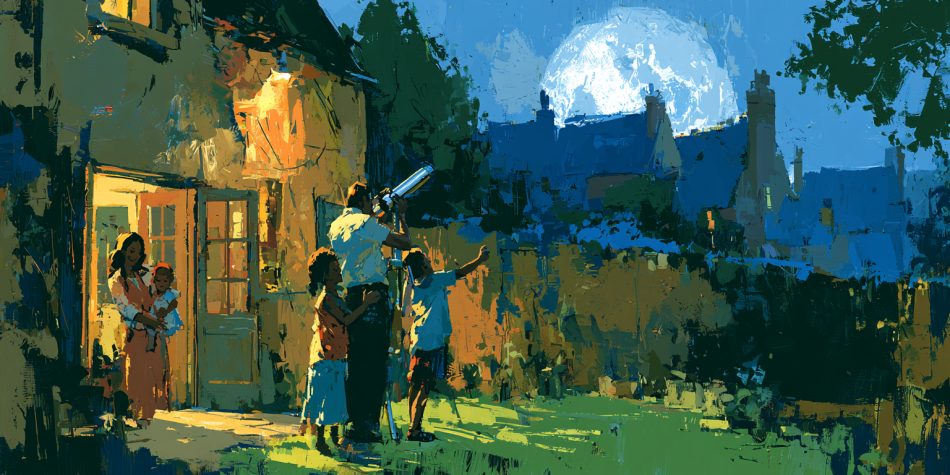
Look at the moon. Pull out the binoculars or a small telescope, take a drive outside the city, and simply look at the moon. I like to point out specific features to my kids and wonder what it would be like to walk on or around them.
Watch the Eagle landing. This year we’re going to watch a full documentary, but even in years we don’t, we’ll usually watch a five-minute clip of the first humans walking on the moon. It never fails to inspire some awe.
Build a moon, lander, or rocket craft. We’ve made papier-mâché moons, built popsicle-stick-and-aluminum-foil landers, drawn pictures of an imagined world, and simply made rocket ships out of LEGO bricks to show how we would go to Mars, or Europa, or another location in space.
Learn about moon phases. We’ve used basketballs, tennis balls, and flashlights to show how the moon phases work. Sometimes we’ll draw the moon phases, or this year we’re carving them out of the icing inside an Oreo.
Go to the museum, observatory, or planetarium. Look up where you can go with your kids to learn more about space. My family often goes to our local community college planetarium to watch a show for Moon Day.
Moon dinner. Our family does our scripture study at dinnertime, so I usually focus on verses like those I shared above for that day’s study. We also usually eat something like pizzas, meatballs, or crescent rolls for dinner. One year, we set up a picture of the moon and made pancakes, and then the children used various toppings to decorate their pancakes to look like the moon.
Turning Our Eyes Up
Human beings are not only problems to be solved. We are minds that seek wonder and truth. We are creators and explorers. Our quest for space honors and trains those intuitions.
On Moon Day, I think about my children. I want them to understand that our theology pushes us upward and outward and that each new discovery can help us learn more about the God who made it all.
So on July 20, we remember that human beings once looked up to the moon and learned how to cross the distance. I hope you and your families find wonderful ways to celebrate! Happy Moon Day!