It was a balmy spring morning in 2019 as we met near New York City’s Times Square to help deliver hot meals to homebound seniors. My wife, Jolene, and I were leading a travel study group of 25 Brigham Young University students, living on the Upper East Side for eight weeks to learn from the city’s diverse racial, ethnic, and religious traditions.
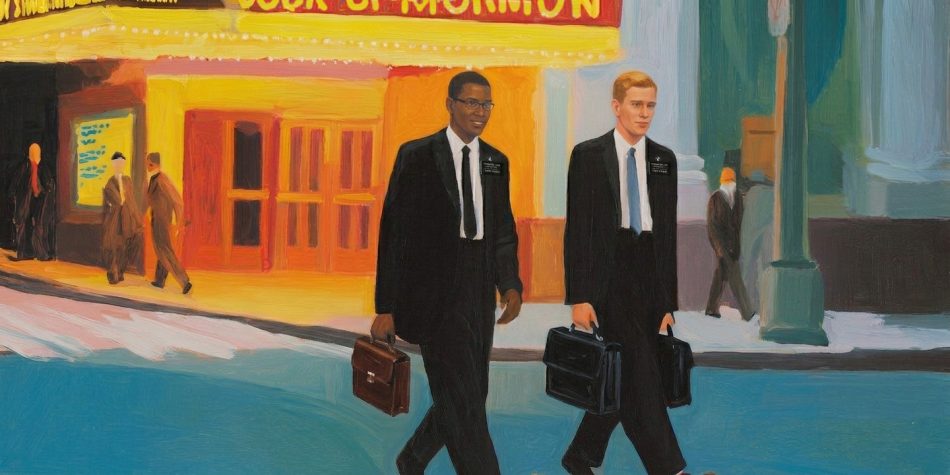
As a handful of students and I neared an apartment building to deliver the meals, we were surprised by the next-door Eugene O’Neill Theatre with its loud and brash signs promoting “The Book of Mormon” musical. The marquee featured photos mocking missionaries from The Church of Jesus Christ of Latter-day Saints. The students—many of whom had served missions—were quick to note the irony of our situation: Broadway presented a caricature of our faith while we were performing the quiet service that actually defines it.
A dubious anniversary brought back those memories. The irreverent, bawdy, vulgar, and mocking “The Book of Mormon” musical opened on Broadway 15 years ago. According to the New York Times, the show has reached 6,000 performances for six million theatergoers, with box office sales now heading toward $1 billion on Broadway. The anniversary sparked a media circuit for creators Trey Parker and Matt Stone, resulting in a wave of recent coverage.
Parker and Stone’s work misrepresents, hurts, harms, and is meant to offend.
The media coverage reminded me of that day delivering meals with my students in New York. Most of us serving meals to shut-ins had also been missionaries of The Church of Jesus Christ, as mocked on the marquees next door. It hurt. I served as a missionary in the 1980s in South Korea, and my students—both men and women—had served more recently all around the world. We considered our missions to be life-changing and sacred experiences. Now people dressed the way we were on our missions were made out to be larger-than-life laughingstocks.
Jesse Green, the New York Times culture correspondent, penned an anniversary story titled “‘The Book of Mormon’ Is Sorry if You Were Offended for 15 Years.” The piece would have you believe that all is hunky-dory with the play and that it’s just been a 15-year run of good fun. No humans were harmed—including Latter-day Saints—in the creation of this Broadway hit, Green decides.
I disagree.
I have not seen the show, but I have read enough of the script, heard the music, and followed enough reviews to recognize its crassness and inherent bigotry.
When I reached out to Green via email, he declined to be interviewed, stating, “I don’t have more to say than I said in the article.” I wish he did, because his coverage reveals significant ethical and journalistic gaps.
Most notably, Green didn’t ask any “real Latter-day Saints” about their reaction to the musical. Instead, he gave creators Trey Parker and Matt Stone a pass on possible tough questions about misrepresentation or harm caused by the show. It shouldn’t be that hard. With 42,000 Church members who live in the New York region, finding a local perspective from a member of the Church wouldn’t have been difficult.
Since the Times was derelict in its journalistic duty, I’ll ask this question: Has “The Book of Mormon” contributed to an American culture where demeaning Latter-day Saints is socially sanctioned? As BYU athletic teams play games around the country, opposing fans often chant “F— the Mormons,” reminiscent of a scene where Ugandans say “F— God” in the play. Take this example of a family supporting BYU at a basketball game in Providence, Rhode Island. It has happened at numerous other venues across the country. Is it coincidental that there’s some similarity to “The Book of Mormon” musical chants and the game chants?
In the end, Parker and Stone will collect their millions and say their show is a “love letter to Mormons,” kind of like “Fiddler on the Roof” was to Jews. But this show is not “Fiddler on the Roof” for Latter-day Saints. Instead, Parker and Stone’s work misrepresents, hurts, harms, and is meant to offend. Communication and psychological research has shown that humor often helps erode society’s normal boundaries of respect, compassion, and good faith to groups that are “othered.” That’s what this musical does.
Although Green’s bio says he abides by the New York Times Ethics Code and is “basically no use to anyone” who wants to influence him, Green sounds like a member of the New York elite theater club. He quotes whatever falls from the lips of Parker and Stone as gospel truth.
Instead of tough questions you get this about Green’s first time seeing the show.
The night I saw it, no less a dignified eminence than Angela Lansbury, seated directly in front of me, laughed her head off. I laughed too, all the time wondering: How did they dare put this on? Those laughs were half gasp.
The real gasp should come as Green gives Parker and Stone easy passes throughout the 15-year recap article with statements like this:
The authors had not meant “Mormon” to be offensive, let alone controversial.
Really? The Times just published that without questioning it? The Times would never let a politician get away with such nonsense. Parker and Stone knew exactly what they were doing and how bigoted it was. This next quote is just as damning:
Still, Stone and Parker, having grown up around church members in Colorado, did not want to make fun of them or their religion.
So, if someone grows up around Jews in Brooklyn and they think of them as great neighbors, they have the right to be anti-semitic? If Angela Lansbury were to laugh at an Islamophobic joke, that would make it OK? The Times then piles on with another anti-Latter-day Saint trope.
Taking precautions against a potentially hostile response, the production hired extra security for a few weeks around opening. And if some cast members worried that an army of the offended might sooner or later run them out of town, the authors were more worried about running at all.
If Green had bothered to talk to any New York Latter-day Saints, 15 years ago or today, he would have quickly discounted any violent stereotype that this was meant to portray. A visit to any number of Latter-day Saint Sunday services only blocks from the New York Times building would have quickly provided a much different picture.
Green’s bias toward Latter-day Saints also bleeds through again when he suggests that Latter-day Saints are inherently folksy, simple-minded people with no theological depth.
“They believe goofy stuff, but they’re really nice,” Parker said. “If you have one as a neighbor, you have a great neighbor.” That was the seed for a gentle lesson: Faith need not be logical to be meaningful; in fact, the opposite might be true.
Granted, the Times does give a nod to a 15-year-old official statement of the Church about the show, but it’s lazy, outdated reporting. The Times missed this statement from a Church spokesman at the time, which opposed the show’s content. At the same time, the ever-innocent Parker and Stone joked to Green and on The Late Show with Stephen Colbert that the Church was just really “nice” about all of this.
True, when the show opened, the Church turned the other cheek through a statement and then took out ads in the playbill declaring: “You’ve seen the play… now read the book.” That was a masterstroke marketing move, but it still doesn’t change the fact that the production—filled with misrepresentations, stereotypes, racism, and vulgarity—helps mold public opinion and disrespect for Latter-day Saints and religion generally. It also gets Latter-day Saint theology wrong. The Church’s savvy response does not equate to agreement with Parker and Stone’s bigotry, although the pair keeps implying as much.
It’s also ironic how Parker and Stone live by a double standard. When “The Book of Mormon” musical was challenged about its racism after the COVID pandemic and Black Lives Matter movements, the show changed the script. But never has it been changed for its religious bigotry.
Unfortunately, as prominent writers Jonah Goldberg and Simon Critchley have observed, while expressions of racism or xenophobia are normally looked down upon in polite social circles, “anti-Mormonism is another matter.” Goldberg has written about how Mormonism is America’s last acceptable prejudice. Of course, it’s not just anti-Mormonism in the show; the central message is anti-religious.
While asking if such a show as “The Book of Mormon” musical could be pulled off today, the Times does acknowledge the sensitivities of demeaning people.
That’s because “Mormon” in 2026 is in some ways more gasp-inducing than it was when it opened. In the intervening years, sensitivities once barely acknowledged about racial, religious and sexual identity have become mandatory articles of theatrical faith.
Let’s hope that American society, with its purported standards of equality and fair play, rejects another mockery of faith groups, ethnic origin, or racial background. But our current culture of incivility and polarization doesn’t bode well for the future of culture and entertainment. Unfortunately, the Times is likely to be there cheering from the audience when another such show denigrates, misrepresents and, yes, offends. It seems that, in reality, no one is actually sorry at all.