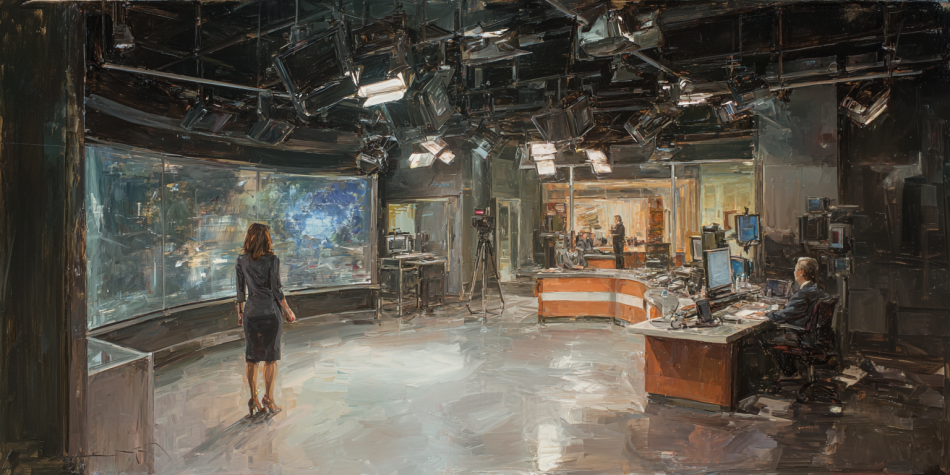
A female meteorologist delivers a weather report, similar to scenes discussed in this "Disclosure Day" review.

‘Disclosure Day’ Turns Aliens Into Angels

Spielberg’s alien thriller finds religious power in disclosure, but its gospel of empathy cannot bear the weight.

Download Print-Friendly Version

In a recent article, I wondered what would happen if we met aliens and they were not predators or imperialists, but actually more righteous beings than we are. What if the terrifying thing about extraterrestrial life was not that they wanted to destroy us, but that they were kinder, wiser, more truthful, and more loving than we imagined?

Steven Spielberg’s newest alien movie “Disclosure Day” begins with that premise and then builds a surprisingly religious sci-fi thriller around it. Josh O’Connor plays Daniel, a contractor who has fled a private defense operation with video proof of alien life and an alien artifact taken from the operation.

Emily Blunt plays Margaret, a weather reporter who can somehow channel the aliens and understand both where she needs to go and the inner needs of every person she meets. Colin Firth’s Noah represents the argument for secrecy: humanity is not ready, and if given access to alien knowledge, it will abuse it. He is also wounded by the loss of his own wife. Colman Domingo’s Hugo represents the counterclaim: truth doesn’t belong to a frightened organization, but to all people, who all deserve to know. 

Spielberg wants to play with religious fire in this film.

The result is occasionally moving. People change because, for one moment, they are fully known and not rejected. That is a real, powerful religious instinct. This instinct understands that love without truth is sentiment, and truth without love is domination. For a film about “disclosure day,” it would have been very easy to allow truth to become the only motivating virtue. But this film avoids that temptation. 

Spielberg wants to play with religious fire in this film. He makes Daniel’s girlfriend a former nun and has her visit her former convent on several occasions. Hugo, in a speechy monologue, says the problem with the world is that we’ve lost our empathy. By contrast, we see that the nuns are always there to be supportive. And the aliens’ mind-manipulation technology is resisted through religious willpower. But rather than leaning into that as a solution, Spielberg seems to set up the aliens as a new kind of god.

Spielberg recognizes that most world religions would adapt more easily to the existence of extraterrestrial life than the secular imagination might assume. But he also suggests that having a superior being in front of us might challenge some religious assumptions. There are even scenes when Margaret, channeling the aliens’ powers, is worshipped. While Margaret rejects the veneration, the implication is not only that the aliens might be worshipped, but also that because they are so superior in their empathy, they might be worthy of it. 

Spielberg is not contemptuous of religion here. But he does seem more interested in replacing it with alien compassion than deepening it. The result is a movie that invokes theology, while often settling for therapeutic awe. 

The movie’s seriousness is sometimes undercut by its unknowing cheesiness.

As a thriller, “Disclosure Day” is uneven. There is a fantastic train action set that had me leaning forward with my heart racing. The opening scene is novel and taut. But too many escapes feel mechanically easy, and the bad guys are much less competent than you’d expect. The screenplay really lets the film down. And the movie’s seriousness is sometimes undercut by its unknowing cheesiness, especially in Colman Domingo’s performance. 

But the ending works. And when disclosure finally happens, Spielberg finds the image the whole film has been driving toward. It is a much longer ending sequence than you would expect, but it is transporting. The television anchors’ reactions in the scene, captured in real time, are evocative and shockingly emotional. For a few minutes, the film stops telling us what disclosure means and starts letting us feel it instead.

“Disclosure Day” is not nearly as profound as it thinks it is, but it’s not shallow either. It manages to assemble a meaningful film from the alien mythology of the last 75 years. And for the most part, it sticks the landing. There is a good chance this film becomes the definitive version of that mythos. 

Its deification of the aliens muddies its conclusions, and its gospel of empathy is too familiar to bear all the metaphysical weight Spielberg places on it. But as a movie about truth and love arriving together, as both a gift and a judgment, it has a real and haunting charge. 
On Key

You Might Also Like

The Ordinary Saint’s Guide to Under the Banner of Heaven

In an age that claims to value “own voices” media, it is sad that Under the Banner of Heaven is probably going to be the biggest story that the public sees about members of The Church of Jesus Christ of Latter-day Saints this year or this decade. While the tale it tells is based on an actual occurrence and about some actual problems within the broader movement of people hearkening back to Joseph Smith, one thing that can’t be said for either the book or the show was that they were written by a member of our community. The producer may have “grown up” as a Latter-day Saint, but he left the faith before he was an adult. If you’ve never had the experience of holding a calling, making temple covenants, or negotiating the relationships that make up a ward (Latter-day Saint congregation), are you really the best person to interpret our community? So I’m stepping in to offer my perspective. I am not a historian or theologian. So, though I try to be informed about the difficult parts of our religion’s past, I can only give you the perspective of what an average member would know or believe about these situations. I undoubtedly will get some of the nuances wrong. This will not be the best place if you’re looking for information about the historical accuracy of the show. (Consider checking FAIR’s guide or Book of Mormon Central.) However, I am an active participant in the larger Latter-day Saint literary community. I’ve written essays about my own life as a woman in the Church and fictional stories about others. I studied Latter-day Saint literature in college and continue reading contemporary Latter-day Saint literature. I am on the board of the Association for Mormon Letters, an organization that promotes literature written by, for, or about those who tie back to the prophet Joseph (including members of The Church of Jesus Christ of Latter-day Saints, but not exclusive to our denomination). So you might say I have some experience with portrayals of the Latter-day Saints and separate fundamentalist communities. The purpose of this series of recaps is two-fold. First, I want to summarize the series for ordinary Latter-day Saints who don’t intend to watch it so they won’t be surprised around the metaphorical watercooler this week. Second, I will catalog the series as it compares to Latter-day Saint literature more broadly. As a writer, reader, and advocate of Latter-day Saint literature, this is my home turf. I am interested to see where the show gets things right and wrong. Granted, my experience isn’t the experience of every member; like any community, Latter-day Saints are not a monolith. But I will compare the show to my personal knowledge of our community and talk about what sticks out. Without further ado, here are my impressions of the first two episodes of Under the Banner of Heaven. Episode 1, “When God Was Love”  Summary—The episode opens with Detective Pyre being called away from his family’s Pioneer Day celebrations to visit a crime scene. At an ordinary suburban house, he finds a scene of chaos with a mother (Brenda Lafferty) and her 15-month-old daughter (Erica) murdered in a gruesome way. (Luckily, we are only shown large quantities of blood on the floor and walls; the show shies away from showing the bodies, though we will get hints through dialogue about the exact method of killing.) Soon the husband (Allen Lafferty) is taken into custody, his clothes soaked in his wife’s blood. The killer claims that his wife was murdered by men with beards like “Mormon prophets” and continually ties his wife’s murder back to early church history stories, particularly Joseph and Emma marrying against her father’s will. We then get a flashback to a young Brenda. She is an energetic and ambitious young woman who transfers to BYU after being tired of “holding girl’s hair back while they puked” at her party school in Idaho. Allen introduces Brenda to his family at a large family dinner. His brothers seem both strangely attracted to her and judgmental of her for her ambition and less strict faith (caffeinated soda is mentioned). The Lafferty family band together to clear a neighbor’s land to prevent it from being seized by the federal government to build a highway. In the present, Detective Pyre’s partner Bill visits Allen’s brother Robin’s home and finds the house abandoned and papers burning. They arrest Robin after a chase through a motel. This episode depicts the First Vision. It shows Joseph going to the woods to pray and a light shining down on him. The script draws parallels between Joseph’s prayer and Robin’s prayer in the woods before he is caught by the police, which doesn’t really make much sense except that they are both kneeling in a natural setting. We also get a scene of Joseph and Emma discussing whether to marry against her father’s wishes. The show tries to make a big deal of them choosing between “God’s will” and her father’s authority, implying that the problem is that they can justify almost anything as God’s will. I found this assertion pretty strange, given that Joseph and Emma were hardly the first couple to marry against a parent’s wishes. It seems a thin justification on which to hang a condemnation of trusting God. Shibboleths—It’s apparent that the showrunners have made an effort to try to include jargon of Latter-day Saints in the dialogue. Sometimes this works: the Pyre family prayer scene feels exactly like the ones that take place in my family. Others make it apparent that the writers are not members of the community. While we do refer to God as Heavenly Father, particularly in prayer, we don’t use this term exclusively like the characters in the show. I regularly hear members refer to him as “God” or “the Lord,” and a brief search of the church’s 1980’s general conference talks shows that this isn’t a new innovation. While there is