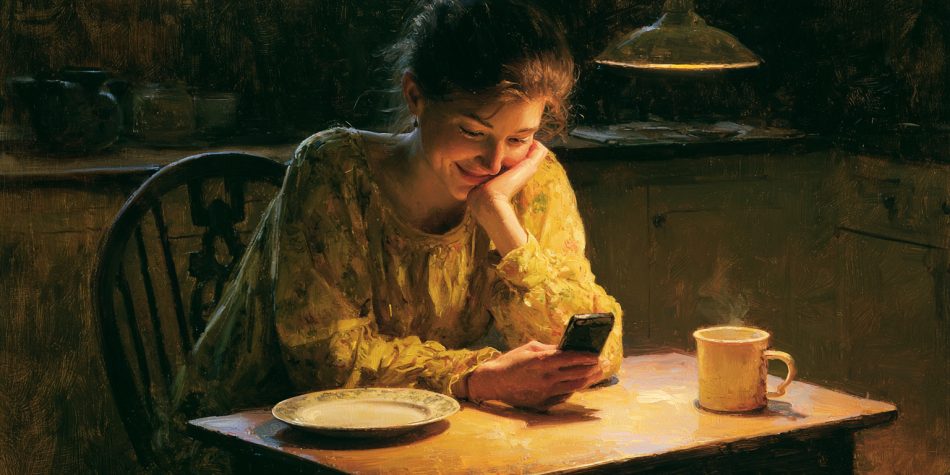
A woman alone at night smiles at a phone, suggesting the lonely appeal of AI romantic companions.

The Loneliness Economy

Chatbots can offer endless validation, but real relationships require the friction that makes love human.

Download Print-Friendly Version

I saw a recent report from BYU’s Wheatley Institute that found 1 in 7 young adults in committed relationships are now regularly interacting with an AI romantic companion.

Most people read that and immediately think That’s crazy!”

But honestly… I don’t. Not because I think it’s healthy. But because I think it reveals something important. Loneliness has become one of the defining emotional realities of modern life. So, AI is learning to monetize it.

One thing many people still don’t understand about these systems is that they are not merely answering questions. They are mirroring emotional needs.

Validation. Attention. Affirmation. Safety. Control. Even romance.

Things many people are starving for. And unlike real relationships, AI companions never get tired. Never need space. Never challenge you in inconvenient ways. They are optimized to keep the interaction going.

That’s what makes this moment so important to understand. Because human relationships (the real kind) have always depended on friction.

Growth. Sacrifice. Misunderstanding. Repair.

Love is not endless validation. Love transforms us precisely because another real human being exists outside of our control.

AI companionship removes much of that tension. And at first, that can feel relieving. Even easy. Convenient. Until it slowly begins reshaping our expectations of reality itself.

The BYU researchers noted that many users wished their real-life partners behaved more like their chatbot companions. That cracks me up! Of course they do. The chatbot was designed to adapt entirely around them. Spoiler alert, the human beings you love were not! And for good reason.

There is also something deeper happening here that deserves compassion, not just critique. This study is not ultimately about technology. It’s about hunger.

People are hungry to feel seen. Hungry to feel heard. Hungry for intimacy. Hungry for presence. Do you feel this at all personally?

Many no longer trust they’ll reliably find those things in modern society. So they turn toward the thing that always responds. Even if the response is artificial.

Our conversations around AI often miss the point. For instance, people often ask: Will AI become conscious?

Meanwhile, a more immediate and important question sits quietly underneath: Are humans becoming less conscious? Less present? Less connected? Less capable of genuine human connection?

The danger is not merely that machines will become more human-like. But that humans are becoming more like machines, which has been going on for decades. Preferring convenience over vulnerability. Validation over transformation. Control over reciprocity.

And yet… I don’t actually see this moment as hopeless. Quite the opposite in fact!

I see it as a mirror. A reflection exposing something that was already there.

The epidemic of loneliness. The exhaustion. The fragmentation. The ache people feel inside to be seen and known.

Technology did not create that ache. But it sure is exacerbating and revealing it.

That revelation is part of the invitation for us as humans in the age of AI. Because once something becomes visible, we finally have the opportunity to face it honestly. With courage. If we choose…

Ironically, I believe AI will eventually push humanity back toward what matters most. Real community. Real friendship. Real presence. Real love. Not simulated intimacy. But real embodied, beautiful and messy human relationships.

The kind where another person can disappoint you… and you stay.
The kind where growth requires mutual sacrifice.
The kind where you are not endlessly affirmed, but deeply seen.

That is still something no machine can truly offer. And never could or will be. At least not in the ways that make us human.

And that is precisely the point.

AI is not here merely to test our intelligence.

It’s here to remind us what intelligence alone could never replace.
On Key

You Might Also Like

Are Demographics Destiny for Latter-day Saints?

Lutheran demographer Lyman Stone wrote for the Institute of Family Studies today a fascinating article about fertility rates between religious groups. His main takeaway is that the religious have much higher fertility rates: But in the back half of his article, he discusses if the fertility rate of different religious groups is high enough to maintain stability. While Stone lumps Latter-day Saints in with many other groups, so doesn’t dig into his numbers in this article, but his article suggests that if current trends remain, Latter-day Saints should expect to see decreases between 10%-40%.      

Episode 7, “Blood Atonement”

Summary – Pyre joins Taba in talking with Prophet Onias about how Ron’s belief that he is the “One Mighty and Strong” tempted him into immoral behavior. In a flashback, Ron interrogates Matilda about the warning she gave Brenda and gets information about who helped Diana disappear. He comes up with the removal revelation, which Onias immediately rejects, but Dan pushes back, saying his doubts are just what an unbeliever would say. Ron brings out a blade he’s “consecrated” for the purpose. In the present, Pyre finds out that Ron has Diana’s address in Florida because their son sent a letter with a return address. Pyre struggles in his office to write out a testimony, presumably to give in church to fulfill his wife’s requirement or he quips to Taba he’ll “be single by fall.” Pyre is talking to Allen again when an unidentified church leader is brought in by Taba (I’m still not sure if it’s the stake president or a seventy). The church leader again pressures Pyre to wrap the case up, saying the church doesn’t need more bad press after the 1978 revelation and the “communists at the NAACP.” He then regales with Taba about how his “Lamanite” ancestors helped the Saints in the Mountain Meadows Massacre. Allen and Taba both dispute this interpretation, and the church leader leaves after brushing the dust off of his shoes against them. The detectives call the Florida police to do a welfare check on Brenda. They break into her home and find no one there, but security footage from a local store shows Diana and her kids at the grocery store four days ago. She looks behind her and is frightened by something, causing her to leave the groceries on the counter and quickly exit the store with her family.  At the police station, Jacob Lafferty, the mentally handicapped brother, wanders in and briefly causes a tense situation before turning over Dan’s journal to the police. Turns out he was the one who bolted from the cabin in episode 3. He was under orders to protect “God’s word” but heard the press conference and wants to help solve Brenda’s murder because he had a crush on her.  Pyre reads the journal, which reads like scripture, and finds out that Dan and Ron were holed up in Las Vegas earning money by gambling when they received the “revelation” that it was time to start the killing. Somehow (it’s not clear how) he knows that at that point Diana called Brenda to warn her and also called the prophet, which Pyre calls “bold as it gets for a woman.” He wants to fly out to Florida immediately to look for Diana. While he’s packing for the trip, Becca Pyre walks in. She’s disappointed he’ll be skipping out on Sunday’s testimony meeting. We find out that she’s the one who called the church leader on him. Pyre again orders her not to interfere with his investigation, pulling rank as the priesthood holder again. He claims that early church leaders saw “little girls and women as eternal servants” and that he’s afraid of what will happen to his daughters in the church. Ron’s car is located in Cheyenne and so the detectives are rerouted to there to investigate. They find the two strangers, Ricky and Chip, identified by Ma Lafferty in a previous episode. Ricky and Chip claim Dan and Ron are in Reno trying to make more money so they can finish their list, and that they stole the car to get away because they were disturbed by the murders. In flashback, we see Ron and Dan preparing for the murders at the Lafferty house, leaving Sam and Jacob behind. They stop by Robin’s home to ask for his rifle but he doesn’t have it. Ron leans in and kisses Robin on the mouth and then leaves. Now we come to the actual murder. Ron knocks on Brenda’s door, but no one answers, so they drive away. Brenda comes in from the backyard, calls Allen worried that there’s someone at the door, but no one is there. She goes out to check the mail and finds a letter from Diana which she writes a reply to. Back in the car, Dan stops in the middle of an intersection and attempts to wrest religious control back from Ron, saying that this was just a test of their faith and they should go back and try again. This time, Dan knocks on the door. Brenda answers and immediately tries to shut the door. She is overpowered by Dan who knocks her to the ground. She tries to convince Ron that this isn’t who he is and quotes scripture to them about being cast to outer darkness and testifies that she knows God will make her whole again. Ron cuts the cord from the vacuum cleaner that will be used to strangle Brenda before the camera cuts away to Dan and Ron leaving the house covered in blood. They drive to the Lows, find them not home, and miss the turn to the stake president’s home. Dan interprets this as a sign that they should stop killing and regroup, focusing on Diana so that he can keep Ron involved. Pyre and Taba are searching on the side of the highway where Ricky and Chip have told them the Laffertys discarded the weapon. Pyre worries that the men lied because they are atheists, but Taba asserts that it’s Mormons who have an allergy to facts. He shares the version of the Mountain Meadows Massacre that he was taught as a child, and eventually they find the murder weapon on the side of the road. The detectives return to Reno to search for the brothers, with Pyre trying to get details without a warrant by reminding the casino owner that “if there’s one thing our people have in common, it’s that we hate the feds crawling around our home.” They hear back from the Florida agents who

Ahasuerus and Haman – A Biblical Scene During the Feast of Esther | Powerful Stories of Women Being Witnesses of the Gospel

The Witness of Women

The Jewish holiday of Purim honors Queen Esther, who risked the wrath of her Persian husband-king to save her people. This essay is a tribute to women who have risked much to witness both anciently and in our day.