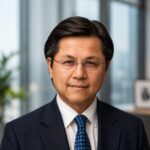


We spoke with with Nury Turkel, a Uyghur American lawyer, author, and human rights advocate opposing China’s genocide of the Uyghur people. Born in a communist-run re-education camp in China, Mr. Turkel came to the United States, where he became an attorney and a religious freedom advocate, even as the Chinese Communist Party (CCP) continued to persecute his family and other Uyghurs in the Xinjiang region. As the first Uyghur American to serve on the U.S. Commission on International Religious Freedom (USCIRF), Mr. Turkel has been profiled by Foreign Policy and other major outlets. Our interview focuses on the stark realities of the repression of religious freedom in China, the role of U.S. leadership in advocating for international religious freedom, and what Latter-day Saints can do to remember and stand up for the Uyghurs.
Editor’s Note: This interview has been edited for length, clarity, and style, and Mr. Turkel has approved the edits.
Remembering the Individual Victims of Genocide
Anna Bryner: Let’s start with China’s genocide of the Uyghurs. In your 2022 book, “No Escape,” you describe the system of surveillance, forced sterilization, sexual violence, detention, re-education, forced labor, family separation, and cultural erasure. You explain the genocide through stories of individuals in your book. What was it like for you to write this book about your people? How can we always remember the individuals affected by genocide?
Nury Turkel: Thank you very much, Anna. It’s so nice to speak with you again and to share some thoughts.
Writing this book was a therapeutic process for me. It made me feel as if I finally had an opportunity to unload much of the pain and suffering that I experienced, both in China and later in the United States.
I never thought that I would end up talking about the way that my mother brought me into this world in such a horrific way. But I decided to use my story, starting with the title “No Escape,” to illustrate that people like myself—who are disfavored and disliked by a ruling regime—have been suffering, whether under the thumb of the Communist Party or as free Americans. Even as a senior member of the U.S. government, I was still affected by the regime.
So I was trying to use my story to tell the stories of those who are similarly situated and those who have not had the type of privilege I have—being a lawyer in the United States’ capital, having extensive professional and personal support—who are eager to have their voices heard.
Individuals in “No Escape” are not just data points. They are flesh-and-blood human beings who had dreams, families, careers, faith, and desires as simple as meeting their future wives and husbands to get married and build families.
When I think about the challenge of keeping individuals at the center, after interviewing all of the camp survivors, I’m reminded of a sentiment often attributed to this horrific individual, Joseph Stalin: “One death is a tragedy, and a million deaths are a statistic.”
When you hear the media and the advocates saying upwards of 1 million, that’s a lot of people. That’s more than the population of the District of Columbia. But those people, as I noted, have had lives, aspirations, and desires. They’re real people with names, with families, careers, and aspirations.
The Chinese government has weaponized our psychological tendencies to reduce people to statistics, essentially saying, “Once I lock you up, you disappear. No one cares.” So I focus heavily on the Uyghur women to make the case that this is not only a mass atrocity, but there’s orchestrated, systematic sexual violence being committed against the most vulnerable women. I have some graphic accounts in my book, including their names.
I also have a chapter called “Cultural Erasure” that specifically talks about the systematic and deliberate attempts to debase the Uyghur religion and just completely wipe it out. We have seen it already in society. For example, when my dad passed away, people who expressed condolences over the phone could not say, “Rest in peace. May Allah preserve a place in heaven for your father.” I mean, that kind of Quranic language is not even permitted.
Some of the things that I’ve seen done are erasing the names from the headstones, removing family photographs from homes, and banning the Uyghur language in schools. Because when you erase the people’s names, you erase the people. This was in the ugly chapters of the Nazi playbook.
My approach during the time that I wrote this book, and also afterward, was just to keep naming individual names. Just keep reminding them that those names need to be read and mentioned.
I had the fortune of meeting the incredible diplomat Ambassador Nick Burns during the confirmation process, and he said something that still sticks with me. When he was working for then-Secretary George Shultz, every time they met with the Soviet leadership, they brought in names, and they said the names, repeated the names, regardless of whether they listened or not.
Ambassador Burns did exactly that, going to the meetings with the Chinese and mentioning my parents’ names, my mom’s name. I think we have seen some really good, happy endings in that endeavor. So my approach is to keep naming the names.
And also, in the book, I wrote about scholars, musicians, and ordinary farmers whose children don’t know where their parents are. Based on the credible investigative journalists’ work, 800,000 to 1 million Uyghur kids have been locked up in children’s detention facilities. You don’t have to be a parent; you don’t have to be a sister; you don’t have to be a brother to be able to appreciate what that would do to you if somebody took your children away. That’s not only breaking the spirit. It’s breaking the family, the roots, the connection. That will have a generational effect.
So, to conclude the question, this is to the general public, this is to the advocates, this is, of course, to the diplomats who have access to the jailers of the prisoners of conscience and prisoners of religious freedom: Just say the name. Learn the name, say the name, repeat the name in every meeting that you have. I’ve done it. It annoys the counterparts. But in the end, that’s what they do, and that’s what they will continue to do: imprison and keep repeating the line that no one cares about the prisoners—unless you repeat their names.
Patterns of Repression
AB: What have you learned about patterns of repression from writing this book?
NT: The CCP does not allow people to have dignified final days, funerals, or burials. The Uyghur people are not only not allowed to practice their religion, but the CCP is also changing the religious text.
This is also happening to the Christian community. They have specifically targeted the Uyghur Muslims and the Catholics. There are a large number of Chinese Catholics. They went underground. During my time at the U.S. Commission on International Religious Freedom (USCIRF), I specifically advocated for their rights when I was engaging with the Vatican because what the CCP is doing is horrific.
The CCP changed the text, both in the Quran and the Bible, to make it in line with its policy of Sinicization. That’s a state project. This project was articulated in Xi Jinping’s speech from 2013 in an infamous document called the Number 9 Document, which is available on Wikipedia. This once-secret document was leaked and essentially argued that the Chinese government must do everything possible to prevent the spread of what it called the “thought viruses” of religious belief that are metastasizing the whole human soul and human body. I’m paraphrasing it, but that’s the essence of it, the doctrine that they strictly believe and continue to follow. They see these faith groups as carriers of the Western ideology or the Abrahamic faith, which they believe are antithetical to the communist ideology.
This is their state program and policy to Sinicize the faith groups, specifically those who follow the Abrahamic tradition. So when our government officials—those of us in the space of advocacy, foreign policy, and national security—mention that the CCP leadership has a plan to reshape the world, that’s not hyperbolic. It’s based on the Chinese leadership’s own speeches and policy documents.
And whenever the Chinese leadership delivers a speech, it becomes a blueprint for policy pronouncements and implementation. So, once Xi Jinping said, the year after he became the leader of China, that Western ideology is a threat to the existence of the Communist Party, people did not take it seriously. But now we’re seeing all of it—you know, it’s even in the broader national security space, specifically in technology.
I spend a lot of time thinking and writing about technology, particularly its misuse. That’s how it started. They used technology to surveil places of worship and the devices that exchange religious texts. And then they also look at who’s purchasing what, using all the online purchase history. They also look at using technology to see who they’re talking to, what ideological leanings or spiritual teachings they’re leaning towards or more receptive to, or what countries they want to visit. These are all AI-powered tools of repression targeting ethno-religious groups in China.
U.S. Legislative Responses to the Uyghur Genocide
AB: Can you talk about what it was like to lobby for the Uyghur Human Rights Policy Act of 2020 and the Uyghur Forced Labor Prevention Act in 2021?
NT: It was a privilege to be involved in this legislative advocacy work. We call it lobbying. In the United States, it is perfectly legitimate, constitutional, and legal. Some people make a living as lobbyists in Washington. But what is remarkable about this whole process is that it was done without a single penny spent on professional lobbyists. No professional lobbying effort, no massive advertisement campaign, or expensive fundraising, or that sort of stuff was ever part of this process.
It is so satisfying that good people in the U.S. Congress, specifically on a staff level, recognized early on that this is something that had to be done.
I got involved, starting from my very first congressional testimony in 2018 that paved the way for the Uyghur Human Rights Policy Act (UHRP Act). And this was also publicly documented. In October 2019, I testified before then-Senator Marco Rubio specifically on forced labor. That one hearing, based on what I heard from the staffers who put it together and advised congressional leadership, was the catalyst for the Uyghur Forced Labor Prevention Act (UFLPA).
So it was a humbling and instructive experience in my career. I’ve done legislative advocacy for my corporate clients, but this was the most meaningful because we are a country of laws, and it’s a capitalist market economy. And it’s perfectly okay and legitimate that companies make money. But what we were advocating was providing guidelines and guardrails on how to engage in ethical business, specifically for those with a business presence or business dealings in China.
In the UHRP Act, the most important aspect is to utilize the tools in our toolbox, for example, the Global Magnitsky Act. That is one of the most powerful legal tools we have for going after entities and individuals responsible for human rights abuses. That hadn’t been utilized against those who are responsible for mass atrocities and egregious human rights abuses in China.
So we wanted to have a legislative mandate for that to be utilized. As a result, for the first time, sitting Chinese officials were sanctioned under the Global Magnitsky Act, in the spirit of, under the mandate of, the UHRP Act.
As for the UFLPA, this is arguably one of the most important legislative mandates that the United States Congress put in place to address modern-day slavery or lingering trade issues in our country’s dealings with China on economic and trade fronts.
For years, the U.S. government had urged governments around the world–including China–to end the use of forced labor and stop enslaving fellow human beings. I mean, anti-slavery is deeply embedded in our national values as Americans. We have a history of our own. And with such a large consumer base, we have a responsibility as a country and as a society to say no to forced-labor products.
And most importantly, this was something that could be a potent weapon to stop, or respond to stop, or interrupt, or disrupt the ongoing genocide. The Uyghur genocide, religious persecution, mass atrocities, and collective punishment—all of these go hand in hand with the enslavement of the Uyghurs.
So the brilliance of then-Speaker Nancy Pelosi and then-Senator Marco Rubio, the congressional leaders who spearheaded this process, recognized that this menace, this cancer of forced labor, needs to be eradicated from the global supply chain by way of helping the Uyghur people.
And I have to underscore this. I mentioned that we didn’t hire professional lobbying firms to help, but we had tremendous support from the faith community. The Catholic community, the Latter-day Saint community, and the Southern Baptist community were advocating and using their influence to lobby.
This whole effort to draft, advance, and pass the UFLPA started in early 2020. This was the time that the country was suffering and losing thousands of lives during the pandemic. And this pandemic, the shortage of supply chain supplies, critical supplies, ventilators, PPEs, and medicine, all were connected to the Uyghur forced labor.
So it was a historical movement, a moment, that brought in a lot of people from all walks of life, all faith communities, to address something that is in line with our national interest and also a part of American values.
It was not a hard sell, to say the least. That experience taught me the power of persistence and persuasion. It also demonstrated that a compelling moral argument can ultimately prevail. That’s one important thing to keep in mind: what we were doing was against the entire global supply chain. And we’re talking about more than 80 global brands that are affected. I don’t want to name the names because some of them stopped that practice. But virtually every major brand we know—as consumers of the things we eat, wear, drive, and use–was touched in some way by Uyghur forced labor.
So it was very satisfying to pass this legislation. It could be used as a case study for other communities to successfully build bipartisan support and get something done meaningfully in Congress.
Founding Ideals and Preventing Modern Slavery
AB: You’ve talked before about how the world’s response to the Uyghur genocide has been morally inadequate. As we’re approaching America’s 250th anniversary and thinking about our founding ideals, what would a morally responsible response look like from Americans and also from the world?
NT: This is an important moment for me to reflect. I live in Washington, D.C. I think the whole city is getting ready for this 250th anniversary. You’re seeing some new monuments and exhibits going up, many reflecting on different chapters of American history, including the Civil War. That makes this conversation especially meaningful and timely.
When America was founded and in its early decades, economic interests—particularly slavery and the cotton economy—made it politically convenient to look away from profound injustice. Today, the economic incentives are different, but the moral dilemma is strictly similar. Critical minerals, manufactured goods, and global supply chains have created powerful incentives to ignore forced labor. The United States is now investigating forced labor in dozens of countries, and the Office of the United States Trade Representative has initiated a Section 301 investigation. Yet it can still be politically and economically convenient to look away from what’s happening in Xinjiang.
In other words, economic stakes are enormous. If you look at our government’s tone, publicly calling out those abusers has been almost nonexistent today because economic interest is still at the top of the priorities. And history will not be kind to us if we follow the same path.
We’ve seen this movie before. In the early 2000s, when China joined the WTO, American companies moved to China because there were incentives—tax incentives, cheap labor and all the rest—and a mindset that doing business in China, helping to build the Chinese economy, would eventually encourage political liberation and bring China closer to the international rules-based order. It didn’t happen.
So there’s a lesson to learn. And I don’t want to get too deeply into my other work on international trade, export controls, and global compliance. China has identified and exploited strategic choke points in critical minerals, some of which, according to documented evidence, are linked to forced labor. That presents a serious strategic challenge, and I believe the U.S. government should be doing more to address it.
So a morally responsible response has several components that we need to keep talking about, even though this is not a very popular topic these days.
First, it requires that we actually enforce the laws that we have passed. We have so many good laws. I’m a Foreign Corrupt Practices Act (FCPA) lawyer by training, and I’ve worked extensively on global regulatory compliance. The FCPA matters because corruption and human rights abuses often go hand in hand. Companies that ignore corruption risks frequently ignore forced labor, repression, and other human rights abuses as well. The same commitment to corporate accountability underlies the UFLPA, which, like the FCPA, is landmark legislation. But enforcement requires resources, political will, and a willingness to confront powerful corporate interests.
Second, it requires diplomatic courage. I mentioned a 301 investigation. I know it’s too much trade talk here, but it has significant diplomatic implications as well. Forced labor and genocide should be treated merely as bilateral trade disputes. They should be treated as moral and diplomatic red lines that shape every aspect of our engagement with the Chinese government. That principle should guide U.S. diplomacy at every level. It’s so important.
And third, it requires a supporting accountability mechanism, documentation of crimes. The State Department used to have a global war crimes office and had done some documentation of crimes. I don’t know if that is still the case under the current leadership. And also, the U.S. government should be pushing for accountability. Without accountability, perpetrators will continue committing these atrocities with impunity.
So as America approaches its 250th anniversary, we should ask a simple question: Do we still believe in the universal ideals on which this country was founded?
Another question we need to ask ourselves: What did the founders mean when they wrote about liberty and the pursuit of happiness? Are we living up to those ideals?
So if you believe in all that, then we cannot be silent when the government is systematically destroying a vulnerable population, their faith, their language, their families, their lives. The measure of American leadership is not what we say about ourselves. It’s about what we do. Actions speak louder than words.
American Leadership in Promoting International Religious Freedom
AB: Related to that, what is the role of American leadership in promoting international religious freedom, and how would you assess our current efforts?
NT: It’s sad to see that our leadership in the international religious freedom space has not been as visible as during my time in the U.S. government. During the first Trump administration and the Biden administration, international religious freedom was an important aspect of our foreign policy and diplomatic engagements. Today, it has been pushed to the sidelines, and that leadership is no longer as visible.
But when Congress put in place IRFA, the International Religious Freedom Act, in 1998, it had a very simple but powerful intention, which was to make sure that we don’t forget about who we are. Religious freedom is enshrined in the Bill of Rights. It’s an older concept than human rights. The UN Declaration of Human Rights drew heavily from principles reflected in our constitutional tradition, including religious freedom.
So this is not about the United States going out and telling people how they should be free of political repression and religious persecution, but this is a way of magnifying and presenting ourselves based on the foundational concept of the United States, based on the ideal.
So this was the most effective message that I deployed during my time in the U.S. government:
We’re not here to impose our values on you. We’re simply saying that your country will be stronger if people are free to practice their faith without fear. If there are no prisoners of conscience or prisoners imprisoned because of their religion, your society will be more peaceful, more prosperous, and more stable. You won’t need thousands of police officers or pervasive surveillance systems to control your own people. The more freedom people enjoy, the less resentment and resistance governments create. So this is less constant monitoring and relatively easy for you to do.
That was the kind of message that I delivered and sent as a USCIRF representative.
So it resonated. We were able to secure the release of some political prisoners. We were also able to engage with some governments to modify some of their laws and regulations. But in the end, what we do, what we did, and what USCIRF does, what IRFA does or intends to do, is good for humanity, good for the country.
By advocating for international religious freedom, we also advance U.S. national security interests. Societies that protect religious freedom are generally more stable and less susceptible to violent extremism. Radicalization has a lot to do with religious persecution.
So there are multiple benefits to recommitting ourselves to the vision Congress established in IRFA and supporting USCIRF’s mission. And disturbingly, USCIRF has to fight for adequate funding almost every year. Given America’s economic strength and the scale of federal spending, USCIRF should not be worrying about whether it has sufficient resources to carry out its mission. Those are the things that really concern me.
We need more people showing up, especially in Congress, speaking about the importance, or talking about the importance of religious freedom, both at home and abroad. The political will is so important. We have the legislative mandate. We have the culture. We have the willingness to help those who have been suppressed and repressed because of their faith. We can do a lot better.
AB: Can you talk more about how, when you were at USCIRF, you had opportunities to not only advocate for the Uyghurs but also for people of many other faiths? I know you personally adopted a prisoner of conscience, Shamila Kakimov, a Jehovah’s Witness. Can you talk about what it was like to stand for people of other faiths when your own group had been suffering so much? And why does religious freedom mean religious freedom for everyone? Why should we stand for each other?
NT: For me, this question gets to the very heart of religious freedom.
When I had that platform, I knew there were many others whose voices also deserve to be heard. So at the time, when my people were suffering on a scale that is hard to comprehend—we talked about millions, when the mosques were demolished, when the children were separated from parents—it would be natural, perhaps, even expected that I would focus exclusively on the Uyghur suffering.
But I believed, and still do, that it is both a moral and a strategic mistake to focus only on one group. Because the bad actors use the same method. They vilify not only one religion, but all religions. So the people who have problems with religion and faith are generally about more or less the same people with the same idea and the same playbook.
So I decided to use my time and platform to advocate for those who have not had enough voice in this arena.
I picked up a few cases, specifically those from Central Asia. They have a cultural, historical, and linguistic connection that is convenient. So that’s why I advocated the rights of the Latter-day Saint community, Jehovah’s Witness community, Catholic community, and Jewish communities living in predominantly Muslim societies.
I did that because when my people were desperate to be heard, those same communities stood with the Uyghurs. They spoke up for us when it mattered most.
Supporting them wasn’t only an expression of gratitude–it was also a reflection of my belief that religious freedom is universal. And if we defend it only for people who share our own faith, then we aren’t really defending religious freedom at all.
The Personal Toll of Advocacy
AB: And you’ve paid a personal price for your advocacy. In 2024, you were reunited with your mother after 20 years of separation. How do you carry the grief of this work without losing hope? And how do you measure success when so much remains outside of your control?
NT: Anna, as you know, I was born in a re-education camp. That was my beginning, and I’ve been dealing with this as long as I’ve been breathing.
A long time ago, my mother was pregnant with me during her third trimester. And she sustained physical injuries because of the physical abuse in the camp. She ended up giving birth to me while her body was in casts, chest down. So that fact—that brutal way that I was brought into this world—shaped everything about how I understand persecution, everything about why I do this work.
For more than 20 years, my mother was separated from me. She was not allowed to leave town. She was under both domestic and international travel bans. She was not even allowed to go to Beijing to meet with our ambassador. She lived under watchful eyes every day. So it’s no different from being locked up.
And this was the time when I was building a life and career in America, and I could have just said, “Okay, I have a life here. Don’t worry about it. Forget it. They’re not going to change. They’re not going to do anything humanly possible. I’d be better off just being a lawyer in Washington and enjoying my life.”
I decided to take the other way. I started writing, testifying, speaking, educating, and advocating. In some instances, I found myself involved in some of the controversial political and geopolitical issues.
When I reunited with my mother, cinematically, miraculously, at an Air Force base in Texas on Thanksgiving in 2024, it was one of the most joyful and heartbreaking moments of my life. She was alive. As soon as she got off the plane, she said, “I’m glad I won’t be dying alone.”
That was so moving. It was the first hug in 20 years that we had on the tarmac. But those years of suffering taught me a lot of things in life that otherwise I wouldn’t have been able to learn by reading or from real professional experience. Pain and suffering sometimes make you value and appreciate life more. That’s how I feel.
And also, I believe in fairness. I believe that being persistent and staying hopeful in this kind of advocacy work—being factual, not hyperbolic—and just people will respond. I cannot say—I cannot thank those people in cross-administrations enough. We’re talking about the U.S. presidential administration, starting from George Bush, Obama, first Trump, Biden, now Trump.
So from the previous four administrations, I’ve made so many friends and contacts, and I have nothing to give them. But I earned their respect, earned their support, secured their support. In the end, they become an advocate for me.
So those wonderful people made Trump hand in my parents’ names on his first trip in November 2017, and then that same work continued in the Biden administration. President Biden himself asked Xi Jinping twice, in person, to allow my mom be able to travel to the United States to be with her American children and grandchildren.
So it was the endurance, the perseverance, staying hopeful. I was looking at some of my email communications with the officials that I communicated with over the years, letters I’ve written, and I sent essentially the same message: “I am a free American. I testified. I spoke out against human rights abuses. I served in the U.S. government. I volunteered my time. And my government should not tolerate another government punishing my parents, my family, for what I do in America as a free person. We should not have a foreign government reaching out to me through a long arm and making me feel that I cannot escape from their persecution.”
So it was a happy ending, but the reunion is not the same. It’s not the same as restoration. You may have seen my public messages. My family and I lost a time that can never be brought back to us. So this regime essentially stole 20 years of my life and family time from me.
So, how do I carry this? Honestly, I’m not sure if I can carry it as much as I have learned to walk alongside it. And I don’t try to put it down or put it away. I let it remind me that this work is not abstract. The person who benefits from this, from the next piece of legislation or the next diplomatic intervention, is real.
I wrote about this in my latest piece for Fox News. Like me, they have a mother, they have family, they have faith. It took almost 20 years for my mom’s name to be said to the person who was holding her. And there are many others who are waiting for their names to be said to their jailers.
So that’s the type of thing that I always mention when I meet with people who are in power.
But as for measuring my success in that one-family advocacy, I have to radically define what it looks like.
I cannot feel free from all of the people who are still there. And the current political environment is not ideal for that. And I cannot undo the years of suffering. What I can do is to make the next violation more costly, amplify the next survivor’s testimony, help one person to feel less alone in their suffering.
Some days, that is enough. Some days it’s not. In the latter days, I return to the faces of the people that I’m fighting for, that I profiled in the book, and that I interviewed. And I remember that to stop would be abandoning them.
I know that when you look around today in the political environment, it sounds impossible. I’ve been there. I’ve been in impossible situations and rather hopeless situations as well. But hope is not something I wait to feel. It’s a discipline. Hope is a discipline.
And late Senator John McCain once said—and this is very applicable to a community that faces repression: “Hope is the best weapon against oppression.” So that’s the kind of thing that keeps me going every day.
Picturing the Individuals Persecuted When We Fast for Religious Freedom
AB: As members of The Church of Jesus Christ of Latter-day Saints participate on July 5th in fasting and prayer for worldwide religious freedom, what would you want them to picture when they’re thinking about the Uyghurs and others who are persecuted for their beliefs?
NT: First of all, I want to begin by acknowledging something very important. I find The Church of Jesus Christ of Latter-day Saints deeply meaningful. It has profoundly moved and touched me with the level of support I received from it, including the opportunity to meet with the Church leadership during a lunch in Salt Lake City a few years ago.
So the Latter-day Saint community knows something about what it means for the government to turn against your faith. I think that commonality, the common experience, is where something built a really strong bond between my way of seeing the world, seeing religious repression, and the Latter-day Saint community.
The Missouri extermination order comes to mind, the forced migration. I was a tour guide in San Francisco before I moved here. I took tour groups to Temple Square countless times. I’ve been to Latter-day Saint communities in Idaho, in Nevada, in Arizona, and, of course, in southern Utah, countless times. Fascinating history: a long history of being told that your beliefs made you dangerous or unacceptable. That memory is not merely historical. It’s part of the Latter-day Saint community’s memory identity.
So when you close your eyes and fast and pray on July 5th, I want you, as the Latter-day Saint community, to draw on that memory, and then I want you to imagine this:
Imagine a grandmother in Kashgar, my place of birth, who can no longer teach her grandchildren to pray. Not because she has lost her faith, but because the government has taken her grandchildren to boarding school, where they will be raised to forget who they are. She knows their faces, but she does not know if they still know hers.
Imagine a father who has been in a detention camp for three years or more. His only “crime” was having too many contacts in a foreign country, or going to the place of worship too often, or owning a copy of the Quran. He does not know if his wife is still waiting for him. He does not know if his children still say his name.
Imagine a young woman who was taught to be proud of her language, her music, and her faith, and who now lives in a world where all three have effectively been erased from public life.
When you pray for the Uyghurs, pray for those individuals. Not the abstract statistic of a million, but the grandmother, the father, and the young woman. And pray, knowing that your prayers are not empty. They sustain the ones who are fighting. They signal to governments that people of conscience are watching. And they testify that in God’s eyes, these lives matter, and they’re not forgotten.
And July 5 is significant. In 2009, in the streets of Urumqi, the Uyghur capital, Chinese security forces violently suppressed peaceful demonstrations, resulting in the death of many Uyghurs. So July 5 holds profound historical significance for the Uyghur community.
What Can the Average American Do?
AB: Finally, what are some concrete steps that individuals can take? How do supply chains fit in?
NT: As a corporate lawyer who advises companies, I know business leaders care about consumer concerns. So we don’t have to be in a position of power to make a difference. We have tremendous influence as consumers.
So one of the most direct actions people can take is to look at the labels on their clothing and other consumer goods. Many everyday products — from groceries and tires to sporting goods and school supplies—have been linked to forced-labor risks.
So check the label. For cotton products, roughly 85% of China’s cotton is sourced from the Uyghur homeland. Many of the garments hanging in closets across America and around the world were made with cotton picked by people who had no choice or no right to say no. And those cotton products are made by vulnerable modern-day slaves. So the cotton is the thread connecting your wardrobe to the camp system. Don’t forget about that. That’s really important.
And also, contact your representatives and urge them to continue funding the enforcement of the seminal Uyghur Forced Labor Prevention Act. Support Uyghur advocacy groups. They’re easy to find online.
And then when you go to the church, just share what you heard, what you read about the Uyghurs. Again, there’s so much relevance and connection between the Latter-day Saint community and the Uyghur community’s historical suffering or facing religious persecution. The fact that you’re interviewing me today speaks to that fact. We met several years ago. You still remember. You read my book. And that speaks volumes about your caring about these issues.
And then the other thing is to stay hopeful. This pendulum will swing back. When we look around today, it may seem as though people no longer care about human rights or religious liberty. I don’t believe that’s permanent. I don’t know exactly how things will change, but I do believe we cannot remain a healthy society if we stop caring about these fundamental values.
So my message is simple: stay hopeful. Pray, and act. And do both together.
And the Uyghur people—I know this might be a little bit provocative—but I often say the Uyghurs ask for partnership and support, not pity.