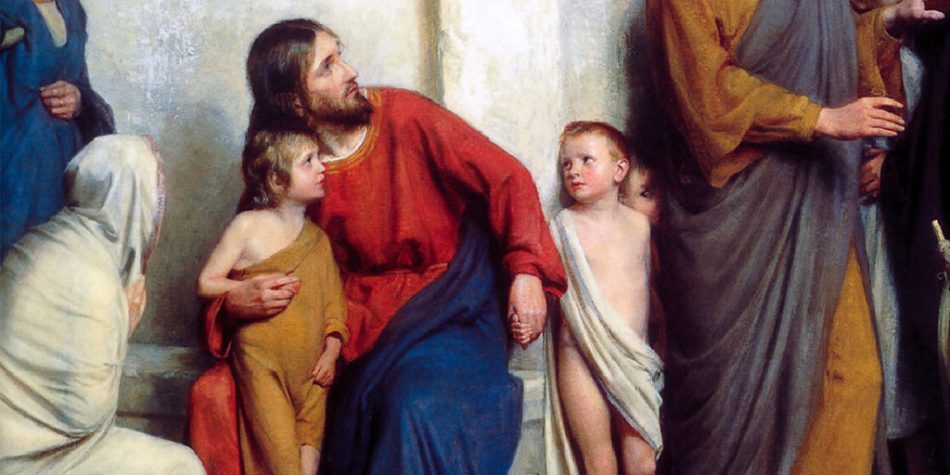
Carl_Heinrich_Bloch_-_Suffer_the_Children (1)

Agape Love for Christmas

So many of our conflicts today stem from a mistaken, deformed notion of love—one that departs sharply from what Jesus Himself taught long ago.

Some of our nation’s most thoughtful thinkers see the United States heading towards another civil war. A Zogby poll this year found more Americans thought civil war was likely than otherwise. 

While some might point out that from a historical perspective our divisions are not unique, the general sense that our country is becoming increasingly divided is based on real and increasing trends.

For instance, our political, philosophical, cultural, and socio-economic differences are increasingly resulting in decreased trust and friendship and increased suspicion and distance. And our media landscape and political dialogue have turned into echo chambers that serve to exacerbate these differences.

Christmas is an ideal opportunity to reflect on and heal these divisions because Jesus’ life and lessons represent a better way forward.

This way unsurprisingly revolves around love. Having a correct understanding of love can help heal the divisions among us. When Jesus says that He gives us a new commandment to love one another, the Greek word used is agape.

As we seek to heal our communities, may we turn to the Master of Love, the Christ.

Agape is also the word most often translated as love in the New Testament. Because of its importance in the Christian faith tradition, the word agape has been dissected and nuanced millions of times. Even so, it’s still easy for us to dismiss what the word would have most commonly meant to the writers who chose it.

Strong’s Concordance defines agape as simply, “To welcome warmly.” 

Christ’s example is filled with instances of Him sitting and conversing with those He would otherwise disagree with. Foremost among these is the story of Christ eating with the sinners and publicans.

Today many people miscast this story as one of Jesus approving of the sinners, or even favoring them over other groups. But Jesus’ stated reason for being with them was to call them to repentance, even if doing so brought the approbation of others.

Similarly, we can demonstrate Christian agape love by welcoming those we disagree with, without concern for guilt-by-association.

Just like the Pharisees of old, those who wield today’s cancel culture weapons have many fearing that they will face social consequences if they are seen sympathizing or fraternizing with those harboring ugly beliefs. 

In many quarters today, love is not defined as Jesus historically used it, but instead through the lens of Rogerian humanism. They define love as unconditional acceptance. 

In the same moment, they can then twist the idea of love to defend excluding others—especially those who don’t embrace this same vision of love. If certain people don’t accept everyone unconditionally, then perhaps, they reason, the way to show that they themselves accept everyone is by rejecting these people?

So many of our social divisions today are born on the back of this strident, non-Christian understanding of love.

There is a better way—and Jesus Himself shows it.  As we seek to heal our communities, may we turn to the Master of Love, the Christ. As we seek to welcome all in His way, we can emulate the example of the Jesus we worship in this season—and together find greater peace and civility.


About the author

C.D. Cunningham

C.D. Cunningham is a founder and editor-at-large of Public Square magazine.
On Key

You Might Also Like

Why Your Therapist is Failing You + Today’s Digest

Our daily rundown of the articles from around the web that we feel our readers would enjoy and appreciate. We hope to highlight the best of what’s around. Public Square Bulletin recommends: Therapy Beyond Good and Evil James Mumford — The New Atlantis As modern therapy has come to rely almost exclusively on Rogerian humanism, it has lost the ability to help its patients recognize an objective reality that exists outside themselves. Explainer: Religious liberty in Ukraine in the 20th and 21st centuries Jordan Wootten — Ethics & Religious Liberty Commission A brief history of Ukraine, its approach to religious freedom, and the impact it is having amid the current conflict. A better abortion debate is possible. Here’s where we can start. Leah Libresco — America Leah Libresco offers a stunning account of bringing friends together to discuss abortion in her home and a path towards a more productive conversation. A must-read for those hoping to have difficult conversations better. Groundbreaking dates set for new Ephraim Utah Temple and Lubumbashi Democratic Republic of the Congo Temple Scott Taylor — Church News Groundbreaking for the Ephraim Utah Temple will occur on August 27, 2022, and be presided over by Elder Walter Gonzales. Groundbreaking for the Lubumbashi, Democratic Republic of Congo temple will occur on August 20, 2022, and be presided over by  Matthew Carpenter. The Certainty Trap Ilana Redstone — Tablet The solution to our broken political conversation won’t be found in censoring ‘misinformation’ but in recognizing the profound limits of our own beliefs. Washington Post Finds Thriving Anti-Abortion Church and Moribund Mainline Jeffrey Walton — Juicy Ecumenism Recent reporting in The Washington Post about religious responses to the leaked Dobbs opinion paints a vivid picture that can only be found between the lines. Jeffrey Walton highlights the way pro-life churches are vibrant places for educating mothers and finding adoptions.

The Mobs Now Come from Both Sides

In America today, even mobs come in red and blue flavors. This was especially evident in last week’s controversy over a featured Church News article, and subsequent apology.  

Subscribe To Our Weekly Newsletter

Stay up to date on the intersection of faith in the public square.

You have Successfully Subscribed!

Pin It on Pinterest

Share This