666px-Healing_of_the_Blind_Man_by_Jesus_Christ (1) (1)

Jesus All Around Us

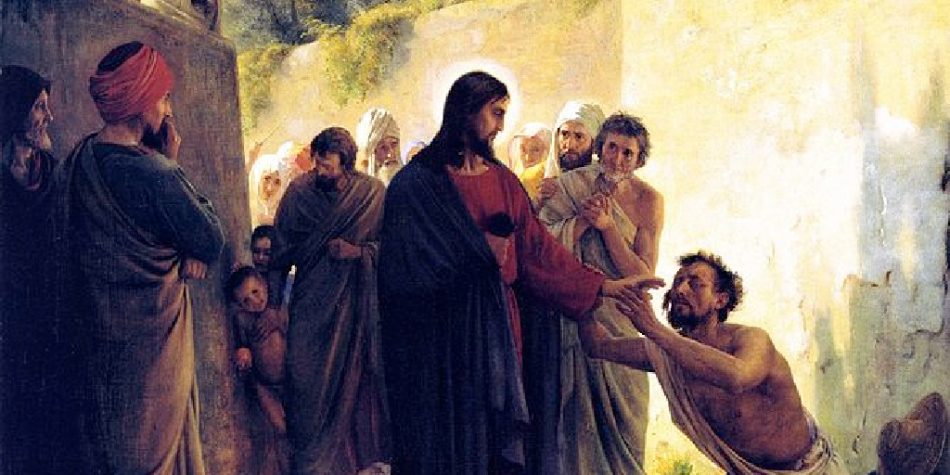
If you look close enough, the influence of that baby born in Bethlehem is all around us. I rejoice in how the life of Jesus continues to change our world today.
Reprinting some of our best holiday pieces from Christmas past.

I love saying that I am a “follower of Jesus.”  

I’ve found that when I say that I’m a Christian, often eyes narrow and people wonder exactly what that meanswhat am I trying to say?  Something political, something ideological?  People wonder if I’m friendly to them, or if I might be someone they should be afraid of if I say I’m Christian.

Yet when I say that I’m a follower of Jesus, I see eyes light up, I see faces soften.  Some will eagerly agree that they, too, follow Jesus.  Others repeat the famous quote attributed to Gandhi: “I like your Christ, I do not like your Christians. Your Christians are so unlike your Christ.”  I chuckle along with them, knowing that talking about religion can be hard. But talking about Jesusthat’s a different story!  I’m among the many persuaded that the life and mission of Jesus have more meaning today than ever.

I am blessed to see the life Jesus lived every day through the people I know and love, changing the world in ways large and small.  Like you, I am surrounded by friends and family striving to help others, to follow Jesus as best they can.

The truth always leads us to God and never away from God.

I see the life of Jesus when I see my friend Jen Spencer, also a follower of Jesus. Jen has had a difficult life by anyone’s estimation, yet she has taken difficulties and turned them into blessings for others. As she recollects, “My addiction led me to being homeless on several occasions throughout my life, and during that time I personally knew seven people who froze to death.” Jen turned her experience of homelessness into the Turtle Shelter Project—where volunteers make life-saving vests. The vests are called “Turtle Shelters” because they are a portable shelter—just like a turtle taking its shelter with it. Wearing a Turtle Shelter Vest like this makes having a source of heat a nicety, but not a necessity because the foam insulation in the vest effectively harnesses the body’s heat and conserves it.  Five years later, hundreds of vests have been made and donated to people in extreme need, no doubt saving lives in the process.  Jen is a follower of Jesus:  “Our main mission is to convey that they are loved,” she said. “That really is the most important goal here.” (Read more about Jen here).

I see the life of Jesus when I think about my friend Laura Warburton.  Laura and I are dear friends who disagree on almost everything, but we agree in our love of Jesus and our desire to look to His example.  Because we agree about this core love and desire, we have worked together for years.  When I was first trying to find someone, anyone, to help me get legal shelter for LGBT+ homeless youth, it was Laura who quietly stepped up, with steely reserve, and worked to help change the law in Utah so that youth didn’t need to sleep out in the cold.  When there was a need for a new suicide prevention hotline, Laura made sure that LGBT+ youth would be helped, too. And when Laura’s beloved daughter Hannah died, Laura did what heroes doshe used her grief to find even more people to help.  People ask me how Laura is able to do what she does.  You know the answer as well as I do:  it is because Laura follows Jesus. Thanks to this foundation, Laura has a seemingly boundless love and courage that shines like the sun from her heart and her smileeven, perhaps especiallythrough her tears. (Read more about Laura here).

My friend Bill Evans is also a follower of Jesus.  I meet someone all the time who has benefited from Bill’s help, care, and counselJen Spencer and Turtle Shelter are one example, Madison House Autism Foundation with Greg and JaLynn Prince is another.  From huge projects to small ones, Bill leads with his loving heart and with a life inspired by Jesus’ mission to share the Good News that God is love.  And when my youngest child, Geri, graduated from DaVinci High in Ogden, Bill was there.  Geri is transgender, and not everyone in Geri’s family feels free to love Geri as openly as they used toperhaps they don’t know what to feel.  But Bill knows Jesus, and Bill was there in his Sunday best, clapping and cheering as Geri walked across the stage. (Read more about Bill here).

My friend Luisa Derouen, a Dominican Sister of Peace, is also a follower of Jesus.  She is about to retire from Catholic ministry, a nun who has spent the last two decades providing spiritual companionship and counsel to transgender people.  “For all these years my mantra to them has been, ‘The truth always leads us to God and never away from God. Keep your heart and your life close to God and God will show you the truth of who you are and how to live from that place of truth.”  One day Luisa told me the story of meeting her first transgender person.  Since there was no way she could understand what it was like to be transgender, Luisa said, “Loving needed to come first.” She added, “Maybe I would understand later, but for nownow was the time for love.” (Read more about Luisa here). 

I also see Jesus in my friend Beth from Kenya, another follower of Jesus. Beth was raised by her single mother, who died when Beth was young, leaving her with her aunt.  When Beth admitted to her aunt that she was a lesbian, her aunt arranged for her to be sexually assaultedwhat is sometimes called “corrective rape.”  Beth became homeless and then found herself pregnant by the rapist.  She delivered a baby boy that she struggles to care for since her son has many health problems.  Yet Beth found other LGBT+ followers of Jesus and leads the music each Sunday at their small prayer and worship services.  Her friends call her a strong woman of faith, and she is determined to follow Jesus all of her life. 

If you look closely, maybe you too will see Jesus in the people around youin people near and beloved, and those from afar you have yet to meet.  Sometimes this happens with those you expect to show people Jesus, and other times Jesus appears in places we never expect.

Why would people whose religion or theology doesn’t affirm my desires and plans still care about me?

Lately, I am working with new friends, unexpected ones, people who, like me, care about those who are hurt and excluded.  Not all of them are Jesus followers—many faiths and no faiths are represented in this group.  Each one, though, reminds me of Jesus.

This ever-expanding and diverse group of people are partnering with me and other LGBT+ people to work together for equality and religious freedom for all Americans (hearkening to legislation like the famous SB296 legislation known as the Utah Compromiseand current efforts to work together for the best federal legislation possible). I now have friends that are different from me in every way imaginable, yet who care deeply about my human dignity and about my children, especially my two children that are transgender.  It is impossible to believe: why would people whose religion or theology doesn’t affirm my desires and plans still care about me? Yet it is impossible to disprove:  I see them every day and I know their hearts, hearts that care deeply about every LGBT+ person.  

One day I asked a leader in this movementa very conservative and well-known faith and political leaderwhy he would not only care about me and my family but care enough to work so hard for our safety and wellbeing.  He paused and looked me in my eyes and smiled a slow, shy smile.  “Well, Marian, it’s because of my faith, you, see.”  He clasped my hand.  “My faith teaches me to love, and that’s what I intend to do.”  I smiled back.  And his face, the face of Jesus to me, showed me yet again that the love of God is all around.

About the author

Marian Edmonds Allen

Rev. Marian Edmonds-Allen is executive director of Parity, an NYC-based national nonprofit that works at the intersection of LGBT+ and faith. She is former national program director for the Family Acceptance Project and former executive director of the Utah Pride Center and OUTreach Resource Centers.
On Key

You Might Also Like

books

Bites of the Best books: May 2020

Five books that contain sentences and paragraphs and pages full of unique ideas that move our minds, touch our hearts, and fill our souls with light.

A reflection on violence in film

Gladiator II is a serviceable historical epic. If you loved Gladiator, you’ll like Gladiator II. Gladiator II opens as Rome is about to siege the “last free city in Africa.” Our nameless hero loses valiantly with his wife dying in the battle, and he is brought to be a slave in Rome. But if our hero can perform well enough as a gladiator, he can buy his own freedom. And with that, we’re off. The beats of this film will be familiar, with a massive twist only halfway through that changes the stakes for everyone. Our hero is really the son of our hero from the last movie! Which means he has a legitimate claim to the throne of Rome. The movie tries to follow three different stories. Our hero (Paul Mescal) is trying to win his freedom and avenge his wife’s death. Acacius (Pedro Pascal), the general of the armies, wants respite and time with his wife; he also wants to lead a coup against the emperors. Macrinus (Denzel Washington) wants to work his way up in Roman power through political scheming. And then on top of all of that, we are told that our hero must deal with his father’s legacy and discover who he truly is.  It’s a lot, even for an epic, and the screenplay is not nearly tight enough to keep all the storylines coherent and moving. We are led to believe that Macrinus is successful in maneuvering to the top of Roman society because of his exceptional political skill, and Denzel Washington’s delicious performance makes that believable, but all we actually see him do is win a bet and carry out an assassination. Pedro Pascal’s excellent work as the weary general does some of the work in helping reconcile the contradictions in his character, but a look on his face here or there has to carry a lot that a simple conversation could have fleshed out.  Perhaps the reason the script doesn’t have time to breathe is also its biggest contradiction. There is something grotesque about watching audiences cheer on the brutal violence taking place in the film. And yet, the entire film is centered on having us, the audience, watch one set piece of over-the-top violence after another. We don’t get to see Macrinus manipulate the Roman senate because, instead, we need to see our hero fighting with CGI rhinos or CGI sharks. There is a place for violence in a moral movie. It can be helpful to attune our senses to recoil from violence or recognize the rare places it is justified. But the violence on display in Gladiator II is so relentless and gratuitous that it dulls the senses instead.  This is not to diminish the craftsmanship that has been used to bring this world and its many battle scenes to light. Rome feels broad and alive in true epic fashion, and it’s easy to get swept away into its world—with the exception of a few uncharacteristic pieces of clunky CGI work. The opening battle sequence is perhaps the best ever put to screen.  The best part of Gladiator II was its opening. A 1950s style opening credits are shown over a lavish dreamy animated retelling of the first film. Everything about it screams that something epic is about to be shown. But throughout the movie I stayed fixated on what it could have been. What if it had been more focused on the characters I cared about? What if it didn’t try to connect so much plot to the previous film and let this story stand on its own merits? What if they had expanded it to a TV miniseries so that its many plot points had space to breathe? In the end, despite some good acting and a beautiful setting, the movie just left so much to be wanted.  Gladiator II is R-rated. It is not appropriate for children or, in my estimation, most adults. At its core, this film has a moral message: life is hard, but it’s worth fighting for. But the way it’s presented on screen does more to drag down the spirit than to lift it up. Two and a half out of five stars. Gladiator II opens nationwide November 22, 2024.

European Refugee Crisis

As mentioned in this weekend’s General Conference, the Church is focusing on helping with the refugee crisis in Europe. The Church Newsroom has a great article detailing some of the current efforts and how you can help. As we work on putting the principles of Christian living into practice, this represents a useful opportunity.    

Subscribe To Our Weekly Newsletter

Stay up to date on the intersection of faith in the public square.

You have Successfully Subscribed!