cdcunningham_A_golden_statue_of_the_angel_moroni_trumpeting_his_40a17b32-fcf1-4a88-86de-d1558442cb53

Associated Press Embarrasses Itself in Conference Coverage

AP's coverage of the Latter-day Saints misses the mark, showcasing bias and a lack of religious literacy

The Associated Press (AP) one of the most influential news organizations in the United States published an article about the most recent general conference of The Church of Jesus Christ of Latter-day Saints. 

The result is a disaster of journalistic credibility. This article makes it clear the AP is unfit to publish authoritative news about the Church, at least until it makes significant changes in its processes.

Rod Dreher, the influential writer and editor, quipped in response to the AP’s most recent article, ”I thought this was a Babylon Bee headline.” That reaction has become a bit too common in responses to coverage of The Church of Jesus Christ of Latter-day Saints in national media. But it’s usually aimed at publications with established editorial bents, like Rolling Stone Magazine. That the AP has joined its ranks is sad.
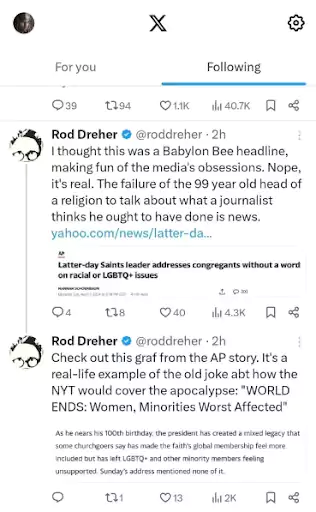
The AP article had the headline, “Latter-day Saints leader addresses congregants without a word on racial or LGBTQ+ issues.” Dreher remarked, “I thought this was a Babylon Bee headline, making fun of the media’s obsessions. Nope, it’s real. The failure of the 99-year-old head of a religion to talk about what a journalist thinks he ought to have done is news.” 

That’s right. The Associated Press published a “news” story about what wasn’t discussed in the conference.

Leaders of the Church of Jesus Christ also didn’t speak about the War in Gaza, the population crisis in South Korea, how well the Armenian dram is performing against the dollar, or Javier Bardem’s stunning performance in Dune Part Two.

What she produced is about what you would expect from a person in her position.

What they did talk about was becoming more like Jesus Christ, praying, and attending temple services. Given that millions of people heard these messages and will leave the weekend with a newfound focus on self-improvement, you might mistakenly believe that those messages are worthy of coverage. But alas, apparently to the AP, the only story worthy of coverage is how the Church intersected (or rather didn’t) with the pet issues of their reporters.

Perhaps most egregiously, the headline is factually inaccurate! During Nelson’s remarks on Sunday afternoon, he said, “[God] invites all to come unto Him—black and white, bond and free, male and female; … all are alike unto God.” He explicitly mentioned race in his remarks. Not to mention the dozens of remarks that touched on issues of love, charity, and truth, which explains, even if not directly, how the Church approaches LGBT+ issues.

And this is not merely bad coverage by Hannah Schoenbaum who wrote the article. Schoenbaum’s entire beat is covering LGBT+ issues at state houses. The editor who assigned Schoenbaum to the conference did so, knowing precisely what would come out of the narrow point of view of her coverage specialty. 

As the saying goes, If the only tool you have is a hammer, you tend to see every problem as a nail. Or, in this case, all you can see is there are no nails, ignoring both the beauty and actual news that is there. 

Please, don’t focus your ire on Schoenbaum. What she produced is about what you would expect from a person in her position. The true blame lies at the feet of the journalistic system that put her in the position to fail. Does the AP truly not have a single journalist in Utah who is religiously literate? Until they get one, perhaps they shouldn’t try and cover explicitly religious events. They simply don’t have the right personnel to do it right, as Schoenbaum demonstrates.

Schoenbaum lacks a fair bit of religious literacy in her article. She uses language foreign to the Latter-day Saint tradition, such as  “Church’s leadership panel,” “Nelson’s top adviser,” or “heretics.” She also makes the statement, that the priesthood exclusion was “a policy in the belief that black skin was a curse,” which is at best controversial, without any mention of the fact that neither the Church nor most of its members endorse this version of history. 

However, the article is not only bad in its framing and its lack of religious literacy. It was written to be a straight news story and is peppered with negative editorializing of the faith. She mentions Nelson’s work of reasserting the Church’s full name but describes it as a “sharp shift.” Then adds a frequent line used by critics of President Nelson about the previous ‘I’m a Mormon’ campaign but she states it as a simple fact in her own voice, not attributing it to critics. She doesn’t mention any of the reasons that have been used to support the request.

She describes temples as “lavish,” a description that may feel apt to those who are critical of the temple but not one that would feel appropriate to the Church or its many members. 

She brings in a wild non sequitur about a speech given by a different church leader at BYU and says it’s “known as the ‘musket fire speech’” without clarifying that it is only known this way by those attempting to discredit the remarks.

Schoenbaum additionally claims there are “ongoing tensions between church leadership and LGBTQ+ members” without mentioning the many LGBT+ members who are at home in the Church and do not feel the “tension” she assumes in her statement.

What she produced is about what you would expect from a person in her position.

Schoenbaum quotes three people—two speaking as professors and one speaking as a critic of the Church. Notably missing from her coverage of Nelson’s birthday and general conference is anyone speaking in celebration of his birthday, anyone who has benefited from his ministry, or any one of the millions of Latter-day Saints who listened to the conference.

Schoenbaum frequently covers the Utah legislature, so in case she gets the assignment next October as well, let me pass along some directions from the capital. One block south, one block west. That’s it. That’s the conference center. It’s so easy to find from the capital anyone can do it. And if you can manage the ten-minute walk, there are tens of thousands of sources who would be more than happy to talk to you about what was said at conference, rather than what was not said. 

The problem, of course, is that it wouldn’t fit with the narrative that was predestined for this story from the second it was conceived. 

This kind of deeply flawed coverage is antagonistic to Latter-day Saints. And because it was published by the Associated Press it will be reprinted to media markets across the country. In most of those markets, Latter-day Saints are religious minorities. The narratives imposed on these stories are used by those in these markets trying to stop Latter-day Saints from being able to build places of worship. And this agitation over the different worldview of Latter-day Saints from the broader culture over sexuality inspires vandalism and other hate crimes

Come on, AP. Latter-day Saints are actual, real people. And we deserve to be treated like it. This coverage is embarrassing for you. Do better.

Correction: The 16th paragraph has been corrected. It previously said Schoenbaum didn’t interview anyone “celebrating” his birthday, it has been changed to read “speaking in celebration of his birthday.”


About the author

C.D. Cunningham

C.D. Cunningham is a founder and editor-at-large of Public Square magazine.
On Key

You Might Also Like

The Ordinary Saint’s Guide to Under the Banner of Heaven

In an age that claims to value “own voices” media, it is sad that Under the Banner of Heaven is probably going to be the biggest story that the public sees about members of The Church of Jesus Christ of Latter-day Saints this year or this decade. While the tale it tells is based on an actual occurrence and about some actual problems within the broader movement of people hearkening back to Joseph Smith, one thing that can’t be said for either the book or the show was that they were written by a member of our community. The producer may have “grown up” as a Latter-day Saint, but he left the faith before he was an adult. If you’ve never had the experience of holding a calling, making temple covenants, or negotiating the relationships that make up a ward (Latter-day Saint congregation), are you really the best person to interpret our community? So I’m stepping in to offer my perspective. I am not a historian or theologian. So, though I try to be informed about the difficult parts of our religion’s past, I can only give you the perspective of what an average member would know or believe about these situations. I undoubtedly will get some of the nuances wrong. This will not be the best place if you’re looking for information about the historical accuracy of the show. (Consider checking FAIR’s guide or Book of Mormon Central.) However, I am an active participant in the larger Latter-day Saint literary community. I’ve written essays about my own life as a woman in the Church and fictional stories about others. I studied Latter-day Saint literature in college and continue reading contemporary Latter-day Saint literature. I am on the board of the Association for Mormon Letters, an organization that promotes literature written by, for, or about those who tie back to the prophet Joseph (including members of The Church of Jesus Christ of Latter-day Saints, but not exclusive to our denomination). So you might say I have some experience with portrayals of the Latter-day Saints and separate fundamentalist communities. The purpose of this series of recaps is two-fold. First, I want to summarize the series for ordinary Latter-day Saints who don’t intend to watch it so they won’t be surprised around the metaphorical watercooler this week. Second, I will catalog the series as it compares to Latter-day Saint literature more broadly. As a writer, reader, and advocate of Latter-day Saint literature, this is my home turf. I am interested to see where the show gets things right and wrong. Granted, my experience isn’t the experience of every member; like any community, Latter-day Saints are not a monolith. But I will compare the show to my personal knowledge of our community and talk about what sticks out. Without further ado, here are my impressions of the first two episodes of Under the Banner of Heaven. Episode 1, “When God Was Love”  Summary—The episode opens with Detective Pyre being called away from his family’s Pioneer Day celebrations to visit a crime scene. At an ordinary suburban house, he finds a scene of chaos with a mother (Brenda Lafferty) and her 15-month-old daughter (Erica) murdered in a gruesome way. (Luckily, we are only shown large quantities of blood on the floor and walls; the show shies away from showing the bodies, though we will get hints through dialogue about the exact method of killing.) Soon the husband (Allen Lafferty) is taken into custody, his clothes soaked in his wife’s blood. The killer claims that his wife was murdered by men with beards like “Mormon prophets” and continually ties his wife’s murder back to early church history stories, particularly Joseph and Emma marrying against her father’s will. We then get a flashback to a young Brenda. She is an energetic and ambitious young woman who transfers to BYU after being tired of “holding girl’s hair back while they puked” at her party school in Idaho. Allen introduces Brenda to his family at a large family dinner. His brothers seem both strangely attracted to her and judgmental of her for her ambition and less strict faith (caffeinated soda is mentioned). The Lafferty family band together to clear a neighbor’s land to prevent it from being seized by the federal government to build a highway. In the present, Detective Pyre’s partner Bill visits Allen’s brother Robin’s home and finds the house abandoned and papers burning. They arrest Robin after a chase through a motel. This episode depicts the First Vision. It shows Joseph going to the woods to pray and a light shining down on him. The script draws parallels between Joseph’s prayer and Robin’s prayer in the woods before he is caught by the police, which doesn’t really make much sense except that they are both kneeling in a natural setting. We also get a scene of Joseph and Emma discussing whether to marry against her father’s wishes. The show tries to make a big deal of them choosing between “God’s will” and her father’s authority, implying that the problem is that they can justify almost anything as God’s will. I found this assertion pretty strange, given that Joseph and Emma were hardly the first couple to marry against a parent’s wishes. It seems a thin justification on which to hang a condemnation of trusting God. Shibboleths—It’s apparent that the showrunners have made an effort to try to include jargon of Latter-day Saints in the dialogue. Sometimes this works: the Pyre family prayer scene feels exactly like the ones that take place in my family. Others make it apparent that the writers are not members of the community. While we do refer to God as Heavenly Father, particularly in prayer, we don’t use this term exclusively like the characters in the show. I regularly hear members refer to him as “God” or “the Lord,” and a brief search of the church’s 1980’s general conference talks shows that this isn’t a new innovation. While there is

Would the Left Accept Four More Years?

President Trump’s comments have been rightly scrutinized for their potential impact on America’s post-election environment. Far less attention has gone to certain themes of progressive commentary, which in combination arguably heightens the volatility of our post-election atmosphere.

Convenient Post-Modernism

As the last bulwark for the rule of law in our nation, I’ve been discouraged to see the attacks on the Supreme Court from all corners in light of the recently leaked decision in the Dobbs abortion case. We’ll likely be looking at this issue in greater depth in Public Square soon. But for now, I wanted to highlight just how pervasive anti-institutionalism has become across our country. We’re All Postmodernists Now John Stonestreet and G.S. Morris write for the Stream about how “We’re all Postmodernists Now.” They are focusing on a loss of trust primarily from the political right. Which is why the sudden return of this trend to the left is so noteworthy. Post-modernism is not a sustainable framework, but it is increasingly used as a temporary tool to pursue specific political or cultural goals. As Latter-day Saints, we agree with their statement that, “Truth is knowable and that it doesn’t depend on the source but a reality external to ourselves.”  These trends are certainly worthy of continued concern.