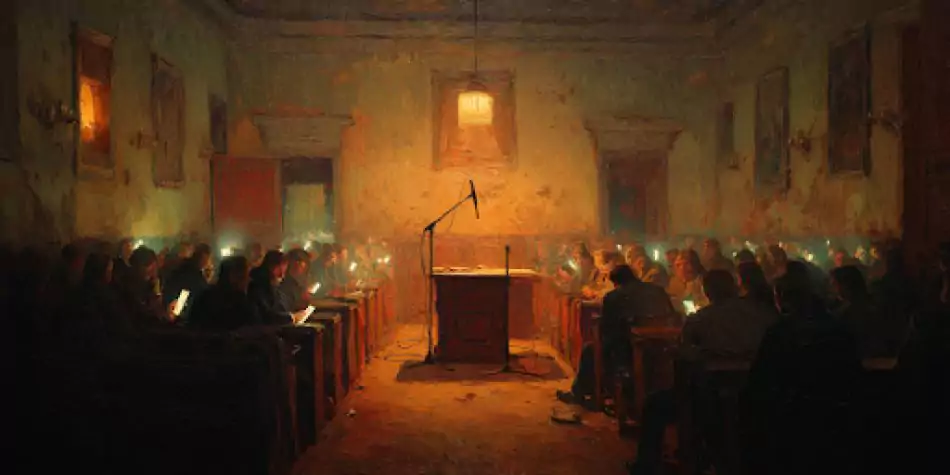
Alt Description: A quiet town hall echoes Iran Revolution democracy lessons as phones and surveillance overshadow dialogue.

I Fled Post-Revolution Iran. I’m Worried for America.

Who guards freedom in polarized times? Civic doubt, pluralist respect, and local ties, not outrage, preserve liberty.

Download Print-Friendly Version

I was seven when I learned to disappear—not with footsteps, but with thought—because silence meant survival. In post-revolutionary Iran, an honest question could lead to prison, exile, or worse. Before I had words for any of this, my mind built an invisible checkpoint: Don’t say that. Don’t ask that. Don’t look too curious. The wrong word, heard by the wrong person, could alter your life—or end it.

Silence meant survival.

No one taught me to self-censor; I absorbed it by watching others vanish into silence. My often mind returned to the invisible checkpoint, refined by years of fear: Don’t say that. Don’t ask that. Don’t look too curious. Even in the most ordinary of settings, a political connection or a personal grudge could become a weapon. There was no justice. No appeal. If your beliefs challenged theirs, your life ceased to matter.

I wasn’t one of “them,” and I couldn’t pretend to be. So I kept my head down and poured myself into work and family, trying to make a quiet difference and raise a daughter whose future might be larger than my survival. Even that carried risk. The regime turned the poor against the successful, stoking envy to keep control. More than once, I was told that any achievement must be luck or appearance.

What happened there explains what worries me here—and the small civic habits that can interrupt the slide.

A Pattern Learned in Iran

Ideological tyranny weaponizes belief, envy, and resentment to divide and rule. In Iran, the regime co-opted the moral authority of religion to suppress opposition. Questioning those in power became synonymous with questioning God. Censorship, exile, and even execution were justified as moral acts. And in time, people not only lost faith in the regime, but also lost faith in faith itself. Suspicion replaced solidarity. Society fractured into millions of pieces.

I tried to raise a daughter whose future might be brighter than mine. But even that came with risk. When my daughter grew older—bright, outspoken, and unwilling to tolerate injustice—I knew what her boldness could cost her. I didn’t want her future to be one of quiet survival. I wanted her voice to grow, not shrink.

Before the 1979 revolution, Iran was politically and socially fractured. Communists, monarchists, nationalists, theocrats—each group believed it alone held the moral high ground. Everyone had a cause. Everyone had a criticism. But no one had a unifying vision.

The revolution succeeded not because it was inclusive, but because one faction, Khomeini’s theocratic movement, was more organized, more absolute, and more ruthless. The rest of those critics, visionaries, students, and intellectuals were silenced, exiled, or killed.

One of the promises that helped with the revolution was Khomeini’s vow to make electricity, water, and bus fares free. It was seductive rhetoric, devoid of any real plan, a lie. My family remembers the applause. They also remember the decades of suffering that followed.

So I made the hardest decision of my life: I left everything behind to start from zero in a new country. I believed in the promise of free speech. I believed that talent and hard work could still open doors. I believed in the American ideal.

But today, I’m concerned by the familiar patterns I once fled. I don’t worry that America is Iran. I worry that no democracy is immune to decay. 

American Echoes

In this new homeland, outrage is often harvested for influence. Pain is politicized for gain. People are labeled, deplatformed, publicly humiliated, and shamed, all because they expressed a different opinion. What I fled from was a system that blurred the line between faith and power. What I now observe is a culture where ideological certainty plays a similar role, enforced not by the state, but by tribes of public judgment and algorithmic enforcement.

I worry that no democracy is immune to decay.

Both extremes of the political spectrum now mirror each other. One side champions “tolerance” while shaming any dissent. The other rejects tolerance altogether, clinging to a nostalgia for order and tradition. Both flatten disagreement into betrayal. Both shout over the center. And both claim the unimpeachable moral high ground.

From Polarization to Fragility

In this environment, we no longer debate; we condemn. We no longer ask questions; we assign guilt. The moderate voice isn’t just overlooked; it’s erased.

Technology accelerates these dynamics. Social media amplifies rage. Performance replaces substance. Remote work and fragmented communities weaken the civic bonds that once tempered our most reactive impulses. Loudness trumps logic. Outrage substitutes for outcomes. We reward those who stir emotion, not those who offer answers.

And as we fragment into increasingly isolated factions, we grow more vulnerable, not to reasonable compromise or better ideas, but to those willing to exploit the chaos. 

I’ve lived this story before.

Polarization makes societies fragile.

Polarization makes societies fragile. It creates self-reinforcing bubbles that destroy trust. And when people no longer believe in the good faith of others, they stop asking questions like: “What’s the evidence? What’s the trade-off? What comes next?” They open the door to more radical solutions and more dangerous leaders.

What to Rebuild

We are not doomed to repeat the past, but we are not exempt from it either. I don’t believe the solution lies in going back in time. In moments of uncertainty, humans romanticize obsolete systems. We tend to retreat, not toward innovation, but toward the familiar. That impulse is a symptom of fear, not a path forward. 

We need to move beyond performance and toward pluralistic, rational solidarity—rather than blind allegiance or nostalgia. This solidarity is grounded in mutual respect, shared responsibility, and the discipline of critical thought.

That begins by rebuilding the habits of thinking critically and asking the hard questions:

  • Ask for evidence and trade‑offs. Reward arguments that grapple with costs, not just causes.
  • Separate people from positions. Disagree without dehumanizing.
  • Protect conscience and respectful dissent. Honor moral agency and religious liberty. The freedom to make mistakes is part of what helps us grow and develop. 
  • Prefer outcomes to outrage. Celebrate solutions, not just slogans.
  • Assume partial knowledge. Speak in drafts; listen for revision.
  • Rebuild local ties. Thick communities make thin caricatures harder to sustain.

I’m not writing this as an expert. I’m writing this as someone who has lived the consequences of silence, of tribal fracturing and dogmatic chasms. I don’t have all the answers. But I’ve seen what happens when a society abandons the effort to find them, when it replaces thoughtful debate with emotional absolutism.

That’s why I’m speaking now to provoke reflection. To ask: How far are we willing to go down this path? And what are we giving up along the way? And to achieve what? 

If we lose the courage to ask those questions, we may soon find ourselves unable to ask any at all.

So I leave you with a question: while we are all busy criticizing, resenting, and defining ourselves by what we oppose, who is guarding our freedom? If we mistake outrage for civic action and replace deliberation with denunciation, our liberties can be hijacked sooner than we imagine, and an entire country can be held hostage to a new form of dictatorship.


About the author

Leyla Mirmomen

Leyla Mirmomen is an Iranian-American entrepreneur and the founder of Optimuos. She has a PhD in engineering from the University of Leeds.
On Key

You Might Also Like

Demanding Conversations About Violence

In the weeks since the premiere of the Under the Banner of Heaven miniseries, there has been a broad consensus that the show doesn’t quite work. Its attempt to paint Latter-day Saints as promoting violence just doesn’t land. And its depiction of Latter-day Saints simply doesn’t resonate because it’s too dissimilar. This of course must come as some disappointment to critics of the Church who had hoped the series would prompt more conversations around the issues they deem problematic such as how the Church promotes violence. Into this void comes a new argument made most prominently by Taylor Petrey, but also echoed by a student columnist at the University of Utah, and now promoted on Twitter by Benjamin Park—namely, that because there has been some violence done by some Latter-day Saints who use the language of their culture in perpetrating it, Latter-day Saints should watch the series with the intent to learn how to make their Church less violent. Both Petrey and Park had previously criticized the series for its poor job in portraying Latter-day Saints, but have since shifted. We don’t want to attack the Daily Utah Chronicle piece because it’s a student article. But Petrey and Park should know better. Some of us have been on the record defending Petrey as a serious scholar, despite the fact that his conclusions don’t often derive well from the available evidence. But Petrey seems to suggest in his article that any violence that uses the language of religion must have been inspired by that religion. We understand the temptation of this point of view. What else could we blame violence on if not the culture it arose in? But Petrey’s position assumes that human beings are naturally non-violent, and only become violent as a result of their culture. This is a major assumption in the Robert Orsi essay that Petrey relies on extensively. Parks’ tweets similarly assume that any conversation about Latter-day Saints and violence must concede that the faith contributes to the violence in some way. But the causes of violence are often complicated. Because of the importance of our innate nature in creating violence, even the most peaceful society would still produce fringe examples of extreme violence. Having a Latter-day Saint who becomes violent isn’t proof that the faith contributes to that violence, even if the perpetrator uses the language of their culture in perpetuating that violence. Cultural contexts can then increase or decrease the likelihood of that emerging, but no culture has discovered how to remove it altogether. And because Under the Banner of Heaven fails to present a clear picture of what most experience as Latter-day Saint culture, it doesn’t do much to establish whether a Latter-day Saint context is more prone to cause violence than others. Those who use Latter-day Saint or another religious language and context to perpetuate violence weren’t necessarily made violent by those cultures. But rather, violent individuals will leverage anything around them to perpetrate their violence. We’re aware of many other similar examples—of abusers, for instance, who used the language of therapy to perpetuate abuse. But it would be absurd to suggest that therapeutic culture caused that abuse. Even pacifist language has been known to be used to perpetuate violence by shaming survivors into silence. An abusive person will draw upon the most powerful language available within their given cultural context and weaponize that. This is not coincidentally the conclusion made by prosecutors in the Lafferty case, that the murder was about power and relationships and that religion was merely the pretext. Does the Church of Jesus Christ disproportionately create violent offenders? We’d be interested in reading any definitive social science research on the question, but unfortunately, those promoting this point of view or hoping to have this conversation have not yet presented any. And rather than attempt to answer this question clearly itself, Under the Banner of Heaven skips the question and takes it as a given. A study of this sort could start the conversation Petrey, Parks, and the student author hope for. Instead, we get a story about a 38-year-old murder that was notable mainly for how unusual it was among the Latter-day Saint community and perpetrated by someone who had recently been kicked out of the Church for their extremist views. It should not surprise anyone that it hasn’t prompted anyone to conclude there’s a problem with violence among Latter-day Saints.

Subscribe To Our Weekly Newsletter

Stay up to date on the intersection of faith in the public square.

You have Successfully Subscribed!