IMG_4429 (1)

What Temple Square Teaches About Change

Cherish the ground you walk on. Honor the influences that uphold you. They’re always there—until they’re not.

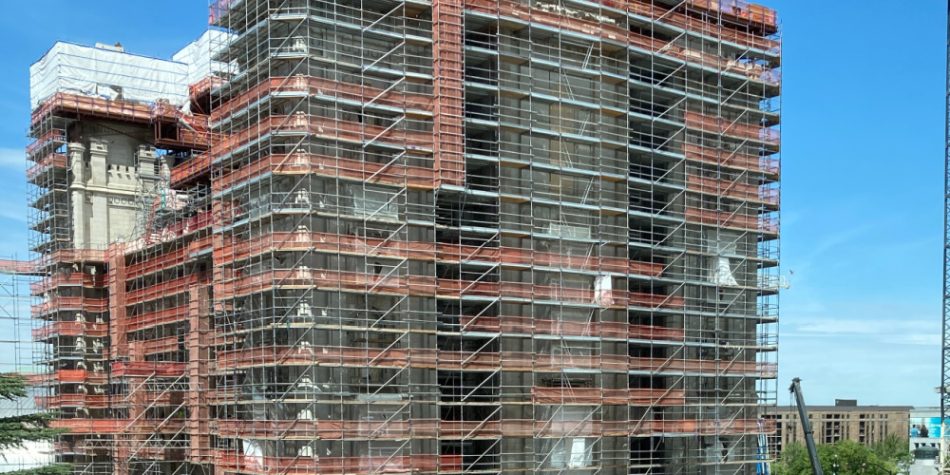
As I return to my office space on Temple Square for the first time in the post-COVID world, my west-facing window shows me a scene of 21st-century desolation.

It is March 2022, two years into a half-decade seismic renovation of the Salt Lake Temple. The familiar ground surrounding this iconic house of the Lord is gone. No more flowers and trees, walkways and benches, grass and statues. In their place are cranes, scaffolding, dump trucks, backhoes, debris, Porta Potties, and construction workers moving about like ants in white hard hats and fluorescent yellow vests. Some parts of the grounds are being excavated nearly 70 feet deep in a spirit of total overhaul. 

All of this, along with the incessant beeping of construction vehicles and the mind-numbing rumble of jackhammers, reminds me that an old world is ending and a new one emerging.

Gone is the ground that allowed me to vent the steam of an intense workday among the beautiful scenes of the Square. Gone is the ground that shortened my walk to the train station. Gone is the ground that supported my family as we enjoyed the comforting Christmas lights on cold winter nights in December.

Jesus said there are times when even the stones can speak (see Luke 19:40). What I see through my window cries out like a preacher from a pulpit of rock and rebar: 

Cherish the ground you walk on!

Honor the influences that uphold you!

So much that makes life wonderful can be as hard to notice as the ground beneath our feet. Strong marriages. Loving families. Deep friendships. Beloved traditions. Civil society. They’re always there—until they’re not. And we suddenly find ourselves in change’s Gordian knot, our souls wrapped mummy-like in scaffolding, as is the Salt Lake Temple. 

Growth, Not Comfort

God is a dramaturge, the best of writers, concerned with even the smallest of detail in this earthly thriller we call life. But His writing isn’t merely for dramatic effect.

It’s for our eternal growth.

All of this reminds me that an old world is ending, a new one emerging.

As I watch Jacobsen Construction perform a radical dusty surgery on Temple Square, my mind turns to my Latter-day Saint mission experience. During my two years in Russian-speaking eastern Ukraine, I was assigned to live in seven cities. Each transfer to a new area was an unexpected and uncomfortable uprooting. This was often frustrating. I sometimes felt like a sandbag tossed from person to person in a storm. Let me breathe, I often thought. Let me become more comfortable. Let me make more friends. Let me see more of this city. 

But in storms, sandbags are moved for a purpose. God, I learned, cares more about my growth than my comfort. I see now that those frequent moves put me in places and situations where I could do the most good and that were best for my soul. 

I think also of my mother-in-law, Ginger DeLaMare Cannon. From the time I was engaged to marry my wife in 2006 until Ginger’s death from cancer in 2019, frequent visits to grandma’s house in Logan were a reliable part of our routine. With her death, the solid ground of that tradition became shaky, soggy, and strange. A cherished mother and grandmother was gone. Her house was sold. Most visits to Logan ceased.

We moved on. 

Those 13 years are frozen in photographs, in videos, in hearts.

And then I think of a colleague who, one year later, retired. His illumined lamp light above his cubicle was, for the 10 years we worked together, a sure sign that he was in the office. That light was a metaphor for his presence. His power did not come from a high position (he was one of the hoi polloi). Every day he infused the office with spiritual leaven through compliments and humor. Every day he inspired us through his willingness to do things others didn’t want to do. 

I did not know how much I would miss his jolly presence.

And then he was gone, leaving me with 10 years of time that I can visit only in the musty halls of memory.

A week after my friend’s retirement, COVID-19 hit, dissolving the ground of office work that so many had stood on for decades. In Utah, as if our Heavenly Parents were turning up the volume on a key message, we awoke to a 5.7 magnitude earthquake just three days into lockdown. That morning, our girls ran scared into our room, and our neighbors rushed to grocery stores in panic. The words of scripture came alive: “For not many days hence and the earth shall tremble and reel to and fro as a drunken man. … And all things shall be in commotion; and surely, men’s hearts shall fail them; for fear shall come upon all people.”

Fortunately, COVID was a mixed blessing of pain and pleasure, a bit like Socrates’ two-bodied animal of old. “If [a person] pursues and catches the one, he is almost always bound to catch the other also, like two creatures with one head,” that ancient teacher says in Plato’s Phaedo. I warmly welcomed the new rhythms of working from home like long-absent family. I began to see my wife and daughters so much more. This was and continues to be a miracle as great and unexpected for me as the parting of the Red Sea was for the Children of Israel.

My return to work in March 2022 brings the opposite feeling. I’m consumed with an empty melancholy. The old familiar office space is gone, replaced by a new floor design, new colors, new cubicles, and chairs. What were once simple and quiet walks around Temple Square are complex and noisy affairs because of construction. The people I ate lunch with aren’t here; different teams come in on different days. 

Working in the office can be lonely. I’m left to walk down a hall of memories sealed behind glass.

‘Ye Shall Not Surely Die’

Losing familiar ground is just one of the many ways we taste death. One of the devil’s first lies to the first people on earth was that they would never die. To never die is to always walk on solid ground, to never change, to never need to adapt.

Indeed, many today live as though death doesn’t exist. We don’t like to think about it. We’d rather not talk about it. We hide it from view like dirty laundry. We cover it up like body odor. We are shocked when it happens. 

Yes, death is sad, a goodbye nobody wants to say. 

And yes, we mourn when those we love die (we are, in fact, commanded to do so). 

But we are wise to live with eyes wide open to the reality that everything—absolutely everything—dies. And that expiration can come anytime, anywhere.

The Book of Mormon and the King James Version of the Old Testament use an insightful phrase to describe death. When someone is about to die, they say they are going “the way of all the earth.” Everything on this planet—food, relationships, youth, health, people—expires. How should we interpret this depressing reality? Speaking in 2015 to Latter-day Saints in Moscow, then-Elder Russell M. Nelson provided a helpful frame. “God gave us a special gift,” he said. “It’s called the aging process—just to remind you that you’re temporarily here on planet Earth, because you’re one of His children, and He wants you to come home.”

As I creep toward 40, every day a little closer to that heavenly home, I see that my accumulating life experience yields a painful wisdom that is “more profitable than silver” and has “better returns than gold” (Proverbs 3:14, NIV). Insufferable people and social situations become less so when you grasp how brief are the various phases of life. 

So many hellos. 

So many goodbyes. 

I’m inclined to try a little harder, show a little more patience, and enjoy a little more of the moment.

As I did prior to the pandemic, I continue to wander around the Joseph Smith Memorial Building when my mind needs to stretch its legs. This building, a house to the ghosts of a century of memories, is a fitting place to mourn a dead past. The surrounding construction has reduced foot traffic considerably. It’s quieter now. My wanderings yield such poems:

Change makes me feel
naked as a branch in winter,
my pointy edges so real,
the soul ready to splinter. 

Everything we behold
has a birth
has a life
has a death—
it all runs out of breath. 

Childhood and teen years,
married life and careers.
We’re always changing gears,
moving to new spheres. 

I’m as impatient as Enoch:
When will the earth rest
and in quiet nest the blessed? 

That impossible time when
everything we behold
never grows old,
has infinite breath,
and no sign of death.

Count on it: The intensity of change of the past few years is but a drip of the oceans of upheaval yet ahead. That’s not such a scary thought when you see life as a school of experiences custom-designed for your eternal growth.

The intensity of change of the past few years is but a drip of the oceans of upheaval yet ahead.

Hence, the encouragement from President Russell M. Nelson to be proactive about that growth and seriously consider ways to “implement extraordinary measures—perhaps measures we have never taken before—to strengthen our personal spiritual foundations,” in much the same way this mighty temple’s foundations are being strengthened right before our eyes.

Until our world rests in millennial peace, the only reliable ground you and I will ever find is the Rock that is the life and teachings of Jesus Christ. But we ought also to count on this: Because God cares more about our growth than our comfort, even that solid stone is likely to sometimes feel like grumbling ground as we pass through difficult days. 

And that’s okay. Because, as Elder David A. Bednar once said, “everything about the gospel of Christ is about not staying the same. You can’t insist on doing things the way you’ve always done them and expect to progress.” 

So, in the words of President Nelson, “eat your vitamin pills, get your rest,” and prepare to grow some more.

About the author

Samuel B. Hislop

Samuel B. Hislop is a writer in Utah.
On Key

You Might Also Like

Better than Self-Esteem? + Today’s Digest

Our daily rundown of the articles from around the web that we feel our readers would enjoy and appreciate. We hope to highlight the best of what’s around. Public Square Bulletin recommends: Jesus’ Alternative to Self-Esteem H. Wallace Goddard—Meridian Magazine While the gospel has some similarities with the self-esteem movement, Goddard, a parenting expert, looks at the research, and suggests that there may be weaknesses to the self-esteem movement that the gospel can rectify. Religion and the American Constitutional Experiment John Witte Jr.—Canopy Forum An excerpt from the upcoming book of the same name, this fascinating take gives a whirlwind tour of religious freedom, the role the founders and courts have played in developing it, and what we might expect in the next decade. The Perils of Heterodoxy Adam M. Wakeling—Areo Increasingly the information we get is filtered through a smaller and smaller group of individuals, so being independent-minded is important. But this route also comes with dangers that, left unchecked, could prove problematic. Exercising the Virtues Allen Porter—Law & Liberty Physical fitness is an important expression of a virtuous life. The patterns we develop should be consciously chosen and acted on and should be done to shape our minds and bodies in accordance with a higher purpose. Six Theologians Every Thoughtful Person Should Read Bruce Riley Ashford—First Things Excuse the uncharacteristic click-bait headline. This article outlines some of the most influential thinkers in orthodox Christian thought. While none come from the Church of Jesus Christ, each makes thoughtful observations that can not only increase your inter-faith understanding but provide fresh insights into your own faith as well.

Under the Banner of Heaven Episode 5, “The One Mighty and Strong”

Summary – Pyre is interrogating Sam, who shouts scripture at him about the “one mighty and strong.” Pyre uses false details about the murder to trick Sam into revealing that he isn’t the murderer. The police chief is getting ready to release the brothers, so Taba stalls him while Pyre talks to Robin about his brothers’ involvement in the “School of the Prophets” and gets him to reveal two names: Bernard Brady, a Provo businessman, and Prophet Onias. The detectives follow up with Bishop Low and his wife, located at the end of the last episode, asking them about the excommunication of Dan and Ron. The bishop is reluctant to reveal details because of clergy confidentiality but eventually reveals that Dan was excommunicated based on the testimony of his daughters that he attempted to forcibly take them as polygamous wives. We get a flashback to a heartbreaking scene where Matilda has sex with Dan to distract him as her daughters escape out a window in the middle of the night. Dan was excommunicated, and the girls were placed with a family in the ward (as the bishop refused to call CPS) but later ran away, and now they and their brother are missing. At his daughter’s baby blessing, Ron confronts the bishop about his brother’s excommunication, not knowing about Dan’s attempted polygamy and thinking that it’s about his political beliefs. Brenda has a conversation with Sister Low and Diana, indicating that both know that Ron is abusing her but only Brenda is willing to do anything about it. In fact, Sister Low feeds Diana a line about how her only duty is “creating a home and environment to sustain and support our Priesthood holder.” To Detective Pyre, the bishop claims to have followed church procedure but eventually encouraged Diana to leave and gave her money to do so. The detectives follow up on Robin’s lead about Bernard Brady by arriving at his house in the foothills of Provo with a warrant. We find out that the Bradys sheltered Ron when he was having a hard time. In a flashback, Ron receives a summons to a church disciplinary court and blames Diana for it. He punches her in the face and begins throwing the food she’s preparing on the floor, saying he’ll starve her into obedience. Diana grabs a kitchen knife and drives Ron from the house, telling him not to come back. Back in the present, Bernard admits to being in the School of the Prophets study group and driving miles to pick up Prophet Onias and the Laffertys but denies being further into the group than that. But when he sends his wife out of the room to make lemonade, he produces a notarized letter he sent to himself with details of the Laffertys’ hit list, including that Diana is on the list because she wrote a letter that got Ron excommunicated. The detectives rightly chastise him for not taking this information to the police earlier. Brady reveals that he knows the location of “the farm,” a Lafferty compound. With Allen’s help in drawing a map, the detectives plan to stake out the property in the morning. Detective Pyre returns home for FHE and finds that his wife and kids have been invited to the bishop’s house for the evening and are spending the night there. Pyre believes this is an attempt to keep an eye on his family and control the narrative about the case. The next morning on the way to the raid of the farm, Pyre questions Brady about the details of Ron’s excommunication, which we see in flashback. He is indeed excommunicated after lashing out at the church leaders about them not following the “correct” doctrines of the church. When Ron returns home, he finds that his teenage daughter has cut the markings out of his garments, which he puts on anyway with only a sports coat and jeans over the top. He says goodbye to his kids and leaves the home. When the farm is raided, the only people inside are three teenage girls, who we learn are from a polygamous compound in British Columbia and were brought down by Prophet Onias to be Ron’s wives. The girls show the detectives a cupboard they had been forbidden to touch, which the detectives open to reveal a single shirt belonging to Ron with some papers in the pocket, a hit list, and a revelation directed at Diana commanding her to repent and return to him. Allen is in disbelief that Ron could have written these things, but Brady confirms that Ron is a violent man. He explains that Ron fled to his parents’ home after his excommunication, where his mother confirms his calling as “the one mighty and strong” and says he’s only a heartbeat away from his rightful place. His father is lying sick in bed and asks Ron to call a doctor, but Ron recalls his cruelty to them as children and refuses. It’s implied that he indirectly caused his father’s death in order to take over the leadership of the family. Church History—This episode contains the most fabricated piece of church history in the show. When Bernard Brady reveals that Diana’s information led to Ron’s excommunication, he makes an analogy to Joseph Smith’s martyrdom. He claims that while Joseph was in hiding after destroying the press of the Nauvoo Expositor, Emma wrote a letter to Joseph encouraging him. John Taylor intercepts this letter and adds a line meant to make Joseph turn himself in, thus indirectly causing the prophet’s death. Taylor’s motive is to put Brigham Young at the head of the church, instead of Emma’s young son, in order to continue the doctrine of polygamy, which he and Brigham are already heavily involved in. Reputable historians both in and out of the church say there is no evidence to support this interpretation of events, though the succession crisis between Brigham Young and the ten-year-old Joseph Smith III is real and