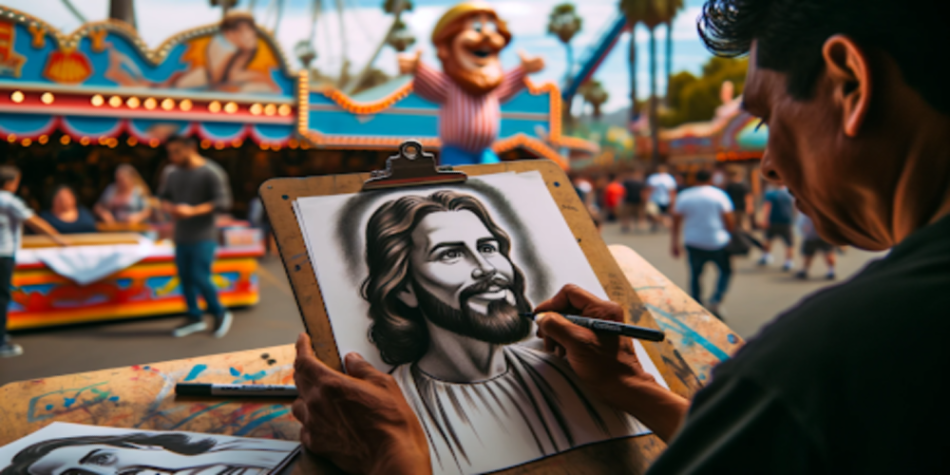
During Christmas time it is easy to be reminded of how blessed we are with the numerous artistic efforts to capture the essence of Jesus Christ in so many mediums.
These portrayals can take on countless forms, attempting to depict Him in ways that align with our own imaginations. Many inspire me, like the grand display hosted by The Church of Jesus Christ of Latter-day Saints in Times Square. But I’ve also seen representations not as inspiring to me, those that paint Him more like a hipster, boyfriend, yogi, or even as a woman. Our challenge is to ensure that our perception of Christ doesn’t become a mere caricature devoid of His true character.
Inspired sources offer us important insights into the question of who is Jesus. And I am encouraged by this sentiment shared by Brigham Young, an early prophet of the Church of Jesus Christ, who said, “The revelations of the Lord to His creatures are adapted to the lowest capacity, and they bring life and salvation to all who are willing to receive them.” So, through the lens of simplicity, as I approach this beautiful Christ-filled season, I offer some attributes of Christ’s character that I believe are notable at this time. Our perception of Him shapes our worship.
We know something of this nature because we are created in His and the Father’s image. Of this truth, Thomas S. Monson, a recent church President, said: “God our Father has ears with which to hear our prayers. He has eyes with which to see our actions. He has a mouth with which to speak to us. He has a heart with which to feel compassion and love. He is real. He is living. We are His children made in His image. We look like Him, and He looks like us.”
In answering who is Jesus, Latter-day Saints place special importance on the embodiment of Christ, believing this to be an eternal trait. Other Christian thinkers understand the importance of Jesus’ bodily existence as well. Thomas Aquinas wrote, “When one earnestly and devoutly weighs the mysteries of the Incarnation, one will find so great a depth of wisdom that it exceeds human knowledge.” His argument is that Christ having a body unites us together in a way we could not be otherwise. He goes on to say that we could never understand “that God becomes man, and that man becomes God and a sharer in the divine nature. But he has done this in us by His power, and it was accomplished in the Incarnation of His Son.” It is perhaps no mistake that the two holiest days of the Christian calendar are when Jesus receives a body.
I recently laid to rest my father-in-law. The day and those leading up to it were filled with testimony and tender mercies. One of his daughters had also recently lost her husband and shared this sentiment, “We can never really say that nobody understands. Even if those closest to us don’t ‘get it,’ Jesus Christ does because He lived it when He bore it for us.” The Lord will be a “refuge for the oppressed” and comfort in times of trouble.
John MacArthur, a popular radio personality and pastor made this observation, “Even Jesus’ most scathing denunciation—a blistering diatribe against the religious leaders of Jerusalem in Matthew 23—ends with Christ weeping over Jerusalem. Compassion colored everything He did.
This aspect of our relationship with Christ comes from His character, which is filled with compassion, mercy, understanding, and sincere invitation.
During the most extreme moment of suffering, Jesus conscientiously and exactingly carries out the will of the Father. This divine submission is a demonstration of perfect unity and purpose within the Godhead. As we ponder on this aspect of His character, we are invited to align our will with His, recognizing that true discipleship involves yielding our desires to the divine purpose. In my youth and in my naturally rebellious state still, it seems a difficult concept to grasp, but Christ tells us simply and succinctly, “If ye love me, keep my commandments.”
The influential literacy advocate and Congregationalist teacher Frank Laubach noted that in his gospel, John indicates Jesus was acting “under God’s orders” on forty-seven occasions, such as “The Son can do nothing of Himself, but what He seeth the Father do.”
Christ’s character exemplifies obedience, submission, unity, and purpose.
While serving as the President of BYU-Idaho, David A. Bednar, now an apostle of the Church of Jesus Christ gave remarks titled, “The Character of Christ.” Bednar emphasizes a central aspect of Christ’s character. He notes, “Throughout His mortal ministry, and especially during the events leading up to and including the atoning sacrifice, the Savior of the world turned outward—when the natural man or woman in any of us would have been self-centered and focused inward.” This outward focus, even in the face of unimaginable trials, speaks volumes about Christ’s selflessness and love for each of us.

I’ve seen this kind of outward focus, but I remember one time in particular. I was visiting my mom and dad’s home in the neighborhood I was raised in. One of our neighbors, a good sister I’d known since I was probably about 7 or 8 years old, arrived at our door with a Christmas treat, a pan full of the most amazing rolls. I was shocked when I saw her. She had just recently lost her daughter, our sweet friend Anne, in a car accident. I wondered how she was even standing, much less with an offering for us. When I fumbled over a mix of gratitude and condolences, she was gracious and comforting to me. She is such a Christ-like example of selflessness that has remained with me over the years. I pray that we learn of Him.
Christ’s character is the definitive model of sacrifice and selflessness.
When the children of Israel had left Egypt but proved Egypt had not left them, God’s first commandment to them, remains for us, “Thou shalt have no other gods before me.”
In the Living Christ, His divine character is explained. He is “the immortal Son of God. He is the great King Immanuel, who stands today on the right hand of His Father. He is the light, the life, and the hope of the world.”
What a grand description. As we celebrate Jesus Christ’s birth during this Christmas season, I pray that we learn of Him—that rather than shape His likeness into ours, we will invite Him to shape us into His.